

Abdelrahman ElGendy is the author of Huna, a Summer/Fall 2026 Indies Introduce selection. 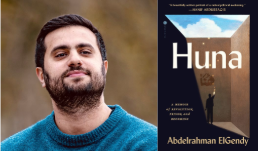
Jamie Hope Anderson of Duck's Cottage in Duck, NC, served on the panel that selected ElGendy's book for Indies Introduce.
“Abdelrahman ElGendy's memoir of the seven years he spent behind bars in Egyptian prisons highlights the tragedy that befell so many Egyptians after the 2011 revolution; often arrested for nonsensical reasons (taking a photo out of a car window at a protest), charged with high level crimes (antiterrorism), minors charged as adults, the constant threat of getting lost in the system, court dates continuously postponed. ElGendy paints a picture of despair, hope, injustice, and optimism while never forgetting that imprisonment of the body doesn't include freedom of the mind,” said Anderson.
Anderson sat down with ElGendy to discuss this debut title.
Jamie Hope Anderson: You received your MFA from the University of Pittsburgh but as the book ends you are making preparations to leave the US and today are joining us from London. Can you talk about why you are no longer in the United States?
Abdelrahman ElGendy: I moved to the US in 2022 to pursue my MFA at Pitt, and I made a home of the city and cultivated the warmest and most supportive literary community. In 2023, with the genocide in Gaza, I was quite active and wrote a lot about what it means to be a writer in the time of genocide and how to take seriously the work of solidarity, whether as organizers or artists or both.
And as everyone knows, once the current US regime came to power, ICE was unleashed against immigrant communities, and the very first targeted population was international students who were active on Palestine. Starting with Mahmoud Khalil, the arrests escalated every day, and I was especially shocked by Rümeysa Öztürk, who was arrested for merely coauthoring an op-ed.
Students were being snatched off the street by ICE in front of their homes, and that last month, I spent it locking myself inside my apartment while I was revising my book. I deactivated or made my social media private, and eventually I just realized I was in the exact same situation I had fled from. I was writing about the terror of living under an authoritarian regime, the harsh consequences of speaking up and writing, and the self-censorship required to spare oneself arrest and disappearing into the system. It was all happening all over again.
Eventually, there were certain escalations around my university and visas being revoked, and the lawyers I was consulting with advised me that my arrest, given my public profile, was very likely. And the stakes for me were much higher than incarceration in ICE detention centers and possible deportation, which is already horrific. It was on top of that the probable deportation to Egypt, where I would've most likely faced imprisonment for the rest of my life.
I just couldn't live that way anymore. I had to uproot my life again, after having made a home and found my people and built a life for myself, and go into this double exile once more.
It is indeed heartbreaking, being denied a book tour, for example, because it's too dangerous, and being unable to celebrate with the friends and loved ones who witnessed all the stages of this book, it's very sad. But I'm grateful that I am unincarcerated and that I still get to write. I will always choose that.
When I left my homeland, I vowed to never be in a place where I cannot write or speak. It doesn't have to be a perfect place, but I need to be able to write and speak without the risk of incarceration. And sadly, the US was not that place anymore.
JHA: Imagine [you’re] a bookseller in a small indie bookstore in England. I’m a customer who has just taken a copy of Huna off the shelves and is looking at the jacket. Handsell your book in five sentences to me.
AE: Huna is a political incarceration memoir set in post-revolution Egypt, but prison and revolution are only its points of entry into a larger meditation on erasure: what it means to be erased from your body, your language, your history, questions that might belong to anyone who has ever known erasure in its myriad forms. It is a book about the cruel paradox of survival, about what happens when the very things that might save you — tenderness, softness, wonder, love — might also be the things that destroy you. How do you find the courage to love when love makes you vulnerable? How much of yourself must you kill to survive, and how much must you stubbornly keep alive so that you can still hold and be held? Huna does not offer hope in the way we might expect such a story to offer it. It strives to offer something more honest, and perhaps more enduring, beyond hope.
JHA: Huna in Arabic means “here.” How did that word become the title of your book?
AE: The word huna means “here” in Arabic. It comes from a popular protest song, “Sawfa Nabqa Huna,” which gained prominence during the Arab uprisings of 2011.
I first really listened to the song on my third night in detention, crammed into a tiny four-by-five-meter cell with sixty other people. We hadn’t eaten a proper meal in three days, and the prison food was inedible. That night, for the first time, our families were allowed to send us food. It was fascinating to see how we softened, how the mood in the cell lifted, even though nothing about our physical circumstances had changed. People began to sing, and one of the songs was “Sawfa Nabqa Huna,” which translates to “We Will Remain Here.”
I found myself wondering what it meant to say that. The song goes: We will remain here until the pain subsides. We will remain here; the melody will sweeten.
Amid such excruciating physical conditions, which have not changed in the slightest, why was I overcome with chills? What was this huna, this “here,” we all longed to inhabit?
The book traces my pursuit of this huna as it comes into view, slips away, and takes on new and more complicated forms over the six years of incarceration, as the experience hammers both my body and my psyche.
JHA: Help us understand how you earned an engineering degree while inside the Egyptian prison system.
AE: So, the Egyptian prison system has this one law that allows prisoners to continue their education and sit for their exams from inside prison. This law predated 2013 and applied to regular prisoners. When prisons filled up with political prisoners after the military coup in 2013, they simply allowed that law to stand. But instead of moving incarcerated students to the nearest police station to sit for their exams, watched over by a university TA in some office, because of the sudden influx of university students and for tighter security, they began setting up some of the empty prison halls as massive exam rooms. TAs would arrive from outside with the exams, sit at a desk with their prisoner/student, and monitor them for the duration of the exam.
I was arrested one day before my first day as a freshman at the German University in Cairo, where I was about to begin a degree in Mechatronics Engineering on a scholarship. But the university itself denied me the chance to sit for my exams and eventually revoked my scholarship. I then transferred to Ain Shams University, which is considered the toughest and most selective public engineering program in Egypt, and I started studying for my degree there, always in the hopes that I'd be released very soon — next week, next month, next year — and pick up my studies outside.
The ability to sit for exams was as far as the privilege went. Prison administrations made it incredibly difficult to access study materials, and of course there was no library or any sort of room to sit down and study. If you managed to bribe your way into getting your study materials, which your family would bring during every visit, you would just sit crammed into your overcrowded cell and try to find a corner, or a few inches someone would lend you, to rest your back against the wall or the ground and study.
A lot of people told me it was a crazy endeavor, including the university, to try to self-study my way through this particular degree. But in prison, engineering had become the last vestige of my former life. I always say control was the main battle field between us and the jailers, and I felt that I needed to earn the degree I had intended to earn, the degree I had worked my life toward, even as I began to feel that my real fire lay elsewhere, with language, with writing.
Studying for this degree was a torturous process. I had to self-study through five years of a notoriously difficult mechanical engineering program, with nothing but notes and textbooks. I hadn’t set foot on campus, never attended a single lecture. I would spend hours and hours and sometimes days trying to decipher problems that if I had access to Google for example I could've understood in minutes. I felt like banging my head against the wall so many times. But it mattered so much to me that I hold that degree in my hand and then say, “I don’t want it. I’m doing something else.” I needed to know that I was choosing to say no to engineering, and you can only choose to say no when you also have the choice to say yes.
As I said, it was not only about education. The struggle over control was the main terrain between us and the jailers, and for me, education happened to be one of the major grounds on which that struggle manifested. I eventually graduated in 2019 from prison without having ever stepped foot into that campus or sat in any of its classrooms.
JHA: There is quite a hierarchy among the incarcerated within Egyptian prisons. Can you tell us about that and where you, as a political prisoner, fell in the pecking order?
AE: Egyptian prisons are quite segregated when it comes to political versus non-political prisoners, which is funny enough because prison administrations are more concerned with political prisoners potentially politicizing or radicalizing the non-political prisoners. But non-political prisoners tend to hold political prisoners in very high regard and respect, as long as no provocation has happened, which could then get ugly. Within non-political cells, seniority is always the main edge, and so much is determined by force. In our cells, we strived toward more democratic models, and tried to build those little microcosms of the world we imagined we wanted to build outside, and sometimes that was incredibly warm and wondrous, and others it was disastrous and systems collapsed and people fought, and I write a lot about that and what these sorts of survival conditions crack people. Class is also a crucial factor when it comes to prison hierarchy amongst both political and non-political prisoners.
It's a little more complicated when it comes to our relationships with the jailers and prison administrations. We all have terrible prison conditions, but typically non-political prisoners have more access to prison privileges like newspapers and sometimes TVs, maybe novels. Political prisoners are denied access to information. It's one of the most key ways they're confined, so almost always you have no access to papers or TVs or books. The only smuggling route was through students, which is how I smuggled so many books by pretending they were study materials.
On the other hand, non-political prisoners are completely dehumanized by the jailers, so they're brutalized and tortured daily, in a very routine and normalized manner. Political prisoners can be tortured and brutalized too, but mostly at the direction of the National Security Agency, which all the security apparatus takes its orders from when it comes to political matters.
Sometimes it's about specific individuals or cases, and sometimes it's a more general political climate where they want to send a message of deterrence. So I'd say when we were brutalized, we were really brutalized, but for the most part, we had more wiggle room to organize and try to make some wins, to maybe increase recess time by an hour or limit the occupancy of overcrowded cells, at least until the next crackdown, when everything is taken away and we have to regroup and figure it all out from scratch.
So I'd say it's always precarious and ever shifting, depending on so many internal prison variables and external political variables as well.
JHA: Have you been back to Egypt?
AE: No, I haven't, and I probably can never go back. People are arrested for things as trivial as a Facebook post or a tweet and disappear or spend years behind bars. I have obviously done way worse than that with my writing, and now with this book, so it's almost certain that I'd be arrested at the airport.
It's sad. I miss Cairo a lot and wish I could at least visit. But who knows what tomorrow will bring?
JHA: This is such an emotion filled book — you went through everything imaginable during those seven years. What are your primary emotions now, looking back at the experience and reliving it to some degree with the writing and publication of Huna?
AE: I think it was actually much more intense throughout the writing process of this book, which took six years after my release. There's this intense dissonance between prison and the world outside. While you're in prison, it's very difficult to recall your memories outside and think of them as memories. Like, could this body in this prison uniform, subjected to these horrific things, be the same body you recall laughing with friends, going for a morning run, or having dinner with family? So it almost feels like you hallucinated your whole life outside.
But then, when you're released, it's reversed, and you suddenly cannot recall prison in the same concrete way. It's almost this strange fever dream. Of course, it attacks you in the most unsuspecting moments, like in nightmares or with certain triggers, and you realize your body remembers it all. But it's still very difficult to wrap your head around the fact that this person writing these lines now is the same person.
And it doesn't help that dissociation was one of the main ways you survive prison, at least in my case. I always say this book is not about how I survived, this book is how I survived, because I fantasized about writing it all those years. And suddenly, if we were being tortured or beaten, I would think, “Oh, what a great scene this would be in the memoir,” or “How would I render this on the page?” And suddenly the slap is not landing on my face. It's landing on the face of the protagonist of the book. And that made it hurt less. It made it less personal. But that comes with a certain damage that you do to yourself to numb yourself, but in prison, if it works, you keep doing it.
All that to say, outside prison, writing this book, the page was the only space where these worlds collided, where I had to suddenly relive these things in my body and really break open these memories and reexperience them while physically being outside of prison. It was very disorienting at times, and very cathartic at others.
But it was partly why this book was so urgent, why it was weighing on me so much. Because this was a prison fantasy, it almost felt like I wouldn't get a semblance of closure unless this book was out of me. I always tell people, this is the book I needed to write to get to the books I want to write.
And serendipitously enough, I spent six years in prison imagining and writing, and six years outside prison actively drafting and polishing this book, and it came out exactly at that full-circle juncture. Six inside, six outside, and the book closes the circle.
So I guess the overwhelming emotion now is relief, I would say. I feel relieved.
Huna by Abdelrahman ElGendy (Hogarth, 9798217153602, HC, Memoir $30.00, On Sale: 9/1/2026)
You can learn more about this author at abdelrahmanelgendy.com.
ABA member stores are invited to use this interview or any others in our series of Q&As with Indies Introduce debut authors in newsletters and social media and in online and in-store promotions. Please let us know if you do.