Ama Ofosua Lieb is the author of Goldenborn, a Winter/Spring 2026 Indies Introduce selection. 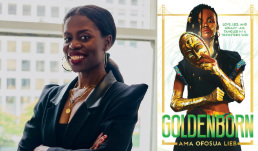
Fisher Nash of Carmichael's Bookstore in Louisville, KY, served on the panel that selected Lieb's book for Indies Introduce.
“Goldenborn is the kind of sci-fi/fantasy mashup I didn't know I was looking for,” said Nash. “Akoma lives in a near-future AfricaTown in San Francisco and works with a secret law enforcement division to stop crimes where magic may be involved. She just wants to find out what really happened to put her father in a coma, and a sting gone wrong leads her to a mysterious stranger who may have the answers. Goldenborn is filled with lush, beautiful worldbuilding, African mythology, and an Afrofuturist twist. An outstanding debut!”
Lieb sat down with Nash to discuss this debut title. This is a transcript of their discussion. You can listen to the interview on the ABA podcast, BookED.
Fisher Nash: Hi, I'm Fisher Nash, a bookseller at Carmichael's Bookstore in Louisville, KY, and I'm here with Ama Ofosua Lieb. Welcome!
Ama Ofosua Lieb: Thank you, I'm so thrilled to be here!
FN: Ama Ofosua Lieb was born in Ghana, and has lived in Canada, the Bahamas, Puerto Rico, Nigeria, and South Africa. She now resides in the San Francisco Bay Area with her husband and their two young children. She holds an MA in Sociology and a BA in Economics, both from Stanford University. Goldenborn is her debut novel.
From the beginning, one of the things that I loved about Goldenborn was the really great worldbuilding. From the very first few pages, I felt like I was walking into a fully realized, fleshed-out world. It felt really fresh and unique, so congratulations on such a fantastic book!
AOL: Thank you so much, and thank you to you and the panelists for Indies Introduce for selecting Goldenborn.
FN: I love a book that takes mythology and folklore and weaves it into a modern story. There's lots of books that do that, but there's not as many that take African mythology, and I was really excited to see it. Can you tell me about Anansi, the spider trickster god, and how those stories inspired you to write Goldenborn?
AOL: Absolutely! I loved Anansi stories growing up and it always fascinated me how often people would immediately mention Anansi once they heard I was born in Ghana. I was like, “Oh, he's a global celebrity!” I was proud of that as a kid, and I still am.
When I became a mom, it was fun for me to introduce my kids to Anansi stories and they love them. They wanted to go to a bookstore and find books starring Anansi, written by authors from Ghana, and at that time we couldn't find any. They were so disappointed, and I just had this whole moment of, “Don't worry, Mom will write one for you!”
I thought I bit off more than I could chew, but I got right to it. I started imagining Anansi in a modern day setting in a book blending fantasy, sci-fi, mystery, and a bit of romance, and that was very exciting to me.
FN: Your book takes on a lot of topics, and it is so impressive how well you handle them. How did it feel to take something mythic and larger than life — a symbol like Anansi — and turn him into a fully fleshed-out character with his own motivations and personality?
AOL: It was a challenge, for sure. I did not write this book was overnight. It took me six years to figure it out, because I was juggling so many components.
But it was a lot of fun to imagine myself in conversation with Anansi. That's where it started. If I met him in a cafe, what would that be like? What kind of adventure could I create with a young protagonist who gets pulled into his orbit?
A lot of the Anansi stories give you some sort of lesson. My kids always loved that. There was one Anansi adventure I told them that explains why spiders have eight thin, long legs.
There's a story where he is going through the village and he smells some food. His friend Rabbit is making a pot of greens and Anansi goes, “Oh, I want some, but I don't want to stick around and help.” So, he spins a web and ties one end to the pot and the other end to his legs. Then he goes about town again. He smells something else and it's his friend Monkey. Monkey is making a pot of beans, and he's like, "Oh, I want some of that, but I don't want to stick around and help,” so he spins a web and ties one end to that pot and another to his leg. He repeats this six more times, and before you know it, all eight of his legs are tied to eight pots.
He sits in the center of town waiting for someone to yank on a thread to tell him that his food is ready. The first thread gets pulled, then all of the other seven get pulled. He's getting pulled eight ways and it's so painful. He dives into the river and lets the water melt his threads. But when he gets out, all of a sudden, his legs are long, and that's why spiders have really long legs. The lesson is to not be lazy and greedy.
In trying to come up with my Anansi character for this modern-day book, I was like, “What lesson is the protagonist going to learn from interacting with Anansi? What lesson is Anansi going to learn?”
FN: I love it. One of the things that makes your book stand out is the worldbuilding. You've got ancient mythology, you have futurist technology, you've got the secret magical detective squad, and then especially AfricaTown, which is so lush and inviting to read about — especially the food. I wanted to eat so much of that food.
AOL: Me too!
FN: How did you set about building this world?
AOL: It was so much fun to do. I started with the setting. I wanted to set it in San Francisco, because it's my own backyard, but I didn't want it to be present-day San Francisco. I wanted a near-future San Francisco that would allow me to play with the geography and create a new neighborhood, AfricaTown. I started imagining what I would love to see and experience in that neighborhood. I put myself in it — the smell of savory food, the sound of activity, the feel of the vibrant community.
Next, I had to think through what kind of tech I was going to be playing with. Goldenborn isn't a true sci-fi story, but it needed to be a sprinkle of sci-fi, so it made sense to give the secret agency most of that tech.
The fantasy world is where it got even more fun, because I needed a character who could straddle both fantasy and the tech world. Enter Akoma. It was fun to create a character who doesn't trust magic but has to work to keep it hidden from the world, all the while not knowing that her own family has a connection to magic.
I needed a character who would be our window to the magical side of her family. I picked her grandmother for that. It became an interesting choice because we're following the POV of an elder in a YA novel. In Ghanaian culture, we have a deep respect for our elders. I loved that I got to honor that by using her grandmother in that way.
These were all the puzzle pieces — the tech, the magic, the mythology — and I had to make sure that those pieces fit together with Anansi and Akoma in the center.
FN: I love the grandmother! She was a great character.
AOL: Yay! I didn't know my own grandparents growing up, this was just imagination based on stories that my parents had told me. It felt like a great thing to honor the tradition of respecting our elders.
FN: I do love that. Akoma is such a fascinating and complex character. I really fell in love with her.
You mentioned she straddles both worlds. I really worried about her, because there is so much danger — there's people that are dying, and she's in charge of figuring stuff out, there's secrets that are withheld from her, and you know something's going on in the background.
Obviously, there's more to the story than fashion, but I really liked your attention to detail with her clothes. She's so careful in the faces that she chooses to show people, and clothes are a part of that, like an armor.
Tell me more about Akoma and how you went about creating her as a character.
AOL: First of all, thank you for noticing the fashion. I love fashion so much, and it was something I wanted to play with in the story. In some ways, what Akoma wears reflects certain parts of her life.
The gray suit represents her work life at the agency. It's serious, and it's plain, but she needs to be serious at work. She chooses something more casual and vibrant while attending the big community festival with her friends, which allows her to show more of her personality. Everybody around her is celebratory and also vibrant in what they're wearing. She wears white to celebrate a ceremony because white is the go-to color in Ghana for joyful milestones and events, so I honored that by putting it in there.
There are a few more moments where what she wears is important to what she's doing. I thought that her attention to such a detail also reflected her hyper-awareness, which is a central part of her personality. I thought it was a fun way to reflect her personality and all the different aspects of her life that are happening in the story.
FN: What other myths and authors and stories inspire you and led you to write Goldenborn?
AOL: I’m really inspired by myths from around the world. They're just so many rich stories and legends that I've read and have yet to read. I have this book called The Book of Mystical Beasts and Magical Creatures that features legends from all around the world, and it's such a fun and beautifully illustrated book that my kids have actually taken it from me.
One of the creatures in it that I like is called a kitsune, a shapeshifting fox spirit from Japanese folklore. Every one-hundred years it gets a new tail, and they can get up to nine tails, meaning they live a very long time. They can take the shape of anything they choose, change the world around them, and take over people's minds. It's so fascinating.
There are so many different ways that the cultures of the world can contribute to storytelling, and I just love discovering them.
FN: I agree with you. I actually have a whole section in the store of fairy tales and folklore and mythology! After reading your book, one of the other Indies Introduced panelists, Elisa, and I both went out and bought a book of African folktales. We needed to know more, and that was inspired by you.
AOL: I'm so happy to hear that! I hope people read Goldenborn and enjoy it, but then are excited to learn more about Anansi or even more about Ghanaian culture. I really appreciate hearing that.
FN: Goldenborn is this big web with a lot of narrative threads spinning out from the center — the world of AfricaTown, the mystery story, the really fun romance, a series of strange murders, the world of the gods, and Akoma, the teenage girl at the heart of the story.
You control all those narrative threads like a master weaver, like, dare I say it, Anansi the trickster god. In the myths, most tricksters are also storytellers, which is why I love trickster stories so much. So, for you, our trickster goddess storyteller, what is next for Akoma and Anansi?
AOL: I loved using Anansi because he's a god of stories, and in some ways the book is a story of stories; everybody has their own stories happening, and they intersect and affect Anansi and Akoma.
Right now, to borrow your words, I'm busy weaving a new web of entanglement for Anansi, Akoma, and friends, and I'm really having fun discovering where their story goes next. Stay tuned!
FN: I'm so looking forward to it. Is it a planned trilogy?
AOL: It's a planned duology. I gotta work to tell it in two books, because once you start dancing with Anansi, he's got lots of stories for you to tell.
FN: It's such a great world, I can see why a writer would want to spend a lot of time there.
AOL: Yeah, it really sucks me in. I spend way too much time in it sometimes. I really could take it in so many different directions, which is a fun thing to be able to do, but at the same time I have to tell myself to focus.
FN: How would you tell booksellers to handsell your books?
AOL: Goldenborn is a fun blend of fantasy, mystery, sci-fi, and romance, all threaded through with elements of Ghanaian mythology and folklore, and at the end of the day, it's a universal story. You have a protagonist who's navigating things that everybody navigates — family relationships and obligations, friendship dynamics — and she has an external factor that throws her off the path she thought she was on. Now she needs to be brave enough to be the author of her own story and rewrite it in such a way that she moves down a path where she feels empowered. We all want to feel empowered, so I think it's a fun story, but a universal one.
FN: I think it's perfect for readers of Legendborn by Tracy Deonn, or anyone who loves Nnedi Okorafor.
AOL: Children of Blood and Bone by Tomi Adeyemi is a fun one too.
FN: Yes, that one's also fantastic! Thank you so much for talking to me. I really appreciate your time.
AOL: My pleasure. Thank you so much for the Indies Introduce selection.
FN: I'm really looking forward to seeing Goldenborn in the stores and I'm sure you are too.
AOL: I am so excited. Thank you all for your support.
Goldenborn by Ama Ofosua Lieb (Scholastic, 9781546147466, HC, YA Fantasy, $19.99, On Sale: 05/05/2026)
You can learn more about this author at amawritesmagic.com.
ABA member stores are invited to use this interview or any others in our series of Q&As with Indies Introduce debut authors in newsletters and social media and in online and in-store promotions. Please let us know if you do.