Amy Tern is the author of Sneaks, a Summer/Fall 2026 Indies Introduce selection. 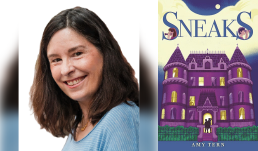
Amy Buren of Maggie Mae's Bookshop in Gresham, Oregon, served on the panel that selected Tern's book for Indies Introduce.
“I devoured this book, I loved it from page one, so good I couldn't put it down. I loved the story, the writing, the characters, one of my favorite reads. Such a great debut novel, I am so excited to see what this author writes next,” said Buren.
Tern sat down with Buren to discuss this debut title. This is a transcript of their discussion. You can listen to the interview on the ABA podcast, BookED.
Amy Buren: Hi, my name is Amy Buren, and I work at Maggie Mae’s Bookshop in Gresham, Oregon. Today I am here with Amy Tern, who is the author of Sneaks. I am very excited for this interview today!
Amy is a freelance editor who worked for the Woodrow Wilson International Center for Scholars while writing short stories and nonfiction in her spare time. She is currently at work on a second novel. When she's not writing, she likes to read, walk, study Japanese, and play easy music on the piano. She lives in Virginia with her husband, two book-loving sons, and a petulant gecko.
Amy, I would like to welcome you to today's podcast and just say that Sneaks was one of my most favorite books. We were so excited when we got to read it on the panel, everybody just instantly fell in love with it. I was hooked from page one, maybe because I'm such a big fan of the movie Rear Window. I was so intrigued and I loved the dynamic of the characters and the story. I'm so excited to get to share it with the kids that come into my shop who love a great mystery. Thank you for being here!
Amy Tern: Thanks very much for inviting me on the podcast. I’m very excited!
AB: What was the spark that made you write this story?
AT: The spark was when I was watching Rear Window with my kids — that's the old Alfred Hitchcock movie from 1954 with Jimmy Stewart and Grace Kelly — and I thought to myself, “This would make a really fun middle grade book.” Of course, the story has been adapted many times; Hitchcock's own version was adapted from a short story. It's such a great premise to solve a mystery by spying on your neighbors and finding clues from the outside of the building.
In Rear Window, the police don't take Jimmy Stewart seriously, and in my book, the parents don't take the kids seriously — which I'm sure all kids can relate to that. The parents accuse the kids of having overactive imaginations because the parents are busy, serious people, and they think the kids are just screwing around and making things up. But, in fact, there really is some fishy business going on. I tried to make it so that the children notice certain clues that only children would notice.
When you write kids' books, too, you always go back to your own childhood; all the books that we write have their roots in our own childhoods. When I was eight years old, my family went to Belgium and we lived there for a few months. We lived in a five-story apartment building in the city of Leuven. It was very different from our home in Colorado, and it was very exciting.
Kids were given a lot of freedom in those days, and we explored that place from top to bottom. There was an old rickety elevator, and we spied on people. We were not nearly as principled or purposeful as the characters in the novel, because they're trying to rescue somebody. But we were just having fun and I tried to capture that feeling in the novel; where the world is a big, exciting place and fun to explore.
AB: It was great because when I was reading it, I could visualize the kids on the balcony and watching the neighbor and the little girl with her piano playing and the dolly head and all of that stuff.
What does a typical writing day look like for you?
AT: It took me a long time to write Sneaks because I was very much in my sandwich years. I was taking care of my children and I was also taking care of elderly parents — in particular, my father-in-law, who lived with us for about five years before he died — and I was also doing freelance editing work. So, I was really busy, and I did not have any kind of a regular schedule for writing.
Now my children are older and I hope to write every day. The best time for me is definitely the morning. I have a small study with a comfortable chair where I can hear the birds, and sometimes I go to a nearby coffee shop. I can get away from the laundry and the unopened mail and those little cobwebs up in the corner of the ceiling and all this stuff I should be taking care of. I like doing that too.
I don't tend to have a set number of pages. Some writers do that; they have a target, however-many pages. I don't do that because I figure two good pages is worth thirty mediocre pages.
AB: I love that. I love a good trip to the coffee shop. How do you get yourself unstuck when writer's block hits you?
AT: For me, writer's block usually comes from a lack of confidence. Sometimes I try to outline my books and I end up getting an outline that's good for a 500-page book when I'm really trying to write a 200-page book. Sometimes I show people my writing, and maybe they have a lot of criticism or they don't like it, and then I suffer a crisis of confidence. So, I guess the lesson is don't show your draft to very many people. You have to be careful.
But I try to see criticism as a gift because anything that makes the manuscript better is a gift. It's funny — back before I was published, I thought, "Oh, if I ever get published, then I will have confidence. My confidence will be unshakable.” But I don't really find that to be the case, and I wonder, “Can I do it again? If I write another book, will it measure up?” And that's how I get myself into these mind games.
The important thing is to focus on the joy of writing itself. That's the key, I think, because no one can take that away from you and that's why we started writing in the first place. When the creative juices are flowing, I don't worry about any of this stuff, I just have fun.
AB: I love that. I do feel that it’s scary! Your first book was so big, but I feel your second one will be just as amazing. I'm excited for whatever comes next.
In the book, was there a character that you related to personally?
AT: I relate to all the characters. I relate to the kids because they want more freedom, and I want more freedom. I relate to the parents because I'm a parent. I even relate to the villain — also known as the Goblin Woman — because I also have insecurities and fears about protecting my kids from harm. Though I don't take it as far as she does.
If you look at my two main characters, they are an introvert and an extrovert. They are a thinker and a doer; the first is more what I'm like and the second is what I wish I could be like.
As a writer, I'm very much an observer by temperament. That's what we do; we sit and we watch and we observe, like Rook does. So, I can relate to that. He's a noticer, and that's how he notices that something fishy is going on.
But fiction is not interesting if it's all about observing and noticing, because people like to read about doers. People like to read about people who do stuff, who jump in with both feet, and that's my other main character. That's Valory.
It was really exhilarating to write about Valory because she doesn’t hold back. I could play at being that kind of person. It was really fun. I don't think I've ever had so much fun writing any character as much as Valory. Of course, she has faults. She's very impulsive and she's very judgmental of people. She makes a lot of mistakes, but that’s why I love her.
So, I relate to all of them!
AB: I thought all the characters were great. I really loved Rook finding himself and trying to get his mom to understand why he doesn't want to leave. I really felt for him, and I was like, “Oh, Rook. I just want to hold your hand and take you outside.” I really loved it in the end when he was like, “I'm going to be brave and I'm going to go to Valory.”
AT: There's a scene in Rear Window where the Jimmy Stewart character is looking across the alley and watching Grace Kelly go into danger, and he can't help her because he's got this big cast on his leg and he can't leave the apartment and he has to just watch her get closer and closer to danger. He can see things that — and the viewer can see things that—she is oblivious of. I always loved that scene and I wanted some version of that scene in the book.
AB: Yes, yes! I always remember that scene, watching her and just holding your breath and waiting.
What do you hope that readers will carry with them after finishing this book?
AT: In all my writing, I seem to always come back to this pivotal moment when kids start to think for themselves. I always return to write about that threshold that every kid has to cross when they realize that the adults don't have all the answers and the adults are fallible. There comes a time when a young person has to say, "That's not what I believe,” or "I don't believe that anymore,” or "That might be right for you, but it's not right for me.”
I remember the sense of astonishment, even the freedom, that came with starting to think for yourself, independent of your parents. I always seem to come back to that in all my writing and maybe that's what middle grade is all about. For example, when Rook crosses that threshold, he's very exhilarated and he loves classical music. So, when he starts thinking for himself, it's like the sound of trumpets and the crash of cymbals.
Of course, I'm definitely of two minds here because I'm a parent, and it's really hard to want to allow your own kids to think for themselves because part of me just wants them to listen to their mother, right? Because I've lived in this world a long time and I've acquired some experience, but if they only listen to me, then they'll never grow up. So, I guess that's what being a parent is.
AB: Yes!
AT: It was really important to me that the parents and adults are not buffoons like in so much middle grade literature. They're antagonists and they're flawed for sure. But I tried to make them very real, because in the end they do want what's best for their kids.
I hope readers will carry away with them greater empathy and awareness that this stuff is really complex for everyone. But that's kind of the goal of every novel, right? That's what novels are all about — to encourage empathy and to make us realize that we are all doing the best we can.
AB: I love that. As a children's bookseller, I read a lot of children's books, and this one was just a great story, it was a fun read. I've read it twice. I've read it and listened to the audiobook. It was great both ways.
For kids that come into my store, I know which one I'm going to sell it to. That’s my most favorite part when I'm reading the book and I know exactly the kids that are going to love it.
AT: That's the sign of an exceptional bookseller!
AB: Thank you. It's been such an honor to get to talk to you, and it was such a great experience to be able to have first access to read it before everybody else got it. I'm so excited for what you will write next, and I can't wait to read that.
AT: Thank you very much for your kind words! I really appreciate the support of the independent booksellers. It's just meant the world to me.
AB: It’s a great community, and I'm so excited that I get to be a part of it.
Sneaks by Amy Tern (Holiday House, 9780823461622, HC, MG Fiction, $18.99, One Sale: 7/7/2026)
You can learn more about this author at amytern.com.
ABA member stores are invited to use this interview or any others in our series of Q&As with Indies Introduce debut authors in newsletters and social media and in online and in-store promotions. Please let us know if you do.