Ari Koontz is the author of Just Ask Elsie, a Summer/Fall 2026 Indies Introduce selection. 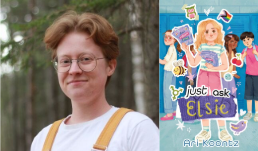
Allie Cesmat of Changing Hands Bookstore in Tempe, Arizona, served on the panel that selected Koontz' book for Indies Introduce.
“Elsie is who I want to be when I grow up! She may be eleven, but she is also wise beyond her years, an advocate for change, surrounded by supportive adults, and an open book for all things puberty with no shame attached. This is a book for those who stand up for others and who have curiosity and empathy in abundance. For fans of Lisa Fipps and Kelly Yang,” said Cesmat.
Cesmat sat down with Koontz to discuss this debut title. This is a transcript of their discussion. You can listen to the interview on the ABA podcast, BookED.
Allie Cesmat: Hi, my name is Allie Cesmat, and we are here with BookED today to talk a little bit about an exciting new debut. Our guest is Ari Koontz. They are a queer nonbinary writer and educator with an MFA in creative writing from Northern Michigan University. They’re dedicated to telling full-hearted stories of bravery and whimsy in every possible genre, centering the beautiful complexities of queer identity and community, and supporting their local public library. A born-and-raised Midwestern UU, Ari lives close to where the water meets the woods and loves to take long walks when they should be writing. Just Ask Elsie is their debut novel.
Ari, thanks for joining us!
Ari Koontz: Thank you so much for having me. It's a real honor to be here.
AC: Reading your book for Indies Introduce was such a delight, our panel had a blast. Middle grade is one of my favorite genres. Just Ask Elsie was my first read of the panel, and it flew to the top of my radar and the rest of our panel quickly followed suit.
It has all of my favorite things, the voice-y narrators, the quirky, political hijinks. It was a delight, top to bottom, and it left me feeling really good about the world and about our future, and so, thank you so much for writing that.
AK: Wow, thank you for those words. That's really what I hope that all readers will get from it: that sense of joy and hope and positivity. I had a lot of fun writing it, for sure.
AC: As a debut author, tell us a little bit about why you decided this was the story you wanted to write.
AK: Middle grade is also one of my favorite genres, but it was the second genre that I came to as a novelist. I started out writing adult for a while and was trying to break into publishing, then I took a bit of a break and thought I'll try middle grade because that was the age that I remember reading the most and being so thrilled about books. I started experimenting with writing a younger voice and fell in love with the curiosity and the possibility that you find at that age, so that was what really drew me to middle grade as a place in which to write.
For this particular story, it was during the pandemic and I was getting into the show Sex Education on Netflix, which is a show about some high schoolers where one of them starts their own sex advice business and gets into a lot of hijinks. It's very funny, and a little bit cringe, but also very earnest.
I thought there's definitely a place for that kind of book in the middle grade space, especially because there are so few books that are about puberty, and especially books that include queer identities. That's what I really wanted to center here, and it emerged from that premise. I ran away with it and had a lot of fun.
AC: You can definitely hear that passion and that fun while also being informative. It felt really authentic, and is something that, as a queer person, I wish existed when I was in junior high. It would have been my favorite book to read, and it was something that was a little healing to read as an adult. So, thank you for that.
On that topic of puberty and sex education, we're seeing that across the country public schools have moved away from those topics or from diving deep into those questions. Did you have this thought because you had a very similar experience to Elsie around sex education, puberty and all of those big questions when you were growing up, or is this something where your school glossed over it?
AK: Unfortunately, my public-school education about puberty and sex was very similar to Elsie's. I think at the end of fifth grade there was a video that was about an hour long — and boys and girls went into different rooms to watch this video — that was probably an animated little thing about ovaries and periods and that was it.
I remember there was no follow up from the administrators and there was no space to ask. I think they encouraged us to go to our parents with those sorts of things. There was definitely a lot of gossip, a lot of whispers about it among the students, but it wasn't necessarily rooted in a lot of clear information that was being given in that setting.
Fortunately, similar to Elsie as well, I was able to have access to a really great program through my church, which is the OWL program that Elsie goes to. That was super inclusive, encouraged us to ask questions, and gave us more than just an hour to think about these things, and so I was really lucky that I had that.
As a kid I was conscious of the fact that not everybody gets that, and maybe that's not really fair that only the kids that go to this particular program get to learn about these extra topics, and why can't we talk about it more openly? A lot of this book came from the idea that not everyone has access to that education, and so there needs to be supplemental materials for that.
AC: I love that. My school education was very similar. Girls went in one room and were given tampons, and boys went into another room and kind of just talked about deodorant and that was it.
I wish that would have been accessible for myself, and also for all the kids that I grew up with, and I hope moving forward more generations get an experience like Elsie's and that we're some of the last people that have that experience that is negative.
Speaking about your church, Unitarian Universalism is the church that you belong to, correct?
AK: Yes, it is.
AC: And the main kickoff of this book is Elsie's experience in that program, and throughout the book Unitarian Universalism makes appearances as she talks to her friends about it. Why was it important for you to include that in here, as this is a faith many readers probably don't know about?
AK: Yeah, absolutely! Unitarian Universalism was very foundational and positive to me growing up and as an adult, and is foundational to this story. For a little extra context, Unitarians’ main thing is that they have this faith community space where we are all agreeing to be together, not believe together, so there's room for all different spiritualities and interpretations of faith. It's a place where atheists can be in the same room as Buddhists and have deep conversations about life and death and meaning and those sorts of things.
It starts from a very inclusive space and that includes their sexuality education program, which is not only in fifth grade but there's also versions of it for high schoolers as well.
I wanted to bring that into the story not only because that experience that I had inspired me to write this story, but also just because Unitarian Universalism is a niche faith that I haven't seen represented in any books or media. Part of it is me wanting to have that representation for myself and for other people like me who can read it and see the little inside jokes and think that’s a cool step towards getting the word out a little bit more about it.
In this story, and in general, religious and faith communities are about so much more than spirituality. They are definitely a foundation for your values, your morals, your beliefs, who supports you, and what you believe is possible, and that goes into identities and your body and how you grow into yourself. I really wanted to show that spaces like that exist, and where, for instance, being queer can be celebrated and embraced, not just tolerated or dismissed.
I felt like it was really important to show that and to also have representation for other students or kids who might not be UU but have similar positive experiences with religion or communities in which that's important.
AC: Yeah, I really felt that it was a needed and welcome change to the conversation around religion and faith, as somebody who really loves diving into religion and spiritual conversations. It was one of the main representations that I've seen that really stuck out to me in reading and really filled a hole, especially in middle grade.
Elsie, our main hero, is wonderful. She is brave, she is spunky, she is charismatic, she's everything I want to be when I grow up, she's my genuine hero.
AK: Me too.
AC: I love her so much, and yet, I have to tell you, Nate is my favorite character from this book. Can you talk a little bit about Nate as a character, his relationship with Elsie as her “DNA provider,” and the role he plays in her life?
AK: Nate is also my favorite. Don't tell the other characters, but I love him. Part of it is that he's kind of the cool uncle that I wish I had growing up. I have cool uncles, but I didn't grow up with them super close by, so it’s a little bit of wish fulfillment. I love Nate, it is very foundational to the story that it's queer in all of these different facets.
It was really important for me to represent diverse family structures in this world and in all my books as well. Being queer doesn't start and end with coming out, and there are queer families and family structures that look all different ways and so I really wanted to show that.
I wanted Elsie to have a trans dad, which was very important to me, and then that became a question of, “Okay, what does what does it look like? How was Elsie conceived?” This is a book about puberty and the birds and the bees, in some ways, so we should probably know that and explore that.
So, yes, Nate is her “DNA provider” and biological father, but he doesn't play a fatherly role. He's sort of a third parent who's around and supportive as an adult who can be there for things that she's maybe too embarrassed to tell her parents about or doesn't want them to judge her for.
I think that that's something that is so important for kids to have, and that I hope a lot of kids are able to have that safe adult where they can go to them with questions and feel like this isn't something that's necessarily going to get back to mom and dad, or that they’re going to be punished for it, or they're parents are going to look at them different way.
To have someone who is unconditionally supportive and non-judgmental, and especially at a time where your body is changing and your feelings are changing. Being able to have someone safe that you can go to about those things is super important, so I really love that Nate is there in that role and is able to support her, and also gently sometimes nudges her in a better direction when she's maybe getting a little out of hand, but from a place of love.
There are so many different family structures that I hope will get more representation in queer media.
AC: Yeah, I don't know if I want to be Nate or if I wanted a Nate growing up. I think it's both. The authenticity of Elsie's story, and how seamless her family structure is to the story, is one of the best representations I've read. It doesn't feel like this was just a plot device.
AK: Thank you so much. That means a lot. It was important to me to show that Elsie comes from a queer family, obviously, and she still struggles with her own identity and her feelings, “What does this mean? Is it okay?”
Because there's a lot of cultural things and people around her that are saying different things about it. Even when you are within a queer family structure, you might still have a lot of questions and not be quite sure where you belong and that's okay too.
AC: I love that you said that. I love the way you wrote this family, and I love the way that the kids in school don't view Elsie's family really any differently than anybody else's.
Are there any characteristics, for Elsie or any of the other kids, that mirror your middle school experience? They’re so voice-y. This is a very authentic middle grade voice. It doesn't read tween, it doesn't read too young, it doesn’t read like an adult has put themselves in the mind of an eleven-year-old.
Were there any characteristics of your own life that you pulled from for that, or are you just like really tapped in to the mind of eleven-year-olds?
AK: That's a great question. Sometimes I wonder this myself because a lot of my characters just arrive to me and they have a voice already.
Weirdly, Elsie is sort of the inverse of how I was at that age, or maybe how I wished to be, because she is very cool and funny and outspoken and a little messy. She makes mistakes, but she's able to work through it and talk to other people about what she's going through. I was very much more the quiet kid who had a lot going on internally, but I wasn't really able to go out there and be as cool or as funny as I thought other people were.
I tried to put myself back into that mindset of what was it like to feel these feelings and be at that age and how I felt very grown up at the time and things were serious. I never want to talk down to my audience because I think kids are really smart and they've got a lot to say and they've got a really interesting perspectives on the world.
It also goes back to how curious they are, which is something that I love about this age and writing middle grade in general, the idea that the world is still pretty expansive and they haven't necessarily been told as much what they can and can't do.
I really try to embody that curiosity in my characters, and yeah, there's certainly elements of my relationships with my friends during that age that inspired this, especially how complex those relationships are and how it can get really complicated and hard to navigate when there are crushes involved.
I definitely had a lot of experiences with the drama of what happens when somebody likes someone, and whether someone else has a crush on them, and then you're paying attention to that person more, and there's a lot of interpersonal dynamics that are really real and difficult at that age. I tried to bring that in as well, and make sure the characters are handling it in a way that feels realistic, but also mature enough that it shows their growth.
AC: I love that. It really shows on the page there that you're not talking down to that age group, that you really are taking them seriously and writing a story where they can feel seen and known and heard by the narrator and also by you as the author.
From a bookseller standpoint, it makes it a really easy handsell. It's very easy to talk to a kid about this book, because the narrator is them. I also think there's really great ways to handsell this to educators and teachers.
Do you have any handselling tips and tricks for booksellers to use once your book is out?
AK: I would say leaning into the joy about this book is something that I feel very strongly about. Especially in this time of a lot of book challenges and book bans, especially around kids' books with queer topics.
I really wanted this book to be about queerness and identities, and talking about these issues without shame — or with a little bit of shame but working through that shame.
This book really encourages kids to take their education into their own hands, to ask questions, and to embrace the positive side of growing up, even when it can be difficult, and even when you're dealing with issues of censorship, there are ways to move through it with creativity, with innovation, and with hope for and dedication to your own education.
AC: Love! I just want to applaud that forever. I think booksellers will really resonate with that.
Just Ask Elsie is a perfect staple to be front and center on a Pride display, and all year long. It can be a queer joy and queer resistance story for any age, but filling a space in middle grade that’s been needed.
Ari, thank you so much for being on the podcast today. Thank you so much for this story.
AK: Thank you so much for having me. I'm so honored to be included in this list, and just overjoyed to see Elsie make her way out into the world.
ABA member stores are invited to use this interview or any others in our series of Q&As with Indies Introduce debut authors in newsletters and social media and in online and in-store promotions. Please let us know if you do.