Bar Fridman-Tell is the author of Honeysuckle, a Winter/Spring 2026 Indies Introduce selection. 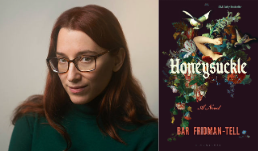
Emily Russo of PRINT: A Bookstore in Portland, Maine, served on the panel that selected Fridman-Tell's book for Indies Introduce.
Fridman-Tell sat down with Russo to discuss this debut title. This is a transcript of their discussion. You can listen to the interview on the ABA podcast, BookED.
Emily Russo: Hello, fellow booksellers and book lovers.
My name is Emily Russo, and I am the co-owner of PRINT: A Bookstore in Portland, ME, and I am thrilled to be here today with Bar Fridman-Tell, the author of the debut novel, Honeysuckle, from Macmillan Publishing. Bar has a BA in art history and an MA in English literature. She gleefully wrote her thesis about Victorian vampires. (I would love to read that thesis, actually, if it would be willing to be sent to me.) She has worked as a bartender, a bookseller, a translator, and a library assistant. She is currently studying for a master's in library and information sciences at the University of Toronto. She lives in Toronto with her professor husband and two very fluffy cats.
Bar, I am so thrilled to be able to talk to you today. Honeysuckle was just an incredible debut. I almost can't believe that it's a debut. It is just that strong. It was an early contender for this list, and I think we knew pretty quickly that this was going to make it to the top 10. Thank you again for joining us today.
Just to give a sense of what the book is about, Honeysuckle is based off the Welsh tale of the Blodeuwedd. What about this tale interested you and made you want to write a retelling, for lack of a better word?
Bar Fridman-Tell: I’ve always loved Welsh mythology. I grew up on The Chronicles of Prydain by Loyola Alexander, which I think a lot of people my age also grew up on. It took me years to discover that it was actually based on Welsh mythology.
I stumbled across the Mabinogion, which is a collection of Welsh tales that are myths, when I was in high school and I fell completely in love. And the story of the Blodeuwedd was my absolute favorite. It's a story about a girl made of flowers, made as a way to overcome a curse that prevents her husband from taking a human wife, and who is later changed into a bird as punishment for choosing a different path and a different love. She does a lot of questionable things, but it really never sat well with me that she was framed as the villain when she never had any choices — not over her life, not even over her own body, which was changed from flowers to woman to bird.
A few years ago, I found myself returning to it again and really thinking about it from that perspective, with questions of agency and power and consent. What does it mean to be in a relationship where the power skews completely to one side? What kind of ripples does that create, even if both sides enter it with good intentions?
Honeysuckle was what happened when I asked all these questions.
ER: I think you did a beautiful job of that, because Rory is a very flawed character, and he’s going into this with love but it's still not okay.
This is a very feminist novel. Of your two main characters, the only one who has free will is a man. Can you talk a little bit more about that choice and why it was important to tell the story that way?
BFT: I didn't think about it as a feminist novel as I was writing it, because the thing I set out to explore was power dynamics in relationships. No relationship is totally equal in the power dynamic, not in the long run, not ever. That's not something that is unique to relationships between a man and a woman, but it's very telling that in the long run, usually it's women who find themselves as the side with less power.
I wish I could say it was historical and that it's not the case anymore, but I can't.
ER: And I think sometimes when you set out to do a very specific thing, sometimes it doesn't quite come to fruition — like “I'm going to write a feminist masterpiece.”
BFT: It's true. I didn't have an answer. I had a lot of questions, and I wanted readers to ask those questions too.
ER: So even though I'm embarrassed to admit this, I've actually never read Frankenstein. But I also couldn't help thinking about that novel while reading yours, and that was also written by a woman. I was just wondering if Mary Shelley was an inspiration. And if so, how?
BFT: I hadn't read Frankenstein until the very last semester of my master's. So I managed to survive two degrees in the English department without reading it.
I had to write a very long essay about it that last semester, which was only a couple of years before I wrote Honeysuckle, so it must have been in the back of my mind somewhere.
I didn't notice the connection until the second draft was done, and I think it's because our starting points — the things that sit in the center of the book — are a bit different. I think Mary Shelley is interested in the morality of creation and what kind of responsibility we have to the thing we created. I sort of skirted that by making Rory's sister be the creator. Daye has been created. The morality of it, questionable as it is, is not the topic. The topic is “what happens now?” What kind of prices both of them must pay, what kind of responsibility do they have, and how far will you go for it?
ER: I would love to talk about Daye’s evolution. When Rory's sister constructs Daye as a companion for Rory, Daye has no decision-making capability. She literally has no voice. But as the seasons and the years pass, Rory discovers a way to give her one, which Daye is just appalled by.
Can you talk about Daye's moral evolution when she gets her voice, and as she becomes more and more “human?” I'm not sure I quite want to use that word. Once she has more decision-making capability and she has a voice, different things start to happen, and her morality is compromised. Can you talk a little bit about that evolution?
BFT: Yes, it was a very fine line to walk, and it was really hard, because she is not a person. She does not define herself as a person. She does not see herself that way, but she has the full range of emotions and needs of a person. And that was really hard.
The thing that I really wanted to explore about her development is that she starts out not so much without decision-making capability, but with her wants and needs always being secondary. She was created for someone. She sees herself primarily as someone else's playmate, and the ways she is dependent on him are so overwhelming. Her life is literally in his hands, and her ability to say “No” is questionable.
Having no voice is taking it to the very extreme, to the point where she can't express her needs because they are so secondary. Her evolution is what happens when she has to define herself separately, and when she has the ability to reflect on her relationship and ask, “Is this something I'm okay with?”
It’s this process of slowly defining herself, and defining her feelings for her relationship with Rory and her agency. That is what I tried to do.
ER: I think that's a very important point to make, that Daye never identifies as human. I thought of the question because there is a moment in the book that is just heartbreaking but also the pinnacle of humanity — when you need to make a decision that you don't want to make and you’re questioning your decisions. The pinnacle of human existence is struggling with those questions and how you want to behave.
For my final question, I want to get a little bit more into free will. And of course, under the umbrella of free will is bodily autonomy, and this novel brings that discussion to the forefront in many ways. Can you talk both about the importance of that bodily autonomy, and how you chose to address it, both as a writer and through your characters?
BFT: I think bodily autonomy is something we take for granted.
Of course, there are things we can control. There are freedoms that are questioned. But the ability to control our own body, to have agency over it, is supposed to be the one that is unquestionable. They teach us as kids, “You're the only one in charge of your own body.” Because of that, it distills issues of agency and consent and power, and takes it to the max, because this is the one thing we're supposed to take for granted.
This is also what drew me so much to the myth in the first place, the fact that her bodily autonomy is violated so much and it isn't seen as a violation. It's unquestioned. She’s made out of flowers, and she's later turned into a bird, and the question of agency or bodily autonomy is not raised.
I think the very cool thing about using fantasy is that it lets us use the fantastical both as the thing itself and as a metaphor. I was able to take her lack of bodily autonomy, the fact that her body keeps being manipulated and changed, and use it as a way to look at something we experience every day — the question of how much autonomy we have over our own body and what happens when it's violated, or questioned, or outright taken away — in a way that does not make us want to hide under the blanket. We can have the discussion in a way that feels slightly new or slightly sideways.
That’s what I love best about fantasy, so that’s what I hoped to do in Honeysuckle.
ER: It's an extraordinary novel. Thank you so much for joining us today. Thank you to our listeners. Booksellers, readers, I hope you'll pick this up. And again, Bar, thank you so much for joining us today.
BFT: Thank you so much for having me. This was so fun.
Honeysuckle by Bar Fridman-Tell (Bloomsbury Publishing, 9781639736737, HC, Fiction, $28.99, On Sale: 03/24/26)
You can learn more about this author at barfridmantell.com.
ABA member stores are invited to use this interview or any others in our series of Q&As with Indies Introduce debut authors in newsletters and social media and in online and in-store promotions. Please let us know if you do.