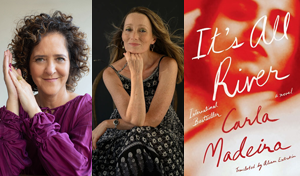
 Carla Madeira is the author of It's All River, a Summer/Fall 2026 Indies Introduce selection.
Amani Jackson of The Ivy Bookshop in Baltimore, Maryland, served on the panel that selected Madeira’s book for Indies Introduce.
“It's All River played in my head like an indie art film with highly saturated colors and manic cinematography. The translation is gorgeous. Entrekin kept a hectic and quickly paced story flowing without making Madeira’s words clunky or overly simple. These characters (especially Lucy) will not be easily forgotten,” said Jackson.
Jackson sat down with Madeira and Alison Entrekin, the book’s translator, to discuss this debut title. This is a transcript of their discussion. You can listen to the interview on the ABA podcast, BookED.
Amani Jackson: Hi, my name is Amani Jackson. I am a bookseller from The Ivy Bookshop in Baltimore, Maryland.
I am here with Carla Madeira and Alison Entrekin, and we're here for It's All River, one of our favorite picks from the Indies Introduce [Summer/Fall 2026 list]. I'm so excited to talk to you both today!
Carla Madeira is one of Brazil’s best-selling authors, her novels having sold a combined one million copies. Her debut, Tudo é rio (It’s All River), topped the bestseller charts for two years and has been published or is forthcoming in seven countries.
Alison Entrekin is an award-winning literary translator from the Portuguese who has translated many of Brazil’s most beloved writers. She lives in Australia and Brazil. How are you guys doing today?
Alison Entrekin: Well, thank you!
AJ: I love a slim translation. They’re some of my favorites. I also am a huge fan of unhinged women and unreliable narrators, so this was hitting a bunch of boxes for me.
This story has resonated with so many people, and it's very extreme in a lot of ways. What do you think is resonating with people? Why do you think so many people love this story?
Carla Madeira (translated by Alison Entrekin): The first thing that comes to mind is that It’s All River is a book that affects the reader's body. People tell me that they feel a gut punch, or they cry their eyes out, or they were very turned on.
A body that's been affected wants to produce meaning. I think this happens because the book tackles issues that readers are already uneasy about, like female sexuality, which is always so forbidden, religion as a source of violence or support, forgiving the unforgivable so that life can go on, and how that can happen without becoming a mechanism of impunity.
In a way, It’s All River doesn't really seem to fit into a Manichean definition of this or that, poetic or brutal, sacred or profane, good or evil, does it? Everything is in there. It's all rubbing shoulders, just like it is inside us. It's this undefined space that makes room for the reader's subjectivity.
AJ: The length of the book pushes all of that into this very intense, compact pressure cooker of all of those feelings, so I definitely see that in the work for sure.
CM: Exactly, it's like falling into a very fast moving current and you can't get out of it until everything's resolved.
AJ: Then at the end you're like, “What just happened?”
What was your reaction when you learned that your book was being translated and released throughout the world, and its impact was going to be bigger than Brazil?
CM: It makes me so happy to see how far my stories have traveled across different cultures and in some places It’s All River has even helped make Brazilian literature — which is so wonderful — even better known.
AJ: Definitely! A similar thing happened with Japanese literature, where we had a few translations that everybody loved and now Japanese translations are everywhere. Hopefully, we'll get that with Portuguese and it'll be because of you.
When did you two meet? Carla, was there anything you were afraid would get lost in translation, or did you trust Alison just implicitly?
AE: I'll answer the first question, and Carla will answer the second. We first met in person at the end of 2024 in Paraty at a literary festival, which is an absolute must. If anyone listening likes literary festivals, it's just the best.
We actually ran into each other in a restaurant. That was the first time we'd actually met in person, and we got to have a chat that time. We got to spend more time together very recently at a literary festival again in Brazil, but in the state of Minas Gerais, where Carla is from, at Flipoços, another wonderful literary festival, in a town nestled in an extinct volcanic crater, the most amazing place.
AJ: I want to go there!
CM: I wasn't at all afraid when I learned that Alison had translated Grande Sertão: Veredas, which is coming out in January as Vastlands: The Crossing, which is an extraordinary book by a writer called João Guimarães Rosa. That has shaped me very much as a reader and as a writer, and the book is set in Minas Gerais, which is my state in Brazil. It has a certain sonorous quality of way of using language that I recognize.
When I knew that she had translated that, I was convinced that I wanted Alison to be my translator. So, I invited her to translate it and was happy when she agreed. I’m certain the book has only gained from it.
AJ: I felt everything that Carla has described that the book feels like. I still felt that in English. Not that I'm an expert, but thank you, Alison.
AE: Thank you.
AJ: Alison, what would you say is the difference in translating for someone that you can meet and talk to versus someone who's no longer with us, like Clarice Lispector?
AE: That's a good question. An author's use of language is like a fingerprint. It's very characteristic. If you paid attention, you will see they have identifying traits, and most of that you get from reading them, not from talking to them. From talking to them, you'll just ask questions about “what does this look like” or “what does that do,” and you get a bit of refinement.
But the better you know someone's work, the easier it is for you to identify those things. Even more important than that, I think, is actually knowing their language and culture really well, because then you can identify what is uniquely that author's style and what are things that just everybody does because it's part of that language and the way they use it.
When you translate somebody like Clarice Lispector or like João Guimarães Rosa, who wrote Vastlands, that's extremely important because they're always doing unconventional things with language. Then, you need to be able to know what they're doing deliberately to be unconventional and what falls within the normal use of language.
All of that said, I think that most books teach us how they want to be translated. If we do a close enough reading, we will find all the clues. Everything we need is actually in the book to begin with. When I start doing a draft of a translation, I mark a lot of things to be resolved later, to think about later, and quite often when I get to the end of the draft, I already know what I want to do with those things because I found the clues in the book.
AJ: That's a great answer. I just learned so much in that little bit of time about translation.
All right, our last thing is a bit of a game. We're gonna do word association, but with no spoilers for the book. Are you ready for the first one? Our first word is: baby.
CM: Oedipus.
AJ: Alison, do you have one?
AE: Vulnerability.
AJ: [Next word is] secrets.
CM: Punishment.
AE: Protection.
AJ: You guys are so good. I just love that you're together because I'm getting different answers. Okay, next word is: sex.
CM: Control.
AE: Liberation.
AJ: And finally: devotion.
CM: Hope.
AE: Presence.
AJ: This is so good. I'm so happy that we're here, you guys have just made my day. I’m doing this in the morning, and now I just feel like I have energy from talking to you two about this wild, crazy, energetic feeling book.
AE: Carla has a question for you.
CM: What are you left with at the end of this reading experience?
AJ: The urge to start over and read it again to make sure that I saw everything.
I described it in one of my reviews as a “colorful indie film,” and it feels like a movie that I saw, and it was so visually beautiful the first time that at the end I was like, "Oh wait, let me read it again to make sure that I'm paying attention to what's actually happening and not just the beauty in front of me.”
CM: Thank you.
AJ: This was lovely. I'm so happy that I got to talk to you guys today. Everyone needs to check out this book! It won't take you very long. You're gonna feel your heart rate go up a couple of times, and that's okay. Just put it down, breathe, and keep going, because it's worth it.
It's All River: A Novel by Carla Madeira, Alison Entrekin (Transl.) (Liveright, 9781324098119, HC, Fiction, $26.99, On Sale: 6/23/2026)
You can learn more find this author on Instagram at @eucarlamadeira.
ABA member stores are invited to use this interview or any others in our series of Q&As with Indies Introduce debut authors in newsletters and social media and in online and in-store promotions. Please let us know if you do.