Emilee Hackney is the author of All That's Unseen, a Summer/Fall 2026 Indies Introduce selection. 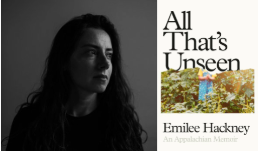
Jamie Hope Anderson of Duck's Cottage in Duck, North Carolina, served on the panel that selected Hackney's book for Indies Introduce.
“Emilee Hackney's Appalachian memoir begins as a primer on the Pentecostal religion in the small coal country USA mining town she is raised in. When her older fiance and long-time boyfriend Sam, a self-proclaimed man of God, turns out to be a groomer and pedophile she begins to question everything she knows. Her search for answers from church and community goes beyond the borders of Tazewell, VA, when she applies and is accepted to Harvard after two years of community college. Ensconced in its ivy walls she realizes how disconnected her upbringing was and how politics and politicians (including today) have used her beloved Appalachia to their advantage. Very well written, timely and compelling, All That's Unseen helps explain why America's most rural areas have been hurt again and again by a government they support unceasingly,” said Anderson.
Anderson sat down with Hackney to discuss this debut title. This is a transcript of their discussion. You can listen to the interview on the ABA podcast, BookED.
Jamie Anderson: Hi! This is Jamie Anderson, and I am the owner of Duck's Cottage Coffee and Books, located in Duck, North Carolina, which is a little resort town located on the Outer Banks. We've been in business for 25 years, and I've been buying books there for all 25 years.
Today we are talking with Emilee Hackney, who grew up in the coalfields of southwest Virginia. She graduated from Harvard University with a BA in English and briefly attended Vanderbilt University’s MFA program. All That’s Unseen is her first book and has been chosen as a Summer/Fall 2026 Indies Introduce book by the Indies Introduce panel.
I was pleased to be part of that panel. We started with 72 books, and we went to 48, 36, and ultimately down to 10 titles. All That’s Unseen is one of those 10. Emilee, welcome!
Emilee Hackney: Thank you so much, Jamie! That's a lovely introduction. I'm just really pleased to be talking to you today.
JA: I'm so excited to actually hear you talk because you talk about your accent so much in the book. It’s fun to finally hear it.
EH: You get to hear the real thing!
JA: The real deal! The cover of your book, All That's Unseen, states that it is an “Appalachian memoir,” but you could have really easily pivoted and turned this into a novel. Your characters — who obviously are real people, not characters — are so well-written, so fleshed out, and the heart of your story is your actual journey. What made you decide to make it a memoir instead of flipping it into a novel?
EH: As a kid, I used to write these little stories. I always thought that maybe I'd write a book one day, like a fun little fantasy book or something fiction. I was even, like you mentioned, in Vanderbilt's MFA fiction program for a little while. But the story of my life ended up being the thing that I had to write about first, because I spent a lot of time writing about Appalachia when I was an undergrad at Harvard.
I'd gone from the coalfields to Harvard, which was a very jarring transition to say the least. One of the ways that I found myself — and found a sense of belonging in a place that I didn't feel like I belonged — was through writing about my life and my experiences growing up in Appalachia in the coalfields. That ended up being what I was writing about and those essays turned into this book and somehow, it's here and it's published and it's crazy that it exists in the world.
It’s a very vulnerable feeling that my life story is out there, but also, it's very gratifying knowing that it resonates with a lot of people.
JA: Growing up in Southwest Virginia, in coal country, just a few generations from the mine, you felt like an outsider. Then, you go to Harvard, where you're among minds and books and intellect, and you still felt like an outsider. Can you talk more about this?
EH: I wouldn't say that I felt like an outsider much when I was growing up there, because I was so deeply rooted in the community and my family was too. What made me feel like an outsider is once I did go to Harvard — which was not something anybody from where I'm from had done before — it was such a jarring transition. I felt like I could never belong there, there was no place for me there.
When I first went home from being at Harvard — that first summer break — that was the first time I felt like an outsider there, and it's because I had left and come back. It's a hard thing to explain. If somebody grew up where I did and then left, it almost made them a traitor. There’s a kind of suspicion of people who would leave these small insular towns to go somewhere else, it’s almost disrespectful, like a slap in the face. You didn’t trust somebody that left; it's like they thought they were better than you.
When I went back home, I started to feel a little bit of that suspicion and distrust. People didn't seem to see me the same way as they had before I left. It was a very difficult thing to grapple with because I didn’t feel like I belonged at Harvard, but then I came home and I didn’t belong there anymore. I'm like, “Where do I belong? Where's my place? What's home? I don't know what this means for me anymore.”
It was a real identity crisis, and it's something I still grapple with, even today. I've moved around a lot in my life, and it seems like nowhere is a perfect fit anymore, and I don't know that it ever will be.
JA: I totally get that. I'm the only person in my family to ever leave a small rural county in Pennsylvania. I definitely know what you mean. To everyone who never left, it seems like a slap in the face.
EH: I'm glad you understand it. It's kind of sad. That's not what I'm trying to do. I'm just trying to go somewhere and experience something different and do something different with my life. It's not insulting, or it's not meant to be insulting, but that can be how it's seen sometimes.
JA: It's like you're turning your back on the life that they all have chosen, whether willingly or not. I totally get it.
As I said before, the cover of the book says “Appalachian memoir,” but it also is a little bit of an expose of the Pentecostal faith and the way our political parties treat rural populations, which is a huge part of our country. Do you think the three go hand in hand?
EH: At least in my experience, they go hand in hand because I grew up in Appalachia and I grew up Pentecostal. The church that I was involved in was pretty well known in the community, and a lot of people attended it, including some community leaders. It felt very entwined in local leadership and local government — there wasn’t much of a separation of church and state. That’s what it felt like.
I felt like growing up in Appalachia also meant growing up Pentecostal, or I should say, growing up in Appalachia also meant growing up religious. In my experience, most people I knew would have said they were Christian, and quite a few people were Evangelical, and the politics intertwined in that too.
Because in the church that I grew up with, and the beliefs that I had — and the beliefs that a lot of other people I grew up around had — aligned with conservative values. It feels like everything is tied together. We hear a lot about Christian nationalism and Evangelicalism being linked to that, and in my experience, that was true while I was living in Appalachia. I was there when Trump campaigned in Southwest Virginia in 2016. I went to one of his rallies because everybody I knew at the time was supporting him. It seemed like everybody was for him, and I should be for him too. All these things are linked together.
JA: Then he gets elected, and the people you grew up with — who are rooting for him so hard — seem to be at the bottom of the list for these conservative parties and the Republican platform. The people in these communities seem to be disposable to them, in terms of, “We're going to tell you whatever you want to hear, but you're going to be the last people to benefit from this.”
EH: Yeah, I can't say that it feels like Trump has helped Appalachia in any noticeable way.
JA: You get into that in more depth in the book too. I just want readers and listeners to know that we're just touching the surface on some of these topics. Emilee's book is very timely, it's very current.
I’ve felt that there’s a blind following for conservative parties in these types of regions — and of course, this is going across the country in a lot of rural regions — but no questions are really asked. I like that you ask those questions, like, “Is this a good thing for my home for my community?” I like the exploration of that, and I think other readers will as well. You branch out from memoir to tying in these other bigger topics, which will be of interest to a lot of people.
How did you arrive at the title, All That's Unseen?
EH: The title was the very last thing that came with this book. It was edited; it was fully ready to go. I had been struggling with the title the entire time, and me and my editors were just picking our brains over and over and over, but we finally came up with All That's Unseen because it seemed to encompass a lot of themes and moments in the book.
Some of the ones I'm thinking of: I go from the coalfields to Harvard. I am immediately stereotyped because of my accent and my background. I feel invisible. I don't feel like anybody really sees me as a person; they just see my background, they see where I come from, they see all the stereotypes that they associate with that. I'm invisible on campus.
It also alludes to the secret life of my former fiancé, who was living this secret life. Then, it alludes to the religious element too that we've already touched on. There are a lot of mysterious forces of the religion that I grew up in; the workings of the Holy Spirit, things that you can't see but still act upon you and that you experience.
There are a lot of little threads to pull with the word “unseen.”
JA: It makes sense because there was a lot going on in all these different areas of your life that you had to uncover for yourself and discover. It's a good title.
There are a lot of people in this book, and you did a really great job of really giving us full characters. I hate to use the word characters because that seems like such a fiction. But the people in your book are so alive. They're so palpable. I could see them. I could hear them. I could picture Jeremy's behavior. I could picture the people in the church’s behavior.
Now with the book coming out, are there any relationships that you still have that you worry about?
EH: I know what you mean. The one person that I was worried about reading my book was my mom because she's in it — quite prominently in the early parts — and I talk about some of her and my dad's financial struggles and the choices they made. I worried that she wouldn't be happy that I was putting them in a book for people across the world to read.
I let her read an earlier draft of my book, and she definitely had some hesitations about it, but she also said, “This is your story. This is your experience. Even though this is something I did, this is still your life story and you're allowed to write about it. I'm part of your life, and this is what you saw and experienced. You're not trying to speak for me; you're just speaking your own truth and I happen to be part of that.”
She was ultimately okay with it. She was at my launch event last Tuesday, and it was wonderful to have her there; for her to be part of the book, part of my story, and for her to be so supportive of it. She was the one person whose opinion I was really worried about. Everybody else, whatever; my book’s for some people, for some people it's probably not. But mom's opinion matters most.
JA: They always do, don't they?
Subway and your co-worker Jeremy were a big part of your life for a while. Do you know where he is?
EH: Yeah, he was such an important part of my life. I really haven't spoken to him since the last time he appears in my book, which is right at the beginning of COVID. It's been over six years at this point. He's always been somebody that's difficult to get a hold of.
He doesn't really keep up social media, and he's changed phone numbers a few times. It was like that with several people that I worked with or that I've been friends with. Several people that appear in my book, I don't know where they are anymore and that makes me a little sad.
I do wish that I knew where Jeremy was, but that's also why I have the dedication to him, “To Jeremy, wherever you are.” I hope he's doing well, wherever he is.
JA: I enjoyed his appearance in the book. Sam is another person from your history who is a huge part of the book. You began dating him when you were fourteen, and he was eighteen, and he was a big part of the church that you belonged to.
Is there any advice you would give fourteen-year-old Emilee?
EH: Oh God, I'd be like, "Don't do it! Get out of there! Run far away!” It's a funny question because I think about what advice I would give myself, but I don't think that I would listen to it. I was so, so stubborn and so convinced, like, “This is right. This is what I want.”
I was getting deeper into the church, and at the same time I was getting more involved in this bad relationship, and the two are intertwined. I became so convinced that God wanted me to marry this older man. I don't know that anybody could have talked me out of it. Even my older self couldn’t have talked me out of what I was trying to do and what I believed in.
It's funny. I don't think that I would go back and change anything, as difficult as things were, because I feel like I've ended up in a really good place in my life right now. That kind of feels crazy to say.
JA: While reading, I was so disappointed in the other members of the church, because I couldn't quite figure out where their heads were, especially when they advised you to go back to him after everything that happened. Have you ever circled back to that church or that faith?
EH: This really speaks to how dangerous fundamental beliefs can be because you can become so convinced of things that you don't take outside evidence as truth. You're not willing to change your mind. You're just so convinced of what you believe to be true, which in this case was, “God's will is this. No matter the circumstances, you have to follow God's will,” and there's just absolutely no questioning that.
I probably would have called myself an atheist for a while after all this because I was so mad and felt so disillusioned with the church and the people I'd been involved with in that church, people in my community that continued to be friends with and support my fiancé.
It's funny because I've found myself in a Presbyterian church. My current husband did not grow up Pentecostal and we found this Presbyterian church together and we were both really into it. It's as far from Pentecostalism as possible. Presbyterianism is so boring, which is great. It's fantastic.
JA: I also grew up Presbyterian!
EH: Yeah, it's so boring and that's what I wanted! That's what we both wanted together. We belong to a Presbyterian church now, and it's a great home for my returned faith, my newfound faith. It just looks completely different than what it used to be.
JA: Is there anything that you would like a bookseller in the middle of the country to know about your book?
EH: There are elements of my book, my background, that can probably resonate with any reader that's either grown up or lived in a small rural town. Sometimes you grow up in a small town and you leave, and then you come back, and people see you as a little bit different — or you don't come back, and you're seen as an outsider. You just don't belong anymore. Once you make that transition, that's it.
There are certain experiences in rural life that are universal, no matter where your hometown is, whether it's in the Midwest or the Southeast or Canada or wherever. I hope that rural readers find something that resonates with them in my book.
JA: You could almost call it a “small town memoir.”
EH: Yeah, that'd be a great alternate subtitle, I love that! Doesn't necessarily have to be Appalachian.
JA: What are you working on now?
EH: I hiked the Appalachian Trail in 2022, and that's actually where I met my husband. Funnily enough, he's from Southwest Virginia too, but we met at a hostel in Pennsylvania while we were both through-hiking individually. We got off the trail and we started dating because we lived really close to each other. We ended up getting married and we've got a six-month-old now.
I'm writing a book about my through-hike because it was a fun, great experience, and I met my husband. I mean, you’ve got romance, you’ve got adventure. What more could you want?
JA: Yeah! Well, you have a great way with nonfiction that just makes it so easy to read. It's really narrative nonfiction. That sounds like a great book.
EH: I hope it turns into something.
JA: I think it will. I highly recommend anybody listening that you bring in Emilee’s book to your shelves. It got a nice little mention in The Southern Bookseller Review by me. You can always go online to SIBA and print that out and make your own shelf talker for the shelves. It definitely has a place in anybody's memoir section or nonfiction section, and you'll have a happy reader.
I’d like to thank Emilee again for joining us to talk about her Indies Introduced title, All That's Unseen. Emilee, thank you so much for being with us!
EH: Thank you for having me. I've really enjoyed this conversation. It's been great talking to you.
JA: I can't wait to keep hand selling your book and I look forward to what you what you do next.
All That's Unseen by Emilee Hackney (Penguin Press, 9780593831403, HC, Memoir, $32.00, One Sale: 7/28/2026)
You can learn more about this author at emileehackney.com.
ABA member stores are invited to use this interview or any others in our series of Q&As with Indies Introduce debut authors in newsletters and social media and in online and in-store promotions. Please let us know if you do.