Inez Ray is the author of Buzzard, a Summer/Fall 2026 Indies Introduce selection.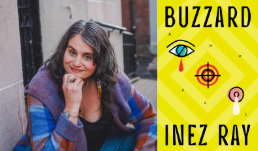
Jocele Skinner of Shared Stories Books in Caldwell, ID, served on the panel that selected Ray's book for Indies Introduce.
“Set in the near-future dystopian Southwest, this book is a terrifying look at governmental control and abuse, as well as women’s health care and reproductive rights. But it also shows heart and the depths of a mother’s love. This book will stick with me for a long time,” said Skinner.
Skinner sat down with Ray to discuss this debut title. This is a transcript of their discussion. You can listen to this interview on the ABA podcast, BookED.
Jocele Skinner: Hi, my name is Jocele Skinner. I'm the owner of Shared Stories Books in Caldwell, Idaho, and I'm here today with Inez Ray, the author of Buzzard.
Inez Ray is a California-born, Puget Sound−based writer. She holds a Bachelor of Arts in Creative Writing from San Francisco State University and has been a doula and midwife assistant for over a decade. Buzzard is her first novel.
Welcome, Inez.
Inez Ray: Thank you. I'm so excited to be here and talking about my book!
JS: Excellent. Your book was chosen as one of our Indies Introduce choices, and from the very beginning, it was obvious that this was going to be one of our finalists. We are so excited to talk to you.
IR: Thanks so much. It was an honor to get the call from Amani Jackson at The Ivy Bookshop. She called me on the phone and said, “You're an Indies Introduce pick!” I was sitting with a friend at the time, I jumped up and down and I think I started crying. I was so excited. It's definitely one of the highlights of this debut year for sure.
JS: Awesome! I'm so excited for you. Can you tell me just a little bit more about your background and what inspired you to write Buzzard?
IR: I've worked as a birth worker for about ten years. I also have three kids, so I took breaks to have my own children. I actually have personal experience in the reproductive disease space; I struggled with endometriosis in my twenties and was really sick with that for a long time.
So, entering into my childbearing years and entering into birth work, I already had this background of seeing the disparity in women's healthcare.
When Roe fell, I was working as a doula and seeing the disparity of care for low-income folks versus people with higher incomes and better healthcare insurance. I was seeing how — without national protection for abortion — the type of care that could be expected for lower-income folks or people on Medicaid was declining.
I started having panic attacks at work actually, so I sought mental health care, and my therapist at the time said, “Well, you're a writer. You should write. It'll help you manage your anxiety.” And I was like, “Oh, I guess I am.” She's like, “Yeah, it says right here that you have a bachelor's in Creative Writing.”
I was like, “Okay, I guess I could write about it,” and what emerged was Mae, the main character, a disgruntled old midwife that had seen too much and was despairing over the state of reproductive care in the world. She just started talking about everything she'd experienced, and that's how that book started.
JS: Very interesting! How did you decide on the format — with interviews and flashbacks — and how did that process work?
IR: I had just read Station Eleven. I loved the idea of an epistolary section, and I loved getting to know my character through interviews.
I read somewhere that, if you're stuck with a character, interviewing them will help you break free and get some stories out of them. I did that as an exercise at some point and that made it into the manuscript.
I love multi-POV stories and multi-timeline stories. When I was physically writing it, depending on what mood I was in, that's the character’s POV I would spend time with. A lot of times, things would just pour out without a whole lot of effort from me. Sometimes I think that's the best writing, when that instinctive thing happens, and it's like magic.
JS: It was definitely magic. When I picked up the book, I didn't read your bio. As I was going through it, I was like, “There is a lot of medical stuff here!” I am a family doctor, and up until a couple of years ago, I delivered babies. I still do prenatal care as part of my practice and teach residents and students.
How did your work as a midwife assistant and a doula inform the more medical aspects of the book?
IR: I had a lot of help. Being in the birth work industry, I know a lot of midwives, other doulas, nurses, and doctors, so I was able to lean on them for some of the more technical medical stuff.
I had a midwife friend read through the main abortion scene in the book and help me decide the details. I remember interviewing her and basically being like, “In this emergent situation, what would be the three tools that you would need?”
We talked about how you would do an emergency dilation and curettage, what you would need, and what you could use as a substitute if you didn't have something. I really had to think about what would be available in this emergent first aid scene.
I had a lot of help from the people around me. I also used personal experience — what I'd been through and what I had witnessed.
JS: It was very realistic as far as what might happen in a setting like that with very limited resources. You did a great job depicting that.
IR: Thank you!
JS: Obviously, in the world right now, there's a lot of discussion about medical care and reproductive health. I live in Idaho, and it is a huge discussion here.
Do you have a prediction for how things are going to go?
IR: I think that abortion will always be available to those who seek it, no matter what, because we take care of each other. Mutual aid networks are only going to become stronger and more prevalent because they have to be, because that's how it used to be.
I love looking at history. I think all the time about the Jane Collective in Chicago before 1972, and about all these historical mutual aid networks, like the Underground Railroad. America has a long history of incredible mutual aid.
Regardless of what happens politically, the mutual aid networks will always exist. Good care will always be available, because there are really brave care workers out there that are willing to put their lives and livelihood on the line to take care of people.
I believe that humans are inherently good, and they inherently want to help. Maybe that is unpopular in the dystopian genre, but I think we'll be okay no matter what. I just would love if we didn't have to rely so heavily on human empathy and mutual aid networks, and it would be great if our government could do the things that a government is supposed to do, like support us in healthcare and food and housing.
JS: That's apparently asking a lot right now.
IR: Yes! But I think it's just like every fight. Every generation has their fight, multiple fights and on multiple fronts.
JS: Well, Buzzard has certainly been a big hit with the indies, and I think it will be a big hit with a lot of readers. Do you have plans for what's coming next after this?
IR: Oh man, I have so many good ideas. I can't really talk about specifics yet, but I have so many things on the stove, and I am always, always writing.
JS: Awesome. We're looking forward to seeing it!
IR: Thank you so much for having me. I am so grateful for the support of the ABA and the indie booksellers. What's happening for my book is beyond my wildest dreams, and I'm so proud. I love talking about it to readers and booksellers, and so thank you for all your support.
JS: You're very welcome. We're excited to share it with the rest of the world!
Buzzard by Inez Ray (Left Unread Books, 9781967967261, PB, Science Fiction, $19.95, One Sale: 09/22/2026)
You can learn more about this author at inezray.com.
ABA member stores are invited to use this interview in newsletters and social media and in online and in-store promotions. Please let us know if you do.