Lily Kim Qian is the author of Until We Meet Again, a Winter/Spring 2026 Indies Introduce selection. 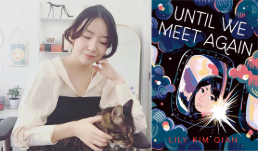
Britney Harker of Rediscovered Books in Boise, ID, served on the panel that selected Qian's book for Indies Introduce.
Qian sat down with Harker to discuss this debut title. This is a transcript of their discussion. You can listen to the interview on the ABA podcast, BookED.
Britney Harker: Welcome everyone! My name is Britney Harker, and I am a Bookseller and Events Coordinator at Rediscovered Books in Boise, Idaho. I was on the Indies Introduce panel, and I'm really excited to be talking with debut author Lily Kim Qian.
Lily Kim Qian is a Chinese-Canadian artist based in New York. She graduated with a BFA in illustration from Parsons the New School of Design in 2021. Along with her illustration practice, she works as a Junior Designer at Penguin Young Readers. In her spare time, she enjoys volunteering at shelters and hanging out with her very own cat assistant, Edgar. Until We Meet Again is her debut graphic novel.
Until We Meet Again was a favorite amongst many of us on the panel. Its gorgeous illustrations had so much to say all on their own, which added even more depth to the story. Overall, it deals with heavy topics of mental illness, belonging, and acceptance, but it does it with such compassion and hope. There are parts of the story that are still sitting with me. This book will be such a good fit for those teens that are touched by mental illness in some way, for teens who have experienced moving around a lot, and for teens who are looking to read an emotional ride.
I am so excited to be talking with you today, Lily! Thank you for being able to join us.
Lily Kim Qian: Thank you so much for having me here, Britney!
BH: It takes a lot of courage to share one's writing, but it takes a special kind of courage to share one's life story. How did this creative project come about?
LKQ: This project has been with me for a very long time. It actually originated as my thesis project back when I was still in undergrad at Parsons. I created a lot of personal work exploring memory and childhood, and my professors really encouraged me to explore more themes about my childhood and come up with interesting compositions interpreting memory.
Naturally, I began sketching and brainstorming more about my childhood. For my thesis, I was thinking, “I've always been interested in graphic narratives and graphic novels, maybe I should come up with a graphic novel or a short narrative about unresolved childhood memories.” I came up with maybe ten pages — which are basically included in the first chapter — about me cutting my upper lip with a razor, realizing that your parents can get scared and, for me personally, realizing that my mom had some deep-seated mental health issues.
My professors really liked it, and they were like, “You should pitch this as a graphic novel.” My senior year — it also happened to be the pandemic — I had a lot of time on my hands. Originally, I wanted my thesis to be a risograph-printed thing, like a tiny book or a zine, but all the studios were closed. I was like, “Okay, I'll come up with a graphic novel pitch as my thesis.”
I was extremely lucky to have my literary agent on one of our panels during my senior thesis seminars. My professors were all super encouraging, like, “Pitch it to him, pitch it to him! He specializes in graphic novels!” I was like, “Might as well, I got nothing to lose.” That’s how it happened.
It was originally titled Pareidolia, a word that describes seeing random patterns in things that don't necessarily have patterns and adding meaning onto them. For example, you look at a cloud and you see a rabbit, but at the end of the day, it's a cloud. I chose that name because a lot of memories are like that. We look back at them and we find meaning based on how we feel in the present and how those memories have shaped us. It also pertains to mental health issues, because my mother had a lot of paranoia and confused thinking.
That was the original title, but they were like, “Since we're going to pitch this to the young adult market, most people won’t know that word.” I changed the title to Until We Meet Again, which has a better ring to it, and it’s the general sentiment I feel towards the people I've encountered in my life.
BH: Wow, thank you for sharing all of that. It sounds like a serendipitous journey, and it's so cool to hear about all the support you had as a student.
LKQ: I was extremely lucky to have all that support. My heart goes out to everyone who has been with me on this journey.
BH: The art you've created for your memoir is just gorgeous. It's stunning.
If you really study it, it adds so much more depth to the story. Your pictures have their own life to them. It’s amazing, you are so talented.
There’s one page that really stood out to me with an illustration of you as a young girl whispering to an older Lily, who whispers to an older Lily, all the way through to the present. You talk about how that game is called “Telephone” or “Chinese whispers.”
The way you illustrated the idea of messages becoming misconstrued and tinged over time is such a powerful way to think about what it means to grow up, to straighten out the mess that you've inherited. How did you think of the idea to illustrate it as the telephone game?
LKQ: I like the imagery of string, whether it's a string of fate or a string of thought. The imagery of string getting tangled is repeated throughout the book, especially when a character feels psychologically confused or turbulent in their emotions.
A lot of times, I feel that imagery within my gut when I am having a tough time. Same with my thoughts when I get stuck in a spiral. I think something over, turn it around, misconstrue it, rethink again, and the whole process makes me feel like I'm turned inside out and knotted up. It's kind of cathartic to draw as well, because when you’re frustrated, you just want to scribble everything. Because I originally had that scribble image, I was like, “Let's think about things with strings. Strings can be cut, strings can be tangled, and can be tied in knots.”
Then I was like, “Oh, I used to play Telephone as a kid!” Most people know it — you have paper cups, you have the string attached to it, and you talk to each other. But, of course, the way the game works is you want to see something get turned into something else, and see what went wrong along the way. I thought it was fitting for memory. We've all experienced growing up and remembering something one way, but then when you reach out to your parents, they’re like, “That didn't happen. What are you talking about?”
BH: That use of string is so interesting. I think that metaphor is accessible in a lot of different ways, especially for a teen audience.
LKQ: When you're growing up and trying to figure out who you are, you can definitely twist it up yourself in some ways. Of course, it's hard to realize in the moment that you're doing it, but especially in retrospect, you start to see how you twisted yourself in that shape. I hope teen audiences can relate to that.
BH: So much of your memoir touches on finding a sense of belonging, both in community and in oneself. You talk about how you moved around a lot, and there are a lot of people who can relate to that struggle, especially in our world right now. What do you hope readers see in your story when it comes to finding that sense of belonging?
LKQ: I hope that the book gives readers a sense that they have the ability to belong. Belonging is more of a mindset, rather than where you are in the world. I definitely grew up feeling displaced because I never had a geographical place I could call home.
Home is where you decide to stick it out. As long as you have the strength to create a space for yourself, and you're lucky enough to have people around you, that can be belonging in its own way, it doesn't have to be perfect.
I've been really touched, because I've had some booksellers and early readers come up to me and be like, “I found this really relatable, because I also moved around a lot growing up.” Even though my experience is a hyper-specific case of moving around Canada, going to China, and ending up back in America, we all crave belonging.
Especially now, as you mentioned, everything's so unstable. A lot of people are physically displaced, or they could be at the risk of being deported, or losing their homes. I hope readers can belong and feel safe within themselves as well.
BH: I can imagine that finding that sense of belonging in yourself is super important for those who move around a lot. Because you do have to start over everywhere you go, having that safe space in yourself is really powerful.
LKQ: Having the strength to create that safe space for yourself is important. Especially for people and circumstances that are beyond our control.
BH: Being mindful that everyone is looking to belong — that’s a message that is getting louder. It’s important to be the ones that are like, “Hey, you do belong. You are welcome.”
LKQ: We're all looking for a place to belong, so we might as well look out for one another.
BH: The moments you shared about your mom — especially when it came to her illness and the harm it caused — were so tender. I thought it was really powerful, because the easier choice is to choose not to see other people's humanity. What has helped you keep a soft heart?
LKQ: Part of it is that I’ve felt a sense of relatability towards my mother as I've gotten older — I have been diagnosed with clinical depression, I've had to make it on my own. Seeing that my mom had moments where she was alone and didn't necessarily have the help she needed, really made my heart ache for her, because at least I was able to get mental health help pretty early. I have a career, I have friends, I have people who reach out to me, whereas my mom didn’t.
There's a certain guilt that I felt after coming across these experiences and realizing my mom didn't have that help or kindness or forgiveness in her life. As her daughter, I felt like the least I could do is offer her some forgiveness.
BH: When we think about that in other situations as well, just thinking about where people are coming from can be really impactful.
What is something you want to talk about when it comes to your book? What is something you want to share with your readers, with booksellers, or with the world about your book?
LKQ: It's been my baby for a very long time. I've been working on it for the past five years. I sometimes look back on it like, “I could have done this better,” but I guess I should treat it more like a child and welcome it to the world with forgiveness and friendly arms. I hope booksellers take it that way too.
I'm very happy with how the team and I put it together. It's so nice to see it printed and in full color. I just hope, even if you don't relate to the story, you can still appreciate it as an art object in your home.
BH: I think people are going to be super excited about it. Your hard work is very apparent, everyone’s going to be really excited about it. Thank you so much, Lily, for talking with me today about your book. We’re all looking forward to it!
LKQ: It's been a pleasure.
Until We Meet Again by Lily Kim Qian (First Second, 9781250884237/9781250884220, HC/PB, YA Graphic Memoir, $25.99/$17.99, On Sale: 04/21/2026)
You can learn more about this author on Instagram.
ABA member stores are invited to use this interview or any others in our series of Q&As with Indies Introduce debut authors in newsletters and social media and in online and in-store promotions. Please let us know if you do.