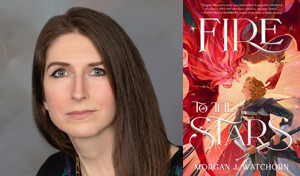
 Morgan J. Watchorn is the author of Fire to the Stars, a Summer/Fall 2026 Indies Introduce selection.
Allie Cesmat of Changing Hands Bookstore in Tempe, Arizona, served on the panel that selected Watchorn’s book for Indies Introduce.
“Fire to the Stars is a debut you'll want to keep your eyes on! For fans of Eragon, Ranger’s Apprentice, and Six of Crows comes a story of humans cursed by a sun god to violently and spontaneously turn into dragons. These dragons are mortal for most of the month, hiding their enhanced healing, thieving and lying and trying not to give into their greed or give themselves away — for if they do, the Slayers Guild will find them and kill them, upholding their religious duty. Told through a dual-POV from Claire, a dragon on the run, and Abel, a legacy slayer with a sordid history of trying to cure dragons, the story unfolds in often violent and heartbreaking beats. This is not a romantasy, it is fantasy with heart, gritty yet beautiful, magical yet grounded at street level, and one I can't wait to come back to,” said Cesmat.
Cesmat sat down with Watchorn to discuss this debut title. This is a transcript of their discussion. You can listen to the interview on the ABA podcast, BookED.
Allie Cesmat: Hi, my name is Allie Cesmat. I am the children's buyer for Changing Hands Bookstore in Phoenix, Arizona, and I'm so excited today to get to talk to Morgan Watchorn for her new book Fire to the Stars.
Morgan J. Watchorn writes stories that feature unapologetic girls at the heart of cataclysms — either fighting or causing them. A Southern California native, she graduated Magna Cum Laude from the University of California Irvine with a bachelor’s degree in Japanese Language and Literature. Her manga and novel translations can be found in most major bookstores. When she’s not writing, she's usually at the barn with her spoiled horses. Fire to the Stars is her debut novel.
Hey, Morgan, thanks for joining me today!
Morgan J. Watchorn: Hello, thank you for having me and for choosing Fire to the Stars.
AC: Yeah, of course. The Indies Introduce panel is one of my favorite things I've done as a bookseller, and getting to read these debuts really shined a new light on the side of bookselling that I hadn't done before. Our panel loved Fire to the Stars because it's not your average YA fantasy that's in the mix right now. To me, from the first chapter, it really jumped out that this was gonna be a contender and I'm so glad it made our final list.
Tell me a little bit about the book. [Can you] give our listeners a little synopsis?
MW: Sure! I'll give you my one liner: [Fire to the Stars] is about a con-artist who hires a disgraced dragon slayer to pursue a false lead. But spoiler alert! She's the dragon.
AC: I love it. I hadn't heard that one liner! That's the other thing, because the panel only gets manuscripts there isn't a lot of marketing built yet.
MW: It's actually not on any of the material. I came up with that way too late in the process.
AC: Oh my gosh! I need you to call everybody and have a reprint immediately. As I mentioned, this is a YA fantasy. I know [in the] industry right now, romantasy is what everybody's talking about. I would more comp Fire the Stars to YA staples like Eragon and especially Ranger’s Apprentice. How would you define the genre for this story? Do you agree with me? Am I fully off base here?
MW: It actually somewhat surprised me that you said that, but only because I agree with you and I seemed to be the odd man out on that. I didn't have a problem with it being marketed as romantasy, but I think that — because it's such a marketing term nowadays — it becomes the label for this gradient. Anything on this gradient is just like, if there's romance in it, throw it on the gradient.
For purely marketing terms, [Fire to the Stars] doesn't dissatisfy the romantasy reader by any means. But I do think that you're right: it has a bit of a larger scope in terms of the different types of conflicts that you would find in more of a fantasy-leaning novel. It's actually funny that you mentioned Eragon. Are you aware that my editor also acquired Eragon?
AC: I did not! Whoa!
MW: Yeah, I feel like there's like some synergy or osmosis or something that you sensed from that. I feel like she has a brand, and my agent nailed it with her.
AC: Wow. That makes so much more sense knowing that because the fantasy and the storyline really does read [like Eragon]. Eragon also has romance in it, right? And Fire to the Stars has a romance in the story, a beautiful romance, but the thing that really stuck out to me for the comp is — as everybody's kind of aware — YA is a really tough space for male readers. Young teenage boys kind of get lost in that shuffle.
[After reading] the first chapter and a half, I got on our panel call and I was like, “Guys, this is a fantasy book for boy readers. They're gonna pick this up.”
MW: Wow, that's such an interesting take. [For romantasy] they just assume that there's the female audience, and they just shove it there, and anything after that is just like a happy coincidence.
I'm so glad that you said that because, now that you say it, in writing Abel's point of view, I did find it somewhat inspired by my anime and manga background. One thing from those stories that I find to be very well done is those stories tend to write really great vulnerable boys, that have a full range of human emotion. They don't have to be this super strong person all the time. They can have the tragic backstory and they can make vulnerable choices and be emotional in front of other people, and that's a strength.
That did feed my experience in writing a boy, because I always have that thought of like, “Oh, I don't want to feminize him too much.” Not that that's a bad thing; I think that there's a voice blending element to it, like the voice differentiation in doing dual POV. There was a level of almost patriarchal programming that I felt a little bit of an obligation to put into his point of view, just to allow the emotional arc to feel like more of a deconstruction of what he'd been raised on.
AC: I can really see that. Abel's point-of-view [parts] were my favorite part of the story. Claire is a brilliant narrator, as well, and I think that even her point-of-views are really appealing to a male reader as well. She's got that conniving roguishness that's very Six of Crows-esque, which really captures all readers [and] which I was really thrilled about.
Speaking of Abel: my boy, my beloved, the child of despair. You hurt my feelings. His journal entries hurt my feelings, but in the best way possible. His despair, his journey that he goes on, that deconstruction of what he thought he knew into the man that he becomes, it really came across strong.
I can see that determination and his love and all of that through his journals specifically, not just his POVs. What was it like writing his journals?
MW: Yeah, so he was interesting. The journal entries in particular because those actually came to me first. I knew who the characters were going to be, but I knew that this backstory was going to be such a key element to that first crack in the faith in the system that Abel has, or started with in his backstory.
It's interesting that they read really emotional for you because for me they felt very clinical because he is so analytical, and I was very careful — at least in the early entries — about making it factual and having that very blunt observational, “This is what I'm seeing. These are the conclusions I'm drawing.”
But I went back and I would make word choice tweaks that were more emotionally charged, so it would kind of tell on him a little bit. You read it physically, right? You said you got the manuscript, did you get the formatted version?
AC: Yeah, I have both. I have an early manuscript and I have since picked up the finished copy, so I did get to see the formatting.
MW: Okay, so you saw the blood smears that they put on the journal entries.
AC: Horrifying! Devastating!
MW: I actually argued for that. I have this big thing about paratext and what is left unsaid on the page.
I knew that if I got too obvious and too expressive with him that that would almost read dishonest and not true to character because he's trying so hard to cling to facts and to find logic in it. I wanted those blood smears to just gradually get worse and worse and worse and then there's like those few teardrops on the last page.
I almost feel sad for audiobook readers because I feel like audiobook readers are not going to have as much sympathy for him. I always wonder how much heavy lifting those blood smears are doing. That's why I argued for them because I thought that they would help build a little bit more sympathy.
Those journal entries [are] rough to read because it's such a dark route to go down for him. I knew writing them that they were going to be controversial, that he was going to lose some people in that. But I think that's kind of the point: when we're trying to help somebody, or trying to resist a very tragic circumstance, we are capable of doing some really horrifying things.
The justifications that we tell ourselves, it gets bad, to put it mildly. As I was writing the entries and it was getting progressively darker, I had a moment where I was like, “I really have to commit to what he's doing, otherwise this is a very dishonest redemption arc. What is the redemption arc if it's not that bad for what this world is capable of doing to people?” It was a really interesting marriage between that analytical brain and what is being experienced in him, turmoil-wise.
AC: That really does come across. [The journal entries] read so clinical and detached. I love that you fought for the blood smears in that paratext, because his detachment reads as pure deranged love, almost like he's so sure that if he approaches this clinically, [then] he's correct and all of this is right, everything he's doing is right.
The more deranged he gets, in those blood smears and the teardrops, you can see that he's breaking at the seams. That breakage that we read in his journal entries then colors a lot of his current day POVs that we are reading and the trauma that he's walking around with. It’s just devastating, beautiful, brilliant. Knowing that you wrote those first, I want to go back and reread the book just to read it with that context.
MW: I'm not sure the rest of it would have come together the same way had I not done that first, which I'm very grateful that I coincidentally did that. [It] made it easier to write.
AC: I love that. I love him so much. I want to shift a little bit over to another character, which is the setting of the book. This book is vaguely French inspired. Am I wrong in saying that?
MW: Oh no, you're one hundred percent correct. That came from, interestingly, Marie Antoinette. Growing up, we hear, “Let them eat cake,” and we think that she's such an evil person who doesn't give a crap about the poor people.
I learned that she really was this ignorant person who didn't really know any better and was just existing in this bubble of, “La di da, cool, we got fashion. We got the jewels.” So many things that were attributed to her are not real or were the result of the greed of the people around her. When I locked into that, I always had that locked into my brain as a piece of inspiration that I filed away for a future story.
When I started thinking about writing a hunter-and-hunted romance, which was one of my favorite tropes, I was like, “Okay, there's not a lot of dragons with this particular trope” — at least in YA at the time — and then I thought about it a little bit further, and I was like, "Well, I can make it even less like other things by making the shifting involuntary.” Then I was like, "Okay, but why?” I thought about the whole trope of dragons on a pile of gold, and then that's when I brought in the Marie Antoinette stuff because I was like, “Oh my gosh, if people are trying to kill these dragons, it would totally be like the exact type of scapegoating narrative that history created [about] Marie Antoinette.”
I did a deep dive into 18th-century France and the culture on the ground — which there’s a surprising lack of literature on that — but I was able to get a good amount. [I found this] awareness towards the takers of society, and I thought that that cultural mood was really interesting. It was also very interesting with all the execution because it had this vibe of people gravitating towards simple solutions if it means their anxiety and fears were resolved sooner, even if it wasn’t the right choice. If they stick a Band-Aid on it, they feel better for the time being, as opposed to taking steps to make sure that that fear doesn't come back in the future, even if in the short term it makes you question everything. You have to dive deep into some really intense problem solving where it might seem hopeless.
That's where the French came from. I just really love the idea of having the classic dragon story in a European country. So, it all seemed to kind of coalesce very well.
AC: I love the Marie Antoinette of it all being your central thread. It's fascinating. It really reads like 18th-century France.
It's upsetting because so much of what you just talked about applies to modern-day problem solving and modern-day mythologies that we're building around people who are different. It's upsetting how much overlap there is there, which I think makes it a good read for a YA reader because teenagers need to see the stories that are happening around them contextualized.
They're smart enough to pick up those threads, and they might see what happens when a religion mandates what people do, a mythos mandates what people do. That fear mongering, it really is something we talked about on the panel a lot: how fear mongering works in a society and in a community. That’s what those shifter stories do best, [they] show that involuntariness, that people that are different don't really get a say.
MW: Thank you. Yeah, the scapegoating in particular. Just to go back to Abel: I wanted to write like an honest redemption story and I had to get him to a really dark and very debatable place to do that, right?
But he was just the one half of the equation; I wanted to have one person who was the scapegoat and [one who was the] the “scapegoatee”, I guess. I thought it was really important to show somebody who enables the system and another person who suffers from it, and to see the things that they see on either side can form a completely different picture.
There's that element of, just because you think you did research, don't think you know everything, because you never know what other pieces of information could completely change what you think you know.
AC: Even if you did a whole bunch of research, what is the validity of the research you're looking at? Where does that come from? You wrote that really well. That all comes back around in — we’ll get there in a second — the ending of the book, [with] the idea that everything we know is actually wrong and everybody that did all this fact checking still got it wrong.
MW: That ended up being one of my favorite parts of the book because there were so many points in which the characters thought they understood the situation.
That’s the other reason why I thought it was really important to make sure that I was writing an honest story about what this world was capable of doing to a person on the scapegoat side as well. Without spoiling it, I fought for the core of Claire's perspective as well. There was a little bit of debate there, but I thought that was a very important piece to keep as well. That, I'll keep that under lock and key.
AC: I couldn't agree more. I remember reading that whole scene — and listeners, I need you to read this book because I want to talk to other people about it — but it’s one of those moments where, if a book club was reading this or if a teenager [were] reading it, they would text their friends immediately and be like, “Oh my gosh, did you get to this point? What do you think? Who’s right? How do you reconcile with this?” Claire’s point-of-view there really brings it home and brings it all full circle.
I hope teenagers get to have the experience [of talking to] each other about this book and be able to be like, "What do you think?” There's a lot of those conversations around government control of knowledge, how our mythos is handed down, who's right, who's wrong, who do we scapegoat? That would make really interesting conversation pieces.
MW: There's an element of, under what circumstances are we willing to love people and the realization that in some circumstances [love] might be conditional.
It's interesting that you bring it up as a conversation piece, because that's what I wrote it for. Going into publishing and doing all the research, I knew that I was never gonna satisfy everybody. But what I could do is make it something interesting to talk about, even if [the] talking about it is bashing on it.
I actually had this thought where I was like, “You know, everybody talks about writing for your ideal reader but I'm gonna write for my ideal hater too.”
AC: I love that.
MW: I literally had a sheet of paper with two columns, and I was like, “I want them to hate it for this reason. I want them to hate it for this reason.” I wanted the characters to be polarizing because what is there to talk about if there's not a difference of opinion?
[With] the themes and particularly the social dynamics that the dragon shifting allegory plays with, it’s important to talk about who was right and who was wrong because that really makes you think about, like you said, contextualizing and bringing those thoughts into real life and seeing the dynamics around teenagers reflected in the book.
I wrote it so that it would upset a certain type of person, but also so that it would validate a certain type of person. I would say [I wrote it to upset] a certain type of person within their healing journey, you know, we've all got something to heal. I didn't write it to piss anybody off; I'm not pointing at any specific person with a belief system or anything like that, but it is meant to be almost like a forced catharsis onto the reader, whether they want it or not.
AC: I really, really feel that. I felt catharsis having finished that book, it did help me process something because our characters go through so much. And not just them, society went through so much. There's been years and decades and systems in place, and the book ends with that system overturning and a new leaf is starting and rebuilding gets to happen. It left me with a satisfaction that a book hadn't left me with in a while.
The journey is complete, and actually, there's hope when we push back on systems, and there's hope for people that have done bad. There's hope for when you've gone through trauma, when you thought you had nothing left. There's a new day coming, and actually the community gets to build that together. I closed the book and it just made me feel better after going through so much sadness.
MW: Oh my gosh, I'm so glad that that helped. [It helped] me too. For me, what shaped a lot of the story was, “How do you get somebody to recognize the wrong that they've done? How do you get somebody to recognize that the place they've been socially driven to is not the end?”
AC: I love that. Who is the reader that you hope finds this book? You want them coming away with that catharsis, but who is your ideal reader?
MW: Somebody who needs a good cry, but wants to feel happy about it.
AC: Agreed.
MW: I think it's real simple like that. [The ideal reader is] somebody who wants to feel.
AC: Perfect. I agree wholeheartedly. This book will make you feel — feel good, feel bad, feel all of it. We need more books like that, where we feel all of it.
Thank you, Morgan, for writing this again. Our Indies Introduce panel had a blast, and we were so glad that it made the list. Thank you for putting this in the world. Congratulations on your debut!
MW: Thank you so much, and thank you for believing in it. I'm so glad that it resonated with you on that level.
Fire to The Stars by Morgan J. Watchorn (Knopf Books for Young Readers, 9780593708446, HC, YA Fantasy, $19.99, On Sale: 8/4/2026)
You can learn more about this author at morganwatchorn.com.
ABA member stores are invited to use this interview or any others in our series of Q&As with Indies Introduce debut authors in newsletters and social media and in online and in-store promotions. Please let us know if you do.