Sharon Choe is the author of Queen of the Spirit Woods, a Summer/Fall 2026 Indies Introduce selection. 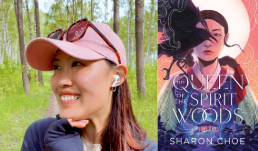
Alyssa Raymond of Copper Dog Books in Beverly, Massachusetts, served on the panel that selected Choe's book for Indies Introduce.
“Inspired by Korean history and folklore, this fantasy mixes lyrical writing and lush worldbuilding with shamanism, royal intrigue, murder, and slow-burn romance. It’s a delightful tale of a kitchen maid catching the attention of a grumpy prince and a charming nobleman — and a critique of deforestation, colonialism, social injustice, and violence in its portrayal of a kingdom on the cusp of political and cultural change. Sequel now, please!” said Raymond.
Raymond sat down with Choe to discuss this debut title. This is a transcript of their discussion. You can also listen to the conversation on the ABA podcast, BookED.
Alyssa Raymond: Hi, I'm Alyssa Raymond, a frontline bookseller at Copper Dog Books in Beverly, Massachusetts. I'm here with Sharon Choe, author of the YA novel The Queen of the Spirit Woods, out November 3 from Simon and Schuster's Athenian Books for Young Readers.
Sharon is joining me from Denmark, which she now calls her home. Born in the UK, she holds a PhD from the University of York and is a postdoctoral researcher at the University of Copenhagen. As a child of diaspora and wandering, she explores what it means to belong in both her academic and creative work.
Welcome, Sharon. Thanks so much for joining me!
Sharon Choe: Thank you for having me and inviting me to have this conversation with you!
AR: It's so wonderful to meet you. We loved reading and discussing your book on the Indies Introduce panel. Thanks for giving us so much to talk about, beginning with the assassination attempt in the opening scene, along with royal intrigue, adventure, mystery, deception, secrets, and betrayal. It's full of complicated family and friendship dynamics and forbidden romance. It has lyrical writing and lush world building, draws inspiration for Korean history and folklore, and is a critique of colonialism, deforestation, and power structures, and so much more. I'm just so thrilled to be able to talk to you about it today!
SC: Likewise, it's so nice to be able to talk about it with other people!
AR: Can you give us an elevator pitch for your book?
SC: Queen of the Spirit Woods is about this fisherman's daughter, Mirae, who cons her way into the royal kitchens to work, only to become accidentally possessed by ten thousand gods and spirits and the key to the survival or downfall of the kingdom of Daehan.
AR: Wonderful, thank you! Could you just tell us a little bit more about the characters, Mirae and the other main characters?
SC: It's a dual POV book. There are two main characters: Mirae, the main-main character, and then Prince Jae, who's the grumpy prince at the royal court. There are a medley of other side characters, a few of whom I will talk about.
Mirae is a happy-go-lucky kind of girl, though not necessarily in the head-in-the-clouds way; she has faced hardship in her life with the loss of family members and a lot of sickness in the lives of those closest to her. She's also the eldest daughter of a fantasy Asian family, so, you know, what more could I say in that?
She has gone through it all, but she is still very resilient and hopeful about everything. She takes on challenges head on. In a way, she's also a bit naive. She's never seen the world outside of her fishing village, so going to this royal court is the very first time that she's left her corner of the kingdom with its obsession with the sea goddess — which everyone thinks is really weird — and yet she clings onto those values of home and family as she moves on. She’s naive but happy and ready to take on any challenge that comes her way.
In contrast, we have Prince Jae, who for me is my personal favorite. I actually quite like him.
AR: Yeah, me too.
SC: He was quite fun to write, but I fully expect him to be a sort of Marmite character — you either will love him or you will hate him — because he's very no nonsense and very duty driven, very high strung.
He doesn't really know how to take a joke or to even joke himself. He's really stressed about everything that's going on, meaning he's not quite fun even for his friends around him, but deep down, I hope I've shown through the book and the writing that he's actually very soft and gentle. He really cares about people more than anything else.
At one point in his life, he was able to have a good laugh with his best friend, he was able to play pranks. But, as is the way for a crown prince, he is driven by duty and this code of the court that he has to follow and abide by. He's a big animal person, so you know, I think that's a green flag.
AR: Definitely!
SC: Then I have three other main side characters. One chick who I’ll briefly mention is the best friend of Jae. He's a pretty boy charmer, K-pop-idol-turned-actor vibe in my head, and he's a very big social butterfly, and he's the kind of guy that asks about your favorite color and actually remembers it. He actually does care about people as well, which is why he gets on really well with the crown prince.
While Oona — Mirae’s buddy that she meets in the court — is this sassy, mouthy kitchenmaid who is from a completely different region. Through her, you get a sense of the rest of the map, and she's a mix of super blunt and honest but also quite private.
She takes Mirae under her wing, especially regarding the spirits and ghosts, one of which is a resident spirit called Doobu. Doobu is the word for tofu in Korean. He is this ghost that possesses other animals to communicate and lovingly terrorize Mirae, and his favorite form in this book is a magpie.
AR: I love that. Yes, I just love all those characters. I like their dynamics and the mix of everything. Yeah, I just love this book so much.
SC: That's so lovely to hear. I think the difficulty sometimes, with a big cast like this, is to create characters in unique and interesting ways so they don't merge. I hope I managed to pull that off.
AR: I think so! I was so impressed by how you balance all those different characters, and then also brought in history and folklore.
Can you talk about the ways you brought in your history and research? In your author's note, you talk about how “your novel is not a full retelling of colonial era Korea, nor does it pretend to present lived experiences. It is a fictional account inspired by true events.” Could you elaborate on your use of research and how this history inspired your novel's world building and the key figures and themes?
SC: Yes, of course. I am a researcher by training, I’m an academic in the other part of my life. But hilariously and maybe surprisingly, I didn't actually do a lot of research for this book because my actual job is researching. Writing is my decompression, my happy hobby. So, I didn't really want to do too much research.
That being said, the “research” that I did, loosely speaking, is talking to my parents and to family members because this is part of a history that's not very well known. It's a pivotal moment in Korean history, but it's also very recent. It's from the generation of my grandparents actually, so they were kids who grew up during the colonial period. So, my research was actually more home-based, and in a way, the story is.
This is why it's not really a full retelling or historical retelling, because I'm not talking about intimate details of very, very specific events. I'm trying to capture the emotions, the tension — what it would have felt like living in a period when you have this encroaching colonizer coming in and destroying your culture. How do you keep your culture and your identity while this is happening as well?
If Mirae was real today, she would be like a ninety-year-old grandma at this point, like it's surprisingly not that far away.
So for me, research was talking to my mum quite a lot. My grandparents have all passed away, but I grew up hearing a lot about the occupation and the impact of that on my family. So I dug into that a little bit more, asking questions like, “What was it like to change their names, to not take Korean names anymore? How did my grandparents try to survive it? All of them tried to survive it in different ways. What changed? How did they feel when they couldn't dress in the traditional Korean clothes anymore, and they had to speak the Japanese language?”
AR: Thank you. I was just thinking about how you thought about colonialism and deforestation, and how you explored that in a fantasy world, bringing in folklore and shamanism and the gods and spirits, and how you used creative elements to explore what was happening with your family and Korea.
SC: In terms of colonialism and deforestation, they go hand-in-hand in this book. Thinking about indigenous cultures as well, that links in with the shamanism, which is actually the indigenous religion, faith, way of life in Korea. Korea culturally now is Confucian, but the shamanism is actually the indigenous culture of Korea before other cultures came into Korea.
When it comes to the critique of colonialism, I can sit here and just say “colonialism is bad, and this is an exploration of that,” which is true and is present in the book. But for me, it was more about the afterlife of it and the emotional impact of these transitions and changes because this is also a book that's not post-colonization. It's the moments just before, it's the lead up to the moment when an empire is basically on the shoreline, ready to take over. It's thinking about how people are trying to emotionally, culturally reckon with that. So, it's more about the subtle changes and the not-so-subtle changes with monumental consequences.
I was thinking about how I could portray cultural and political changes in that subtle way, and I try to demonstrate it in certain scenes where you can see the influence. For example, there is a market scene where you come across some stalls and it has some First Sun sympathizers that are running it, and other First Sun people themselves who are running stalls, and in other places they're wearing their hair in the style of the empire, or they're wearing a trinket that's associated with the empire.
It's those little things that, in the grand scheme, seem very trivial and unimportant. But actually, those are the oddities that are impacting communities and impacting the way people live, react, and assimilate other cultures into their own. And the deforestation is just a bigger visual reminder and metaphor for what's happening there.
With the spirit woods, they are an integral part of this kingdom's culture, the magic system, the faith system, the communities. It's very much symbolic of the way of life that once was, and they're moving away from that.
The woods have disappeared in great stretches already by the start of this book. This has actually been happening before the empire is on the shoreline, sniffing around. It was also partly my way of trying to explore and think about how these changes don't necessarily come from the outside. There may be people on the inside who also sympathize with the colonizer, and that was certainly the case in Korean history. There were Korean citizens who believed in the Japanese Imperial agenda, but not because they thought being oppressed was good, but because they saw it as a way of modernizing and improving Korea and for the benefit of Korea. So, it's not black and white, there are definitely complexities.
With the spirit woods, the destruction of them is a response to the need to modernize and to defend the kingdom. It's not a consequence of colonialism as such, with the empire coming in. It's a way to try to get ahead of that, to protect themselves from that.
In that regard, I'm trying to grapple with quite big topics for a young adult audience, trying to figure out a way to mesh it all together. That's where having fun spirits and ghosts helps.
AR: You did such a wonderful job taking these big ideas and concepts and having a story about a kitchenmaid and about spirits and ghosts and complex relationships.
I'd love to know more about your writing process and how you went about balancing the dual perspectives and all these different elements — the fantasy, the mystery, the romance.
SC: I'm notoriously chaotic when it comes to writing. I'm definitely like a “pantser,” if you know that term. I tend to have no idea what I'm doing, vibe it out, and then hope for the best that I'll reach the end.
I tend to have some scenes, or moments, or themes that I want to focus on, and that will help me get from place to place. But in general, I just write, see what happens, and see the storylines that converge or diverge in ways I didn't expect. Then in the editing process, it comes together. I'll tighten it all up.
I would love to say that I keep track, and I probably should, but I don't really do that. It's usually in my head a bit scrambled up, and I'll start jotting it down once I finish drafting, and then I'll start undoing all the mess that past me has done and tweak as I go along.
AR: So you don't do much editing as you write?
SC: No, not really. I am a pretty clean drafter, and I think that's just from my academic training. I've just been whipped into shape over the years to write cleanly.
It's more tightening the ideas, fixing the pacing, figuring out the beats of the romance and the mystery. That sort of stuff I don't really edit until further down the line, once I have the framework, because usually I don't know what the story is until I've actually finished it, and then it's like, “Ah, okay, this is actually a story about XYZ rather than this theme that I thought I was going to talk about.”
AR: Do you have a scheduled time where you write, or is it more just writing when you feel inspired?
SC: I used to. I go through different seasons. Again, a very chaotic answer. Sometimes I will try and carve out one day a week to work on the creative stuff, and so I'll then do like a four-day work week for my academic work.
But usually, when I get inspiration, I will just rapidly open the document and start typing like mad. Sometimes I will write notes; I'll tend to try and give myself a few minutes to write things down.
Once it's in edits, it is definitely a case of carving out time, being like, “Okay, today I'm going to sit down and I'm going to edit because I need to actually be focused. I can't just ride the vibes and the mood boards to wherever I'm supposed to go. I need to concentrate and figure out how to make it make sense.”
AR: Are you part of a writing group?
SC: Not in person. About two-ish years ago, I moved to Copenhagen for work, but even back in the UK, I wasn't part of a physically located writing group.
I do have my critique partner based in Australia. I have friends in the states and in Korea and across Europe that I will check in with and talk to. I have a friend in Singapore that I talk to a lot. During the process of this book, I don't share a lot of pieces of writing, but I'll share ideas and I'll brainstorm.
My critique partner in Australia and my friend in Singapore are both writers themselves, and I was just kind of throwing ideas at them, like, "Hey, help me make sense of this."
AR: I'm very excited for the sequel. Can you share much about that?
SC: One thing I can say is that you will see a lot more of Daehan. Queen of the Spirit Woods is quite focused on the royal court and the capital city, so you'll see a lot more of the kingdom, the landscapes, the different communities, and the people there.
In that regard, it's going to be a lot grittier, a lot more emotional for everyone. Everybody in the book has some sort of score to settle. So, there's going to be all of these small stakes building into big stakes and all of it's going to collide. Mirae and her friends are just going to have to try and fix the mess that they're in somehow, some way.
AR: Fantastic! You talked a bit about writing the book. Did you have an idea of the whole? Did you already know you wanted to write a duology or did that just kind of happen as you were as you were finishing the first book? Did you have a sense of the overall arc of the story?
SC: I had the vaguest idea of the arc. I'm also an overwriter, so I write and then at some point I'll be like, "Oh, I actually have too much material. How do I either compress this or extend it?" I had in my mind what the endpoint was for book one, so that helps in that this is the halfway mark. This is where all of this stuff needs to have been set up.
When it comes to book two, again, it was very much vibing, pantsing, like, “I see the end point, but I have no idea how we're gonna get there.”
AR: Is there anything else you’d like to touch on?
SC: I don’t think so! I'm excited for everyone to find out about the different gods and the spirits. That was an interesting challenge for me because in Korean folklore there's no real coherent system, and it is basically just nature spirits.
When I started looking into it, it was like, “Oh, it could be like the pebble in the stream, or the puddle you're stepping into, or the twig in the tree.” Trying to conceptualize that was an interesting challenge, so I'm really excited to see readers grappling with that and meeting all those characters.
AR: For sure! Thanks so much again for joining me.
We loved your book and we're just thrilled to have your debut on our list. We wish you a wonderful debut year.
SC: Thank you very much.
Queen of the Spirit Woods by Sharon Choe (Atheneum Books for Young Readers, 9798347106462, HC, YA Fantasy, $19.99, One Sale: 11/3/2026)
You can learn more about this author at sharonchoebooks.com.
ABA member stores are invited to use this interview or any others in our series of Q&As with Indies Introduce debut authors in newsletters and social media and in online and in-store promotions. Please let us know if you do.