T. C. Kemper is the author of The Ginghams, a Summer/Fall 2026 Indies Introduce selection. 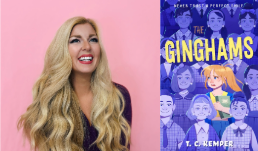
Ashli Byfield of Greenlight Bookstore in Brooklyn, New York, served on the panel that selected Kemper's book for Indies Introduce.
“As someone who doesn't read a lot of middle-grade, I was absolutely surprised by how much I liked The Ginghams. From the first few chapters, I knew this was something special,” said Byfield.
Byfield sat down with Kemper to discuss this debut title. This is a transcript of their discussion. You can listen to the interview on the ABA podcast, BookED.
Ashli Byfield: Hi, my name is Ashli Byfield from Greenlight Bookstore in Brooklyn, New York. I am here with T. C. Kemper, author of The Ginghams, one of this year's Summer/Fall 2026 Indies Introduce picks.
T. C. Kemper is an American author of sparky kidlit and speculative fiction. When she's not sipping peppermint tea sweetened with local honey or hiking woodland trails with her family and rescue pup, she's likely lost in a beautifully crafted story. The Ginghams is her debut novel.
Welcome T. C., I'm so excited to talk to you today!
T.C. Kemper: Thanks, Ashli. I'm so excited to chat too!
AB: I'm very excited to get into The Ginghams. This was one of the first books I read for Indies Introduce, and it was the first book that really hooked me. I was like, “This has definitely got to make it through the entire process.” As someone who's very into fantasy. I love when a realistic fiction book really hooks me because that just means that there's something special there, particularly for me.
This book is great at perfectly balancing eerie with adventure, and in spite of the very real difficulties that the kids are facing, in the end it delivers a story of hope which I think is very important. This is great for readers who love realistic fiction with a little bit of mystery. This is great for queer kids, kids who are navigating friendships, new and old, and for someone looking for something fresh. The Ginghams has a wide scope.
TCK: Thank you, Ashli. I love to hear that!
AB: I want to start with the title of the book. Fashion shows up in the book in a smaller way, but especially when you're young, it's a great tool for exploring individuality and self-expression.
We see a lot of characters in the book doing that, especially Tyler with how he expresses himself, and May with her hair, and the way that the characters in the book are dressed and how that changes is at the forefront of the book. We also see in the book that fashion can also be used to quiet the individual and be used as a tool of oppression.
Why did you choose to pair gingham, the print, with the idea of perfection and conformity in this story?
TCK: Gingham is a very small, boxy, checked pattern, and it gives a retro vintage vibe. I thought, “For a book that is tailored after The Stepford Wives, what is a more perfect visual than a fabric that is literally made of boxes when the story is about someone forcing people into their own version of a box?” They want to box people in; they want to make them behave and speak and look and read a certain way. Gingham as a pattern not only has an old school visual, but also has the symbolic nature to it too.
The Gingham family comes in and they want to control everything. They want to tell you exactly who you should be and how you should look and how you should behave. For such a neat, tidy type of print, it really evokes what the Gingham family was going for when they came in and decided to take over the town.
AB: That makes sense. The Ginghams’ ideology is trying to create more traditional gender roles. It adds to what I was saying earlier about this book feeling fresh because that is a fresh take on how to convey these forced traditional gender roles.
In the book, to serve the agenda of the Pillars of Perfection, other books become banned and they're removed from the school library, including the children's favorite comic, The Twister Trio. So many kids today find they're in with reading through comics, and yet there is a stigma amongst other readers about over whether or not comics are considered a real book. It's interesting to see comics at the forefront in your book, that is what someone might say is more of a traditional book.
What, in your opinion, is the value of comic books and graphic novels to a child's experience of a relationship with reading, and what can it accomplish that a traditional book cannot?
TCK: One thing I know about comic book readers is that they tend to be some of the most passionate, sometimes the most rabid, consumers of the things that they love. If you have someone who's a comic book fan, they're going to be a comic book mega fan. I see that a lot in the people in my life that are really big comic book readers, but I think it's more than that too.
Comic books and graphic novels offer not only the story appeal but also the visual appeal. People have different learning styles. Some people are definitely more visual learners, and having something like a comic book or a graphic novel that provides both the visual aspect as well as the narrative is something that can serve as a really great way to make someone a lifelong reader. Sometimes you have reluctant readers that are intimidated by picking up a book that's just nothing but words for 250 pages, but they'll pick up a 300-page graphic novel because it has the visuals to go along with the storytelling.
We're in a place where our country has a literacy crisis, so anything that we can do to appeal to young readers and foster that love of reading — no matter what form it is — is something that ultimately benefits everybody.
I will actually share one of my favorite graphic novels that I read when I was young. I'll never forget it; it was fourth grade and they used to do a book cart for your birthday. They would bring around a book cart, and for your birthday, you got to pick any book you wanted off that book cart.
The book that I chose was a graphic novel of the complete works of William Shakespeare. It was all comics, visuals with the little speech bubbles and little illustrated characters like Hamlet and Romeo and Juliet. It had The Tempest, A Midsummer Night's Dream, and so on. Imagine a fourth grader getting totally enamored with William Shakespeare because of that particular book. It started my love of Shakespeare, and there's Shakespeare references, of course, in The Ginghams, right off in chapter one.
There is a lot of value to comics and graphic novels, and there can be really surprising avenues that can lead a reader into other interests in that format too.
AB: Another common theme of middle grade books is that the adults in the stories are often ignorant or dismissive of the issue that the kids are dealing with. It's quite reflective of the middle grade reader who is at that age, usually figuring out their own autonomy versus listening to their parents' guidance. I think that's why that is such a theme in middle grade books, and we see it in yours as well.
As an adult yourself, how did you navigate giving your young protagonist agency and autonomy in The Ginghams?
TCK: Joni immediately has a fish out of water feeling when she steps off the camp bus and she comes home to this town that she thought she knew, her neighborhood that she thought she could trust to be the exact same as when she left it. Of course, it's not; she comes home and her best friend is changing, and her neighborhood's changing, everyone's suddenly wearing gingham, the ice cream shop is serving vanilla, and people are wearing pearl earrings out of nowhere. It's very disorienting to her.
One of my favorite tropes in any kid’s book is when the adults aren't the ones that swoop in and save the day because personally, I think that makes for a pretty boring story. Joni taking that initiative and going, “This is wrong. Something that I love has been taken from me and warped, and I'm not going to take that lying down. I'm going to do something about it.” Joni and her friend Tyler go toe-to-toe with this powerful, influential family.
That's a really important thing because it shows kids that it's okay — and in fact, it's encouraged — to question authority if you feel like something's wrong. It's okay to call out powerful people, even if you might be intimidated by them, or if they look really polished or friendly or correct in some way. If you feel that it's wrong, say something.
I, as an adult, feel I have to look through the lens of what I would have wanted to read when I was a middle school or elementary aged reader. I would have wanted to read a book that would show me what I can be and what power I hold.
Because sometimes being a kid, you can feel a little powerless. You have authority figures all around you at school and at home and in your community that are telling you everything that you should be, or how you should look, or how you should speak or behave.
I hope that The Ginghams — through Joni’s autonomy and her willingness to take a risk and stand up for what's right — is something that shows kids that, “If something doesn't feel right to me, I shouldn't stay silent about it.”
AB: This book is teeming with great conversation starters and catalysts for a lot of big and topical ideas that are seen in the world today. I want to give the kids who read your book a place to go next to continue the conversations that are present in The Ginghams.
If you were building a curriculum or reading list for a young child on the ideas presented in this book, what media — films, shows, other books, or other forms of literature — would you curate?
TCK: If I were to create a curriculum, I would probably encourage readers to take a look at books like Ban This Book.
Any books that have to deal with censorship and book banning. Book banning is obviously a very strong theme in The Ginghams because the Gingham family cares a lot about what you read and what you don't read.
I would also say stories that have to do with utopian versus dystopian societies, like The Giver by Lois Lowry, could be a good choice. For nonfiction: literal news headlines. Unfortunately, we're in a place where book banning is constantly being pushed. There's legislative action being taken.
I would include discussions about what's happening currently. What does book banning mean? What does censorship mean? What does that look like? How do you identify censorship? Because censorship is not just censorship of self, but also literal media, and unfortunately, we're seeing an increase right now.
In a little bit more of a fun addition, I would say that if I were to pick a film, I would pick WALL-E. Because WALL-E, while it's very climate oriented, it also is an illustration of, “What does society look like when someone uses technology to drive how people behave?” We see how humans who have left Earth behave and change and look and act when they are constantly fed someone's curated technological messaging. I would say that there's relevance too in the movie WALL-E that could connect to some of the overarching themes in The Ginghams. Not to give away that there's a tech element, but spoiler alert!
AB: That was a great summary or little tease of all the different themes because your book touches on some real-world difficulties that we can see if we just look at the news, while also balancing it with some adventures, some eeriness, some mystery. That was a great list and it makes me want to re-watch WALL-E.
I want to give some more context about The Pillars of Perfection. It's the book that the Ginghams use to spearhead their agenda in the town and help take over. The characters are given these pillars, these ideals, that the Ginghams think is how to become perfect and the perfect family unit.
If there is one lesson or true “pillar” on the idea of perfection that the reader should take away from this book. What should it be?
TCK: Mr. Gingham's Pillars of Perfection are all about creating a sense of what they think perfect is, and it's ultimately a propaganda tool. It's a tool of control. So, I would go completely opposite with my pillar.
My reminder — or pillar of imperfection — is that perfect is a made-up concept. No one is perfect, and even those that think that they understand what perfect means should be reminded that “perfect” is something that is subjective. My pillar is: No one is perfect. Perfect is made up, so quit holding yourself to that standard. It's fake. What makes us imperfect is what makes us special, and that should be celebrated all the way around.
AB: Absolutely, absolutely. Is there anything else you want to say?
TCK: I'm so excited that my debut, The Ginghams, is on bookshelves, and I just want to say thank you so much again to the American Booksellers Association, to the committees that chose this story for both the Indies Introduce honor and for the [Kids’ Indie Next List] honor.
I am so honored, so flattered, so blown away to have this little story — which is a middle grade twist on The Stepford Wives — receive this kind of recognition from booksellers. Independent booksellers are absolute heroes.
AB: I love that. This is exactly the book that should be on the shelves. It just makes sense to me. I'm so happy for it, and I'm so happy for you.
The Ginghams by T. C. Kemper (Henry Holt and Co. (BYR), 9781250489425, PB, MG Mystery, $9.99, One Sale: 7/28/2026)