Tolani Akinola is the author of Leave Your Mess at Home, a Winter/Spring 2026 Indies Introduce selection. 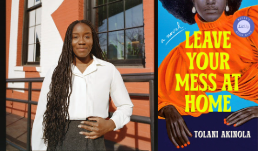
Claire Bone of Wild Sisters Book Company in Sacramento, CA, served on the panel that selected Akinola's book for Indies Introduce.
“A tragedy leads everyone to examine their place in the family, how they relate to one another, and how they see themselves. Anyone with complicated family dynamics will find this book triggering and cathartic,” said Bone.
Akinola sat down with Bone to discuss this debut title. This is a transcript of their discussion. You can listen to the interview on the ABA podcast, BookED.
Claire Bone: Hi everyone, I am Claire Bone. I am the owner of Wild Sisters Book Company in Sacramento, California, and I am here with Tolani Akinola, who wrote the book Leave Your Mess at Home, which is a wonderful family saga. If you have a lot of siblings, and each one of you has a different role within your family, you're going to love this book.
Tolani Akinola is a Reese’s Book Club LitUp Fellow. She holds a BA from the University of Chicago and an MPH from the Harvard T. H. Chan School of Public Health. She lives outside of Atlanta and is here with us today. Hi Tolani!
Tolani Akinola: Hi Claire, hi everyone. I'm so excited to be here. I'm really deeply honored that you all chose my book as an Indies Introduce pick, and I'm excited for our conversation today.
CB: It was a really fun book, and it was one that we really sat with for a while, so I'm really glad that it ended up as one of our picks. What inspired you to write Leave Your Mess at Home?
TA: You would think this is a very easy question to answer, but I always struggle with it. When I sat down to write this novel, it ended up going in a completely different direction than what I had intended.
I'd originally wanted to write an unrequited love story. As I was writing the first few scenes, I was like, “Oh, these people actually both love each other, so that's not working. Also, I really feel the need to explore how this character has come to love in this way, and to deny herself love in this way.”
Then, her siblings hijacked my brain.
CB: As siblings do!
TA: They all had very strong voices and personalities. In trying to understand the ways in which this character had learned to love, I needed to understand the family that they came from. I think that's why they all emerged and forced their way onto the page.
Also, I'm a second-generation Nigerian and I'd always wanted to read a book that centered my experience, but I couldn't find one.
CB: Yes, I love that. It centers your experience, while still centering the family dynamic. As a Catholic girl from Missouri and California, it still really rang true to how families work together — or don't work together, as the case may be. In this book too, each sibling's journey is so wildly different but totally interconnected. How did you so seamlessly weave those stories together?
TA: I love that you could relate even though you come from a very different background. I love the magic that fiction does in that way; there’s this universality in the specific that is just really beautiful. I'm always happy with people — especially who are in Nigeria — who are like, “I totally saw myself in this book.”
I would definitely say that the connection was iterative, and definitely a testament to the gift that revision is.
When I was first working on the novel, the siblings came across as strong voices, but the separate factions were a little bit more understated. The work was to bring that onto the page more visibly. It's interesting, because they all are living very separate, distinct lives, and that was the fun of it. How did these people emerge into this set of circumstances and yet all have a shared background? How is this shared background informing the way that they relate to one another and the people in their lives that they're trying to love?
CB: My sister and I talk all the time, like, “How did we all come from the same family?” Your book speaks to that so well. There’s a saying that “every kid has a different parent,” and you show that really, really well. It got me in my feels a lot of times.
TA: I also got myself in my feels!
CB: Are you a part of a large family yourself?
TA: I am not. I grew up in a single-parent home, with just me and my mom and my sister. That's the really fun part of writing fiction, taking the raw material of your life and turning it into some something completely different, even if it does feel related. People are always surprised.
CB: You nailed it. I thought you were going to say, “Oh yeah, each one of these characters is one of my siblings.”
How did your family dynamics influence what you wrote?
TA: The issues that the family is dealing with — estrangement, resentment, the pressure to succeed, certain people being overlooked within a family dynamic, and parents who are present but also absent — are the raw material that I transfigured, if you will.
CB: These are very universal experiences. I love that you have a totally different background than the family you wrote about.
TA: Yeah, it created lot of space for play, even as I was trying to deal with realistic material.
CB: I like that. “Space for play.” Did your family have opinions on how you wrote the dynamics?
TA: My sister said that I “put my readers in a washing machine” and I love that feedback so much.
My family's been very supportive, and because my family dynamic was very different from the dynamic in this novel, no one was like, “Oh, so that's how you really feel about me!”
CB: What did your mom think?
TA: I don't know if she actually finished it, but she did tell me that it was un-put-downable.
I haven't asked her if she finished it though, because before she read it, I was terrified of what she would think, especially because the mother character in the novel is such a challenging personality. I did not want her to be like, “Oh, so this is how you think I behave?”
But it was interesting to take things to an extreme in this character. I don’t want to say she's a trope, but there is the trope of the stern, immigrant mother who want hers kids to succeed at all costs, and she very much is that.
CB: That's still a lot of people's lived experience, so it's super gratifying and cathartic to see people walk through these challenging relationships, even if it's a trope. It's a fun look at how families work through stuff, either with each other or in spite of each other. Is there a particular scene or interaction that you really liked writing?
TA: There a scene that I really loved writing because it was challenging. Spoiler: The scene where the Longe siblings are all picking out a casket was really challenging to write, but it felt good.
It might be the second scene in the novel where all the siblings are together, but this time they're together without their parents. The subtlety of bringing in everything that's been bubbling up under the surface throughout the novel was really fun to do. I loved writing that scene, even though it was terrifying and challenging.
CB: A lot about writing a book is terrifying and challenging, so I'm really glad you did it. You're not supposed to pick a favorite child, but do you have a favorite sibling? Was there one that was more fun to write than others?
TA: I was very wrapped up in Anjola and her arc with Neil. I wouldn't say she's my favorite, but she was my first entry into this family and the character I first started writing. In that way, she was the most accessible to me.
CB: Do you think there's more for this family?
TA: In my mind, they continue to live beyond the pages of this novel.
Is there more for me and them together? I don't know if I'm interested in continuing to usher on their story. Maybe not in this format. There’re so many other things that I want to write. I love that the novel ends in a place where we know more continues to happen for them.
CB: Like in families, right? Life goes on. I would not be a podcaster worth my beans if I didn't ask you if you have anything else you're working on that you want to tease.
TA: Yes and no, which is such a weird answer. I'm working on things, but I'm just trying to return to writing as a form of play right now.
CB: We all need more play, more fun, more joy, and guys, you're going to get it in Leave Your Mess at Home. Thank you so much, Tolani.
TA: Thank you so much for interviewing me. It's been such a pleasure chatting with you, and again, thank you to all the booksellers who chose my book for Indies Introduce. I am so excited and I felt really supported throughout this process.
CB: Awesome. We can't wait to see what other things you play with in the future!
Leave Your Mess at Home by Tolani Akinola (Pamela Dorman Books, 9780593834190, HC, Fiction, $29.00, On Sale: 04/14/26)
You can learn more about this author at tolaniakinola.com.
ABA member stores are invited to use this interview or any others in our series of Q&As with Indies Introduce debut authors in newsletters and social media and in online and in-store promotions. Please let us know if you do.