Wendy Lu is the author of Casting April, a Summer/Fall 2026 Indies Introduce selection. 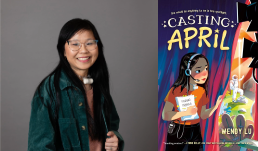
Angela Whited of Red Balloon Bookshop in St. Paul, Minnesota, served on the panel that selected Lu's book for Indies Introduce.
“After totally nailing her audition for the middle school play, April Xue learns she wasn’t cast because of her tracheostomy tube. So she makes a plan to show the director how perfect she is for the lead role…and only tells a couple fibs to put it in motion. April navigates friendships, overprotective parents, her love of the theater, and the ways people treat visible and invisible disabilities in this vibrant and heartfelt middle grade debut. You’ll be cheering for April the whole way (except when you’re cringing because there’s a really good chance this plan is going to blow up in her face),” said Whited.
Whited sat down with Lu to discuss this debut title. This is a transcript of their discussion. You can listen to the interview on the ABA podcast, BookED.
Angela Whited: Well, hello, my name's Angela Whited, and I am a bookseller at Red Balloon Bookshop in St. Paul, Minnesota, and I'm super excited today to be speaking with Wendy Lu, the author of Casting April, one of our Summer/Fall 2026 Indies Introduce picks.
Wendy Lu is a New York Times editor and a global speaker on disability representation in the media. Previously, she was an editor and reporter at HuffPost covering disability, politics and culture. She has written for Teen Vogue, Refinery29, Bustle, Men’s Health and more. She was also named one of Forbes’s 30 Under 30. Find Wendy on Instagram at @wendyluwrites.
Wendy, thanks for being here today!
Wendy Lu: Thank you so much for having me. I'm super excited to be here.
AW: I'm so glad to have you. I loved Casting April. It has everything I want in a middle grade novel. We've got a sixth grader making all kinds of middle school choices, and I loved that it’s a character with a visible disability. I loved that it’s a theater kid book. I loved all the characters, the adult characters, the kid characters.
I'm really excited to talk with you about it today, and have this great new title to offer people, so thanks for being here.
WL: Thank you so much again, for the kind words, and for the honor of being a part of Indies Introduce. I'm so happy to hear that this book resonated with the panel, and I am really excited for more readers to get their hands on it.
AW: Casting April is the story of April Xue, who is a sixth grader just starting middle school. She loves theater, and has the opportunity to audition for her first real-life play. Her friends encourage her to audition, but she gets pushback from her mom. April has a trach tube to help her breathe, and her mom's like, "I'm worried about you being in the world and doing other stuff, because I want you to be safe, I'm your mom.”
She gives this amazing audition and gets great feedback from the teacher director, but then she actually hears the director telling another teacher, “It was a great audition, but I didn't cast her because of her disability.”
April hears this and has to decide what to do, so she hatches the most spectacularly middle school style plan to effectively prove that this was a mistake in the casting and to get the role.
How much of April's story is based on your own experiences doing theater as a kid, and particularly as a kid with a visible disability?
WL: Yeah, absolutely! First of all, I love your summary of the book. That's the heart and soul of this novel: this girl is trying to prove that she's good enough. It is very much loosely based on my experiences of living with the same disability. I also have a trach tube that helps me breathe. I've had it for my entire life — I'm in my 30s now — it's all that I've ever known. I work, I'm married, I live independently in New York, and so it has never been a hindrance for me.
It's very similar for April where she's had it for her life up until this point, and it doesn't affect her acting. She's super talented, and so she's just like, “I don't really understand, like this does not compute.”
I also did theater as a kid. Growing up, I remember I would gather with my cousin, and we would act out “So Long, Farewell” from The Sound of Music. I was in different plays in school, and then I remember when I got a little bit older, I would try to audition for a couple shows, and I never got any roles. In my school, we had a theater teacher who had a tendency to cast the same kids over and over in the same big roles, which is not really unheard of, so I just felt like I didn't fit in very well.
I ended up joining a community theater group in my town that was very scrappy. We would act out homegrown plays and musicals written by someone local, and just put them on together. I think the oldest member of the group was a 91-year-old blind woman, and she was the best out of all of us. Anybody could join, and it felt like a space where I could be myself and also get to act, have fun, and make new friends.
AW: I love that. Did you ever have one of these elaborate lies-based, plate-balancing things? April is making new friends, running lines with the person whose role she wants, telling her parents she has a role she doesn't have, and needing to pass math. Did you ever get up to some major middle school shenanigans of this variety?
WL: I have never lied to try and get the role that I wanted. I do feel like when we're young and in that age, we're trying to push the bounds of what's possible. Sometimes that means making not so great choices. April has a very strong sense of justice in this case, where she's like, “This is so unfair. Nobody believes in me, and I really want to prove to everybody that I have what it takes.” So, in this desperation to prove herself, she makes a split-second decision where she decides to tell her parents that she actually got this role. She just couldn't bring herself to tell the truth.
Even though I've never done anything to that extent, I remember certain moments where I would feel rebellious as a kid. From the time I was born till after I graduated from college, I always either had a nurse or a family member with me at all times. I had a nurse following me around at school and a nurse would pick me up after school and take me home until my parents got back from work. I was pretty much never alone. That's different from April's experience, she is able to be more or less independent and there is a school nurse who keeps an eye on her.
I remember there were times when I would go to the other side of the school and not tell my nurse, or I remember in high school, I would talk to my high school boyfriend late at night under the covers and be all clandestine about it.
AW: I like that you gave April a little more freedom to maneuver than maybe you had at the time, which is great because she gets up to all sorts of things. It gives her a lot of room to talk to all the characters in this book.
Something I really noticed with the secondary characters — and there's a lot of them because there's a whole play full of characters — everyone is handled really empathetically. April meets this direct ableism from her director, and like you mentioned, her sense of justice is strong, she's trying to decide, “What do I do about this? What can I do about this?”
There’s a bully character, Graham, who is super racist to her all the time but in a low-grade horrible way that she just lets roll off of her. I thought that was a really realistic touch. There's this beautiful moment where April sees a little sliver of what he's dealing with at home.
It seems to me like you were being super intentional with all your characters and showing them in their complexity. What were you thinking about when you were working on them?
WL: As a writer, one of the things that you have to balance with the secondary characters, is providing some kind of insight into the main character's journey, and also, that they have their own arcs, their own motivations, and lives and personalities. They exist outside of this main character.
Especially for the teacher and Graham, I wanted to show that nobody's perfect, that even adults can make mistakes and be wrong about things. I never wanted to excuse their behavior, so I tried to leave important moments to indicate that what they do and say to April is not okay, and there's a lot going on there and that there's more than meets the eye.
There are moments of empathy and connection between April and each of these characters, where she sees them in all of their humanity. Graham is always purposely saying April’s name wrong, and there's a moment where April eventually stands up for herself, and is like “Actually, you're saying it wrong.” I really wanted her to have agency over her own story and to really show the humanity in everybody and the mistakes that we all make.
AW: You share a disability with April, but also, you're a very established and reputable reporter, and there is this delightful ace kid reporter, Nancy, in the book. How much of you is in Nancy? Was she a fun one to write?
WL: Yeah, she was so fun. I feel like her personality and her voice came very naturally to me and I could just hear her in my mind talking about pursuing stories. Journalism ethics are really important to her, and making sure to get the story right.
AW: Absolutely. We've mentioned three of the kids now already. There are so many good kid characters in this book. I love how this is a book you can give to theater kids; you can give it to the newspaper kids; this is a book you can give to the kids whose parents have different goals for them.
There's a child that has to audition because her dad is a telenovela actor, and he's like, "Go for it, baby,” and she's like, "I don't want to do this at all.” All the children were great, and all the children problem solving is very authentic.
Do you have a favorite scene or part of the story, either it was the most fun to write or that you most pleased with how it turned out?
WL: Gosh, it's hard to pick. I feel like my initial answer feels a little cheesy, but it was really fun to write the ending. The whole time I was writing, I was really trying to plot out, you know, “What is gonna happen in this scene? How is April going to get herself out of this?” I was always trying to think about what the best outcome would be. I felt like it came together in a really good way. It felt satisfying to me as a writer to put together.
There are scenes between Zahra (the girl who got the role she wanted) and April that I really loved writing, because it felt like their friendship was very naturally blossoming.
In one scene, April goes to Zahra’s place to run lines together, and she’s getting to hear more about Zahra’s story, and who she is in her own life, and in her family. I really enjoyed writing those scenes, and their budding friendship.
AW: I'm so glad you had such a fun time writing the ending, because I love the ending. I can't wait for everybody to read it, and so I can talk about how good it is with them.
The friendship with Zahra is lovely too. That's part of what makes it so authentically middle school-y too: Zahra becomes a new, very close friend, and she's got a very dear friend who's not in the play at all and is not coming to rehearsals, and they're balancing these new activities.
How has writing this book compared to some of the writing you do in your day job as a journalist and speaker?
WL: It is very different from what I do in my professional career as a journalist. As a journalist, you’re writing nonfiction, it’s breaking news, it's very objective, it's really straightforward and deadline driven. The deadlines for publishing fiction are very different from the deadlines in journalism.
I didn't find that it was hard to write middle grade, I think because I'm still a kid at heart, and I have so many strong memories from middle school.
The middle grade voices all felt very natural to write. The hard parts of it were threading together the different scenes and trying to figure out the arcs for Ms. Rooney, for example, who is the theater director. It is very nice to be able to write fiction outside of my day-to-day job, to have another way to use my creativity and have an outlet of expression.
So, it is very different and I love them both.
AW: Do you have more books for kids planned?
WL: That is definitely the hope. I love all the characters in Casting April, and there are definitely some characters that I could totally imagine writing more for. I have other stories in mind. I mostly think about middle grade ideas, because I love this category. Eventually maybe I could branch out into YA, but I really do love middle grade.
AW: That's awesome. Do you have other stories that are real highlights from your youth?
WL: Yeah, definitely! A Wrinkle in Time. I still cry when I read it. I read a lot of The Babysitters Club. I read a lot of Harry Potter, The Boxcar Children, Ramona Quimby, just a lot of books that have always stayed with me. I love Little Women too.
AW: You’ve read all the good ones! You mentioned doing community theater, and that you guys would write your own plays. The play in the Casting April is called Finding Primula, and it is a sci-fi epic with amazing costumes, and many of the characters are plants, and I'm like, “This play is a delight!”
Did you write this play? How much of it did you have to figure out to write the book?
WL: It was a challenge because it's, in a sense, a story within a story, and those are always hard to write and balance. I have a very extensive outline of Finding Primula, but I didn't actually write the play out. Maybe one day I will, that would be very fun.
I wanted to make sure to have at least a few scenes that I could show the kids acting out in the book. I wanted to give enough detail to feel like a full, complete play, but not so much to overwhelm the audience. It was really fun. I don't typically write sci-fi/fantasy, so this was a way to slip some of that in there in an otherwise contemporary novel.
AW: I love it. This book is perfect for the theater kids, the newspaper kids, the kids that want contemporary fiction, all of them. Everybody will like this.
Thank you so much for joining us today, Wendy, and chatting with me about it. Is there anything you want the booksellers to know?
WL: All of your questions were so thoughtful and I’m just so excited for its release, but also, I just have so much gratitude for the ABA and the early readers. It really is a dream come true.
I feel really grateful for all of the booksellers, we wouldn’t have careers without you all. Thank you so much for everything you do for authors, for parents and readers, and for your community.
AW: Thank you for giving such a gift of a book! This has been a delight.
WL: Thank you so much.
Casting April by Wendy Lu (Knopf Books for Young Readers, 9798217030286, HC, MG Fiction, $17.99, One Sale: 6/16/2026)
You can learn more about this author on Instagram at @wendyluwrites.
ABA member stores are invited to use this interview or any others in our series of Q&As with Indies Introduce debut authors in newsletters and social media and in online and in-store promotions. Please let us know if you do.