Independent booksellers across the country have chosen Paul Yoon's Etna (Scribner) as their top pick for the August 2026 Indie Next List. 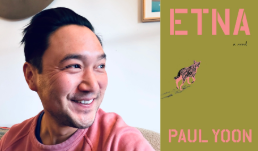
“A canine soldier survives war, only to go on an odyssey that may take more than it gives. The Art of Racing in the Rain meets Angel Down. A beguiling, poetic affair that's bathed in crimson, and barks hope into the dark,” said Dominic Howarth of Book + Bottle in St. Petersburg, Florida.
Here, Yoon discusses his work with Bookselling This Week.
Bookselling This Week: What was the spark for this piece? What made you want to take this sort of intimate look at war and this journey home — which are subjects you’ve touched on before — particularly from a dog’s perspective?
Paul Yoon: Yeah, a lot of these things are ones that I've been working on for — I can't believe I'm saying this — over two decades. This is my sixth book, and these are themes that I've engaged with seriously for the whole time.
Why a dog? A few reasons. The easy answer is I fell in love with a dog.
Oscar is my first dog ever. He's now 12. My wife and I rescued him when he was about three months old. It's been an incredible little over a decade with him.
There’s a real bond. He lies next to me while I write, with his paws on my lap or his head against me.
I know people often talk to their animals. I'll wake up and hear my wife talking and I’ll think she's on the phone, but she's actually just talking to Oscar. I actually don't talk to him. For the past decade, it's been more of a silent communication with him for me, and during that time, I basically started imagining his voice.
The book began as me imagining his voice. Then it became an imagined conversation between me and him, as if he was telling me about his life. We always wonder what's going through the minds of our animals, right?
Plus the themes I've been working on for many, many years now.
Lastly, for the past few years or so, when you turn on your phone and you read the news, your heart breaks over and over and over again. You think you're going crazy, and you're sort of saying to yourself, “How is this happening?”
I think a part of me had a little human fatigue. I needed a little break from humans.
So I thought, what if I pushed humans aside and focused on another sort of being.
What would that do? Would they engage with the world differently?
Whenever I think about the projects that I've worked on, there's always a few things that overlap in a Venn diagram to form that sweet spot where you're engaging with the work and starting to like to create a story.
BTW: So if the book emerged from Oscar’s voice, did it flow easily? Or was there anything particularly challenging about it?
PY: It is him, but it's not him. He’s a big baby at heart. If he ever met Etna, he would literally run between my legs.
I think the challenging thing was figuring out how to write a first-person narrative that is a dog.
I also wanted to also create a bridge for the readers to experience this world. That constant balancing act was kind of challenging — I wanted dog moments, and for readers to be aware they’re in the mind of an animal, but also, I wanted readers to be able to engage with the world that I've built and to experience more than just animalness. So that was tricky. That was the hardest part.
BTW: I think you really managed to balance that all very well.
In a previous interview you said that, because you do short stories and novels, that you approach every story as if it's a short story and then some of them just end up longer. I was wondering if that's still the case, and if so, at what point did you look at this and go, “Oh, this is a whole book.”
PY: I knew this one was going to be longer, because I knew this was a great voice and a really compelling character for me.
I had the stages of the journey in mind. I didn't think it was going to be a long project, but for me, this is a longer book.
It kept going, in part because I wanted to be with Etna for as long as possible and make sure he was okay and got to where he was going.
BTW: Most of your previous works are award-winning or we're nominated for awards. Etna landed on several most-anticipated titles lists, and as the early reviews are coming, we’re getting comparisons to Animal Farm and The Odyssey—
PY: No pressure.
BTW: Exactly! I wanted to ask how you’re dealing with that pressure as this title is nearing its release date.
PY: I am just really grateful. I'm excited for readers to pick this up.
I'm at a stage where I understand that I've been really lucky to be doing this for as long as I've been doing it. It feels like a miracle that I get to be a writer and to create these worlds.
When good things happen, like what's happening with Etna and the Indie Next Pick, I don't take it for granted. I cherish it.
And hopefully I can figure out ways to give that joy and energy back, whether that's through supporting other writers or supporting independent booksellers.
BTW: That's a beautiful answer, and it ties back into what is typically our last question. Would you like to tell us about the role of books or independent bookstores in your life?
PY: There are many instances…the one thing that pops into my mind is that I went off to boarding school when I was 13 and I spent about four years in New Hampshire.
I spent my formative years away from home.
I just remember whenever I felt homesick, or unmoored, or lost, I would walk down to town where there was a bookstore called Water Street Bookstore. It became a kind of haven for me; I felt really safe there. I felt really welcome inside and I would just hang out there for as long as possible.
Stores like that — independent bookstores — they're portals into all these different worlds. They give you access to all these different worlds and, for me, that became my first encouragement to imagine and to create and to learn.
I wanted to learn about everything. I wanted to pick up every book. It encouraged me to imagine.
And to this day, whenever I walk into a bookstore, I feel safe and welcome, but also that encouragement to imagine and create.
A bookstore is like having a dog — there’s a universality to it. People from all different backgrounds and cultures can come in and share being a fan of a book or anticipating a new book. In the same way that people of all different backgrounds or political affiliations can enjoy talking about our dogs.
Bookstores give us space to be a community and I love it.