Independent booksellers across the country have chosen The Lions' Run (Balzer + Bray) by Sara Pennypacker and illustrated by Jon Klassen as their top pick for the March/April 2026 Kids’ Indie Next List.
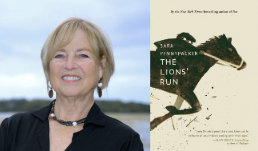
“I read The Lions’ Run with my heart in my throat the entire time. It’s a story of bravery, of courage, of hope — that the smallest act can make a difference. What a gorgeous historical novel. This is Sara Pennypacker at her best,” said Cathy Berner of Blue Willow Bookshop in Houston, Texas.
Here, Pennypacker discusses The Lions' Run with Bookselling This Week.
Bookselling This Week: I would love to hear what your biggest challenge was while writing The Lions’ Run.
Sara Pennypacker: My biggest challenge — in any historical fiction — is not to be a history teacher. Because you learn so much. My research was really thorough for this, and I found a lot of it either compelling or upsetting or just interesting.
I had to continue to remind myself, my job is not to teach history. My job is to tell an engaging story.
That was my biggest challenge.
I also don't remember a book out of 27 where I've been so uncomfortable putting myself in the setting. It was hard to do that.
It was hard to get up every morning and pretend that the Nazis are occupying my town and that women have no rights to their bodies or their babies. These are hard things to face every single day.
BTW: Having to learn all of these things and then pull back on some of it, was there anything that you really wanted to include that you weren't able to?
SP: If my audience had been different, there are many things I would have added, because there was just so much going on that I felt should be talked about.
However, my two main characters were 13 and 15, so I kept it to what would be intriguing or upsetting to those two. Which means these are the things my readers will be interested in, too. They're the same age, right?
BTW: I'd like to take a second to talk about the illustrations.
Jon Klassen worked on the art for these books. But he also did the art for Pax, right? Even though they're different stories, that kind of encourages readers to find other similarities between them.
You've said before that you don't have any involvement in the illustrations and you let the artist do their thing. Can I ask how you felt when you first saw the illustrations for this?
Both my editor and my agent were in my house when I first saw them, which was very cool.
I was very excited. They said, “Here’s what Jon wants to do,” and I gasped.
I was so knocked out.
The next day, I went into my studio, and even though I had already turned in a full draft, we were still polishing it. I went into the book again with only one goal: I was going to make the book as exciting as the cover. I upped the tension a little and I upped the excitement of the scene that's on the cover.
I had never done that before, and I only recently told Jon about this. I wanted him to know that he did that for me. He made me be a better writer or at least a more exciting writer to match that fabulous cover!
There is a real connection between Pax and this book — and it's not just Jon!
It's that the things I learned while traveling and talking to kids about Pax greatly influenced my choice of what to write next. It certainly influenced what I'm writing about now and in this book.
When I was talking to kids about Pax, they continually surprised and impressed me by asking, “What can we do about these problems?”
Specifically, the problem and impacts of pets being abandoned when war comes.
They seriously needed to know what to do about it, to the point where I would have to bring along information like, “Here's an organization in Syria that's feeding abandoned pets.”
I learned that kids want to know what to do about things. Then throughout the next ten years, I learned that not only do they want to do something about it, they don't know if they're courageous enough. They don't know what kind of courage it takes or what they are capable of as pretty much [humans without agency].
So, of course, that's all in The Lions’ Run. What can you do? What does resistance look like when you don't have a lot of agency? What is real courage?
Kids are so much more perceptive than we often give them credit for.
BTW: You mentioned earlier, you’ve done 27 books so far, and they’re for all different age groups and genres.
What's one of the biggest things you've learned along the way?
SP: Over 20 years ago, I heard a quote from Carl Jung, who was asked, “Why is there evil in the world?”
His answer was, “There's evil in the world when people can't tell their stories.”
And it completely changed me.
It felt so true that I stopped writing for kids as though it was something I was presenting to them, and instead started writing for them — as a stand in for them because they can’t tell their stories yet.
I'll tell their stories. That became the goal: instead of giving them something for their enjoyment, I'm giving them something that should express something true for them until they can do it.
That was a big, big moment in my life, and I consider that one of my biggest things I've ever learned. I had just started the Clementine series then.
Another thing came really early on, and it marks me still, is something I read from E. B. White that essentially said if you're going to write for children, the job is basically to present the world as it is, and model it as it should be.
So all my books, I've been thinking of that. There's going to be a problem, because that’s how it is, and here's how it should be, and my characters are going to have to make that leap.
This was the hardest book for me to stick to that. Because the jump is so big, that makes it harder to write a story that both shows the world as it is, and models it as it should be.
BTW: Those are some really powerful realizations, and I think it's amazing that that's what's guiding your storytelling.
We always like to bring these back around to indie bookstores, so would you tell us a little bit about the role of books and indie bookstores in your life?
SP: Oh my goodness, I've seen a lot. My first book came out 32 years ago.
I have had a chance to see personally what I consider the most moving thing in my career, which is when a bookseller or a librarian says to a young reader, “I think I have what you want. I think this is the book for you.
No matter how many times I see that, I cry, because it's such an amazing connection. To have someone know the readership, know the book, and to put those two things together is a magic combination.
Even before I was a writer, whenever I would travel, I always wanted to hang out in a bookstore. You learn a lot about a place by visiting its bookstore, but also feel comfortable there.
In a bookstore, I’ve never had that uncomfortable feeling that you should be buying something, or you should get out of someone's way, or that you shouldn’t touch something. I've never had that feeling.
BTW: Is there anything else that you want to mention to our booksellers or anyone else who might read this article?
SP: One thing I have been doing as I talk about this book is wear my dad's dog tags when I talk about it, because my dad is in it.
There's a mention of the American flyboys who were bombing the oil fields that the Germans relied on and how brave they were, they would go in low and shave the treetops off.
My dad actually was a flyboy. He lied about his age — he was a teenager. He flew one mission, they shot him down, and he spent the rest of the war in a camp.
But it has been very moving, and I think it really tracks with kids when I pull out the dog tags and I say, “I want you to remember two things about historical fiction.”
The first thing I tell them is that these are real people. Everything I'm talking about in the book happened to real people and they have earned our respect.
Because in historical fiction, we're never writing a story about the good old days where everything was easy, right?
The other thing — that I've realized is so important — is that these are things that happened in the past.
It didn't occur to me until, at the first school I went to, a little girl asked me, “Are the Nazis still in France?"
I went, "Oh no. Let's make sure that these dog tags remind you that my dad came home. He got married, he had kids. He was a happy man, he had a life.
When we're reading about the forces of evil and good, there's always evil and there's always resistance. That's what we're talking about. The resistance wins. We go through it.
That has been really important as I'm talking about this book.
Sometimes we feel right now that things are so bad they might be permanent. They will pass. This will be history.