Independent booksellers across the country have chosen V. E. Schwab's Bury Our Bones in the Midnight Soil (Tor Books) as their top pick for the June 2025 Indie Next List.
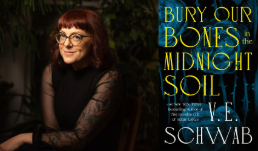
“Bury Our Bones in the Midnight Soil is V. E. Schwab’s literary follow up to the phenomenon that is The Invisible Life of Addie LaRue. This book is truly dripping in bloody soil and grows a dark flower with teeth,” said Kendra Burns of The Book Vine in Cherokee, Iowa.
Here, Schwab discusses her work with Bookselling This Week.
Bookselling This Week: You’ve said before that stories come to you in bits and pieces. What was the starting point for you here? What came to you first?
V. E. Schwab: It's so tricky to try and parse, because it is like ingredients in a meal. Some ingredients feel really large and essential, others feel almost like spice and seasoning. And some, by the time they get amalgamated into the finished meal, no one but me would ever know that they were there.
On one hand, there's some really obvious ones. I wanted to write a love letter to Anne Rice. I wanted to explore villainy in response to Killing Eve and what I saw as a progression of acceptability for women to be messy.
It's a really long time in the making too, because in some ways it's a reckoning with my earlier career, and with myself, and with the feeling that for so many years I tried to assimilate in every way possible in writing and publishing and tried to make myself smaller. That became a huge theme in the book — when the world tries to make you small.
I tried to be like, “Oh, don't pay attention to the fact that I'm femme, because I'll just use my initials.” Or “don't pay attention to the fact that I'm queer. It'll be subtextual, not textual. You won't even notice it, right?”
What you discover over time is that there's no assimilation. It’s never going to work. You're better off just telling the story that you want to tell.
And in the wake of Addie LaRue, I felt if I couldn’t transmute that success into authenticity — into the freedom to tell the story that I desperately wanted to tell — then I'm never going to feel like I can do that.
And I specifically wanted to write queer villains. Villains are the heart of everything that I do and I kept being told, “Oh, don't do that because it'll be conflating queerness and villainy.” What a reductive take — because what you're saying is that queer people don't get to be as complicated as their straight counterparts.
But because of that, I ended up putting myself at the margins of my own stories for years. I didn't let them have center stage because I couldn't write the kinds of messy people that I wanted to do.
So, in some ways, this book is just allowing women to be messy and angry and broken and hungry. In some ways, it's a response and a reaction to the difference of 2020 when Addie LaRue came out, and 2025 when this book is coming out.
It's also just about hunger in every form that it takes, also the intoxication of being seen for who you are for the first time, even if you're being seen by the wrong person. It's also about queer communities and queer identity and closeting across history. It's like these three women represent three stages in my own coming out journey.
But at the same time — this is one of those ingredients that I feel like nobody else will know — one of the initial ingredients for this is that I'm an only child my parents instilled in me growing up that I should never have a one-night stand. Not for sexual health reasons, but because it was unsafe because it meant either going into a stranger's house or letting a stranger into yours. You don't know this person, something bad could happen.
So, one-night stand. Murder. These two things are going to go together. I thought how funny it would be if I have a teenage girl who has an excellent one night stand and wakes up dead. That was one of the core ingredients. It's inextricable from all of these lofty aspirations of examinations of queerness across time.
I also was really interested in collateral damage. I love Louis and Lestat as a pair. I love Interview with the Vampire, especially the TV show, which feels like we finally got canonization of queer content instead of queerbaiting. It's just so lush and so violent and so tactile.
I'm also really interested in everyone that they killed along the way of this epic romance that they have. Not only is their romance toxic and broken, but what about all the bodies? I really wanted to look at a story from the perspective of somebody who started out as an afterthought.
BTW: I love that. So, without spoiling anything, I do think that the ending we got was very fitting. It made sense. And for a little bit, I wasn’t sure which direction it was going to go — which I love. Did you entertain different endings? Or was this ending always the one you had?
VES: I can nod my head so vigorously because, for me, endings are the entire point. Endings are why I tell stories.
They are, to extend the meal metaphor, the taste left in your mouth at the end of the meal. They are overly weighted in our opinions as consumers and creators, and for a reason, because it's what we're left with.
When I write stories, I plan from the ending that I want to hit. So, I know before I ever start writing the novel exactly how it ends. I have rewritten books from scratch along the way, but this will be my 25th book, and in 25 stories I have never changed an ending. To me, that would negate the experience.
People either love or hate my endings, but they're really deeply intentional.
BTW: That's really cool. I feel like I — and probably some other people who read this — will go back now and look at some of your other work with that knowledge in mind to see how it hits differently.
VES: A great example I give is Gallant. I knew what the last shot, the last page, the last moment was. I knew exactly what that looked like in my head, and I wrote the entire book for it.
BTW: I love that. You kind of touched on this, but we meet so many characters who were all of the midnight soil, and they lived in very different ways — not just our main character. I want to know who you think you would be most like if you found yourself in this position.
VES: Well, most like or most want to be around? Because there's such different, right?
I am most like Sabine minus the serial killing.
I think this is important about me, but the reason it took me until 27 to come out was I just genuinely didn't understand the options. I was so opaque, so Sabine's opacity is a thing that I relate to. She just genuinely doesn't understand that there are other choices until they're presented to her, so she just feels hungry and dissatisfied all the time. She's insatiable. She's frustrated by the parameters.
All she's thinking is “I want to break out. I want to break out.” Whatever that means. I related so much to that sense of just wanting to take control. I am most like Sabine in that way, for better or for worse. I just desperately want to be in control of whatever I'm feeling. I'm a control frequent it comes to writing. As I said, I understand what I'm building as I build it. It's an execution of an idea.
I'm slightly less emotional as a person than Charlotte, the middle character.
I obviously gave each one of them a piece of myself. Alice has my neuroses. Sabine has the hunger and this sense of never being satisfied, which I have in spades. Then Charlotte is just so fraught with feelings that she doesn't even want to have. She’s so desperate to be loved, which is not a thing I would say about myself, but so much of what I was working through in my coming out journey was being deserving of love or wanting somebody to see you for who you were. That's why she gets entrapped in the way that she does when the wrong person potentially sees her.
If I could choose anyone to be like, it would be Matteo, who's probably the healthiest character in this book. Matteo or Ezra. I like tend to really love my peripheral characters. I like to think that even when they're secondary characters in the book that you're reading, they’re very easily primary characters in their own stories. I want them to feel fully realized.
But alas, I fear I am Sabine. Creating Sabine was one of the most cathartic things I've ever done.
BTW: So, Bury Our Bones in the Midnight Soil is just coming out, but do you know what’s next for you? Anything you can tell us?
VES: I do! Well, first up is the finale of the Villains series. Vicious came out in 2003, and Vengeful came out in 2018. What's so funny about these books is that they changed so much with both my evolution and the context in which they come out.
I just finished the first draft of the finale for the trilogy, Victorious, so that'll be coming out next year and will hopefully just ruin people.
Then I have the rest of Threads of Power, and I have something that I'm very excited by but that I can't talk about. Every time I do, I get in so much trouble. My publicist is like, “Just stop.”
Here's what I'll say: Addie LaRue and Bury Our Bones are set in the same world. I like to think of this as the garden. It's my version of a low fantasy. I want it to be a lyrical space where I get to play with the supernatural in our world.
With Addie LaRue, you met old gods. In Bury Our Bones, you meet vampires. But I definitely think that some other things are growing in the same garden.
BTW: Amazing. We will look forward to that. Those are all my big questions for you.
Congratulations on hitting the Indie Next List yet again!
VES: I am over the moon. A lot of really cool shit has happened for Bones so far but getting the Indie pick was the first time I've cried. Getting chosen by booksellers…it just means everything. Truly, it was the one thing I dared to dream for.
Addie got the number one pick back in 2020, and it felt so dissociative because of the time period, so I didn't know I was grateful for it. This time around, I feel like I’m on cloud nine about it. I'm so happy.
BTW: Do you have a favorite indie bookstore memory?
VES: It's not so specific, but I did not start as a big author. Because I started so small, there was a time when indie bookstores were the only thing supporting me.
There was a time when independent booksellers were handselling me book over book to people who had no idea who I was.
I write things that would be very easy to just put in the corner, not face out, and wait for it to get remaindered. Instead, from the beginning, independent booksellers were the biggest champions. They are the only reason I have a career. They are the only reason my books got into the hands of enough readers for publishers to keep taking chances on me. They are the reason that my audience has grown from a teacup to a lake with this amazing depth and breadth, and I owe them everything.
I don't have a specific memory, because every single time I have been lucky enough to go do events, I have gotten to work with independent bookstores. I have been reminded again and again of why they are so important.
I got to go to Winter Institute this year, and my publisher didn't really want to send me at first because they were like, “You don't need to. They all know who you are.” And I was like, “No, you don’t understand. It's not about that. I want to go because I want to look people in the eye and say thank you for everything that they did.”
It was the highlight of my year so far, getting to look independent booksellers in the face, getting to see their tattoos of my books, and getting to hear their stories. It will never stop amazing me, the amount of work that independent booksellers do to put books into readers' hands.
I wish I had a specific, really cool memory, but I don't, because the fact is that it's just this continuous heartbeat through my career.