Independent booksellers across the country have chosen Ríoghnach Robinson's Bad Words (St. Martin's Press) as their top pick for the October 2026 Indie Next List. 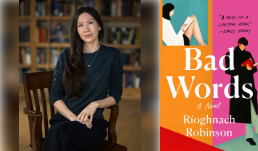
“A book about books, publishing, writing, the internet, and the very best, truly enemies to lovers, unexpected romance. What a timely read — from the constant pressure online to the ways AI is changing publishing. An incredible look at the power of words,” said Leighellen Landskov of Fabled Bookshop & Café in Waco, Texas.
Here, Robinson discusses Bad Words with Bookselling This Week.
Bookselling This Week: Congratulations on being the top INL pick!
You’ve done several young adult novels before, but this is your first adult novel. How did the experience of working on Bad Words compare to that of your previous works?
Ríoghnach Robinson: Thank you so much for the congrats — I'm thrilled and still in disbelief!
My process doesn't change much across age categories. During the draft, I do think about the sensibilities of my ideal reader, and age factors into that to some extent. But the actual book-writing steps remain the same: the feverish brainstorming phase, the vomiting up of the first messy pages, the speculative outlining of the remainder, the spreadsheet-tracked completion of the first draft, and lastly the years-long quest to make that first draft less bad.
BTW: This book was incredibly fun to read (and occasionally incredibly stressful) but you also get the sense that it was fun to write. You balance the romance and drama with humor and meta quips about writing and AI.
What was the initial spark for this book?
RR: I'm delighted that it was fun, despite the stress!!
The book didn't have a single genesis point — it swam up out of a sea of many of my favorite things. I love reading book criticism and film criticism. I love a terrifying critic as a character. I love the bewildering fact that becoming a critic means accepting the burden of being passionately hated (the devotion to the art that requires!) — and that this is something critics have completely in common with authors. I love two characters who feel like the unstoppable force and the unbreakable wall. I love a dramatic change in feelings, a total re-evaluation of a character through another's eyes. I love playing with text voices and email voices. I love the connective power of paying deep attention to someone's art, no matter your reaction to it.
BTW: Bad Words switches between Parker and Selina’s points of view, and while they’re initially at each other’s throats, they’re both very relatable.
Did you identify more closely with one of your narrators? Or was one easier to write than the other?
RR: I think my own personality is more in alignment with Parker's, but I found Selina just as enjoyable and cooperative to write!
I got lucky with this one. Both characters arrived in my head pretty fully-formed in terms of their values, their priorities, their judgments, and (usefully, for me) what it would take to make them change.
As for both feeling relatable, I'm so happy to hear that! As badly as these two behave, I am on both of their sides, feud-wise.
BTW: There are several indie bookstores featured in Bad Words! Would you tell us about the role of books and indie bookstores in your life?
RR: Of course I was going to pack Bad Words as full of indie bookshops as I could! My favorite part of visiting a new city or neighborhood is always ferreting out the local bookshops there and snooping around their corners and observing their ecosystems.
Indies are textured and handmade and represent the dreams of the people who built them, as well as the community of individuals supporting them. They say something about their people. In that, they're a perfect analogue for books themselves, and for everything else that's worth defending in this ever-smoothening world.