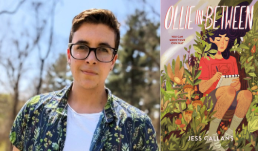
Jess Callans is the author of Ollie In Between, a Winter/Spring 2025 Indies Introduce young adult selection, and March/April 2025 Kids’ Indie Next List pick.
Jessica Hahl of Books Inc. in the San Francisco Bay area, served on the bookseller panel that selected Callans’ book for Indies Introduce.
Hahl said of the title, “A tender, big-hearted exploration of growing up. Young Ollie struggles to grasp the diaphanous tendrils of their future self in the face of puberty, especially when everyone around them seems to have already figured out where they belong. A gentle classic to add to any middle reader's shelf. This book is like a tiny downy bird I want to carefully show every person I meet, so we can collectively admire it in wonder.”
Callans sat down with Hahl to discuss his debut title.
This is a transcript of their discussion. You can listen to the interview on the ABA podcast, BookED.
Jessica Hahl: Hello and welcome. I'm Jessica from Books Inc. in the Bay Area, and I'm excited to speak with Jess Callans, the author of Ollie In Between.
Jess Callans is a queer children's author and a wannabe illustrator with an MFA from Rosemont College. He lives outside Philly with his partner and four amazing kids, where they collectively bake, garden, and tirelessly pursue the human experience. Ollie In Between is his first novel on sale, April 8, 2025.
Jess, thank you so much for joining me today!
Jess Callans: Yeah, thanks for having me.
JH: I felt like Ollie was a tiny, downy bird. I wanted to carefully go around and show every person I met how perfect and beautiful this book is. I'm really excited to get to speak with you today.
JC: Oh my. Thank you! I'm really happy to be here.
JH: Ollie is such a beautiful character that I wish I could hang out with in real life. Did Ollie spring forth from your mind like Athena, or did you have a more layered approach? Did you have to move a lot to find the heart of the character?
JC: I think the story really couldn't have existed without them. I wanted to take on the Are You There, God? It's Me, Margaret. puberty story, and Ollie was the only person I could imagine being in there.
But the layered approach did come in when we meet Ollie. They are at this crossroads in every moment of their life. Their identity is so in flux and they could choose to go any direction. So I spent a lot of time being like, “Even though I know how this person thinks and how they feel like in this moment, what's the most genuine choice or reaction for them?” They're more passive and more internal, so even though the character was very clear to me, the decisions this character would make weren't always super apparent.
JH: How did your own experiences growing up influence the story? Or does Ollie's journey reflect more of the experiences you see in your children and students?
JC: As a kid, I played sports primarily for the access to boys’ spaces. I didn't really like playing the sports, but I didn't want to do anything else. Other than that, some of the observations and the animal metaphors (I was a very animal-driven kid). And the pad scene was something I actually did, so it makes me really happy when people like that scene. I'm like, “Good, at least I was charming even if I was weird.”
Other than that, the experiences that Ollie has are very different. For me and my life, the family and friend dynamics are very different. What is reflective of my experiences are the kind of questions that they're asking and the internal processing. My oldest kid is eight, so I can't really reflect any of that onto them, so Ollie is definitely their own person in that respect.
JH: Wonderful. Ollie faces a few kinds of grief over the course of the book, and I was particularly moved by the grief of growing up and leaving behind your younger self. What made you grab onto those threads?
JC: I think that's definitely a place where Ollie and I had a lot of overlap. I clung onto the idea of my childhood for a really long time. Even as an adult, I felt like that was a very “me” thing. As I would reflect on my childhood, I'd be like, “Oh, everyone else wanted to do this thing. And here was what I was doing.”
Then I started engaging in these conversations with people as I was contemplating this novel, and I was having similar conversations to Ollie about womanhood and the experience of growing up. I realized, as I was collecting these conversations, that a lot of people were like, “Gosh, I felt like I clung on to this thing from childhood.” A stuffed animal in my bed, or reading this kind of book, and all of these little things. I was looking at these people — some of whom I did grow up with — who I saw as growing up so much faster than me, who also felt that way.
It felt like a really important thread to hold on to, that we're all going through this — even as adults — we're constantly saying goodbye to whatever happened. We're always trying to find our “right self.” I think of that form of grief — saying goodbye to childhood — as being such a layered, forever thing. I don't know about you guys, but now that I'm in my thirties, I'm like, “Okay, I wish to say hello to childhood again.” All those things that I put away in my twenties, I wish to take back out, because you're your most genuine self when you're a kid. I think some of that is saying goodbye to really important parts of you that you feel can't come with you into adulthood.
JH: And welcoming them back also feels so important to be a fully realized adult, I think. But maybe that's just the kids’ bookseller in me.
JC: No, I would agree.
JH: The book is so gentle yet deeply, deeply resonant. Was it always that way? Or is there another version of the book and of Ollie that's louder or more bombastic? What was that editing process like?
JC: Interestingly, this book didn't go through a ton of revisions. I wrote the first 30 pages for a class. And during that class, I was having a baby, so I finished the book with a newborn in the middle of the night.
I never wanted it to be a dramatic story. I toyed with more tension in the bullying storyline, or more clashing with the kids and parents, or Ollie trying to do something that was more public, but it never felt very genuine to Ollie’s character. And once you start adding these confrontational parent-kid interactions, or bully interactions, it felt like I was inserting drama for the sake of tormenting my character in a way that they were already internally tormented. It didn't feel like it was necessary for the story. It might have been more interesting to read, but at some point, as a trans person, I just don’t want to torture trans characters with bullying just for that energy.
I finished this book with a newborn, and then immediately it was in a mentorship program — Pitch Wars — and I did one revision through that. I got Beth as an agent the January after, and I did a revision with her. Then I had another baby, and was also revising with Cat and Brittany at Mac Kids. The storyline never really changed, and nobody seemed interested in making it bigger. There was some conversation about how to add a little more adventure with the queer book club friend group, and given who Ollie was, it never felt like they would do something so big and dramatic. They really needed to find themselves before they could make a first dramatic move. And I think I wanted it to be a nice, slow, quiet, friendly book.
JH: Achieved. I love that Ollie rings so true, as a character, and it felt sort of crystalline, almost like a bell. I also loved how much space Ollie finds over the course of figuring out that identity, and how much more space there is still for Ollie to explore and grow. It’s just a beautiful metaphor for life — that we are only ever becoming. Do you think Ollie will ever not be in between? What was it like to conclude the novel knowing?
JC: That was definitely the biggest hurdle I had in writing this. I never wanted to write a novel that felt prescriptive: “If you feel this way, then probably you're this.” I also wanted it to feel like sometimes the first step to figuring something out is just saying what you're not. Sometimes you can say with more certainty, “This doesn't work,” than you can, “This does.” Especially as a kid, you've only tried on so many versions of yourself, so you can't always know.
The novel had three distinct endings that I went through, and that was where the most change happened in my revisions. But they all had the same note of Ollie finding some way to utilize the letter that they write to Stella and for class to speak up, and never establishing anything more than opening these conversations with people about their gender identity, and the certainty that womanhood is not their end goal.
Like you were saying, “You are only ever becoming.” I don't think Ollie will always feel in between. That's kind of my hope, that after this there will be plenty of in between moments as they go through puberty and decide what is the right path for them. But I'm hoping that they will never feel in between as much as they will be in between in those times. There's a difference there, because when you feel in between, you feel like things are on either side of you. When you are in between, you're like, “This is where I am.”
I've definitely had people ask me, “Is Ollie a trans man, and will they eventually realize this?” And I could not possibly tell you, because their journey with me ended in this space, and maybe someday I'll pick them up later in life. But they did the growth that I could offer them, and the rest of it is for somebody else to think about and enjoy.
JH: And try on for themselves.
JC: Yes, exactly.
JH: Bonus question: If Ollie was going to recommend a book to read after folks have finished Ollie In Between, what do you think it would be?
JC: I just finished reading A World Worth Saving by Kyle Lukoff, and fellow Indies Introduce Kyle Casey Chu’s The Queen Bees of Tybee County. I think Ollie would have been very, very interested in those books, and as I was reading them, I was like, “Oh, I want to tell everyone about these books.”
I was trying to think of something less queer-related, but after I read those, I was like, “Man, I could have seen them having a really good time moving out of another quiet story and into these more energetic…” I guess Queen Bees is still kind of quiet, but a different kind of character.
So that's what I think Ollie would suggest.
JH: Wonderful recommendations. Ollie can be a bookseller at my store anytime.
JC: Good, I’ll let them know.
JH: Thank you so much for joining us today. I really appreciate it, and I can't wait to put Ollie on the shelf and into the hands of readers. So don't be afraid to pick up Ollie In Between on sale April 8.
JC: Thank you so much. Thanks for having me.
Ollie In Between by Jess Callans (Feiwel & Friends, 9781250331342, Hardcover Middle Grade Fiction, $17.99) On Sale: 4/8/2025
Find out more about the author at jesscallans.com.
ABA member stores are invited to use this interview or any others in our series of Q&As with Indies Introduce debut authors in newsletters and social media and in online and in-store promotions. Please let us know if you do.