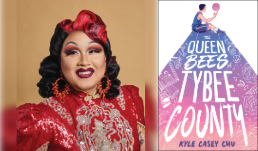
Kyle Casey Chu is the author of The Queen Bees of Tybee County, a Winter/Spring 2025 Indies Introduce young adult selection, and May/June 2025 Kids’ Indie Next List pick.
Kristine Jelstrom-Hamill of Buttonwood Books & Toys in Cohasset, Massachusetts, served on the bookseller panel that selected Chu’s book for Indies Introduce.
She called the book “a truly authentic story with characters who come alive,” and said, “Young readers will recognize their fears, worries, questions, hopes, dreams, confusion, and courage. Kyle Casey Chu does a miraculous job showcasing the importance of equality and open-mindedness, as well as fabrics and sequins and being fierce!”
Chu sat down with Jelstrom-Hamill to discuss her debut title. This is a transcript of their discussion. You can listen to the interview on the ABA podcast, BookED.
Kristine Jelstrom-Hamill: Hi, I am Kristine Jelstrom from Buttonwood Books & Toys in Cohasset, Massachusetts. And I'm very, very excited today to introduce you to Kyle Chu and her debut book, The Queen Bees of Tybee County.
Kyle’s a writer, a filmmaker, and one of the founding Queens of Drag Story Hour. In June of 2022, far-right extremists stormed her Drag Story Hour in an attempt to silence her. She’s now using her global platform to tell even gayer stories. She lives in San Francisco, within nagging distance of her families, both drag and biological. The Queen Bees of Tybee County is her first novel, and it goes on sale April 15.
Kyle Casey Chu: Woo!
KJH: I am so, so excited! I absolutely adored this book. It felt really authentic to me. I thought it really tapped into all the fears, and the dreams, and the hopes, and the worries of kids, especially in this story, a kid that’s on the cusp of learning something about themselves and about their families.
I had a couple of questions. As I say this felt really authentic to me. How much of this authenticity do you think stems from your own childhood?
KCC: Thanks so much for having me here. And also thanks for that illustrious introduction, Kristine. I remember when you called me, I was over the moon. It was such a moment. And I really appreciate that you resonated with the book.
To answer your question about authenticity, I put a great deal of myself into the story. I have a twin brother with autism, and around middle school, he started getting access to a lot of services and that meant I was often in a waiting room with a bunch of adults. I was at Rutgers Center for the Handicapped, playing basketball at a court by myself to pass the time. I had a lot of time to ruminate and develop my own inner world. I think in that time, I was also grappling with a lot of questions around identity: what it meant to be Asian American, what it meant to be queer — I came out very early in seventh grade.
So in order to access this, I immersed myself in that world again. I was looking at pictures of AOL Instant Messenger. I was thinking about those holographic planners that we had, and the Space Makers, and the rolling backpacks, as well as the darkness I felt realizing that I was queer and not knowing what the road ahead looked like for me. When I came out, I lost all my friends, and I had to start anew. And in the early aughts, when racial politics were very different, it was a little more commonplace to make fun of Asian Americans, to advance stereotypes of a perpetual foreigner, or to slant your eyes. These are things that profoundly affected me. It affected how I felt about myself. It affected how I felt I fit into the milieu or not. And what I wanted more than anything was to shine through it and to prove my humanity to the world.
So I started writing. I wrote my first book when I was in seventh grade. It was called Brother’s Ethnicity. I was thinking about race, and it was about finding acceptance with a group of friends. It also helped me process my growing feelings for my best friend, which I think is a very common queer experience. And so writing became a beacon for me in that way, as did performing on stage. I wanted to share that path and kind of illuminate that for kids who might be in the same position today.
KJH: You’re kind of answering one of my other questions. In this book, the relationships between Derek and his father, between his father and his mother, and between the friends — they’re all very real. They’re all very touching. Was this something important that you wanted to express, these relationships and how they can be, how a child can respect a parent and love a parent and vice versa?
KCC: This is such a paradox for me, because my dad is first generation. I'm fourth generation, by way of my mom, and I feel had a very Americanized upbringing. She was the type of mom who cooked steaks but had a side of rice. And as I was grappling with coming to terms with my Asian American identity, with pride, when I had so much feedback that Asian Americanness was shameful or less desirable, or that you're an NPC kind of character who doesn’t have any depth, I was also grappling with the high expectations of my parents.
They wanted me to excel in school. They dressed me up in little Ivy League T-shirts when I was little, because they imagined me shooting for the stars and landing even higher. And I think because my brother was diagnosed with autism, it was as if I had to carry the weight of two kids and excel twice as high. I really resented that growing up, honestly. With my peers, I felt over-programmed. I felt I didn’t have time for spontaneity or for play dates, because I was at swim practice and playing the saxophone and doing all these things to prep myself for college.
Carson, the father in the book, has a similar sort of drive for Derek, and it took me a long time to reconcile that that was coming from a place of love and protection. I know now, looking back, that they were doing their best to prepare me for a future that sometimes is uncertain, and it was one of those hard learned life lessons that I came to appreciate in full circle writing this book.
KJH: I think that really comes through in the book. Were you ever in a pageant as a youth?
KCC: Not as a youth, that would have been so sickening. But I was in a pageant called Mr. Hyphen when I was 21, fresh out of college. It's a social justice pageant for Asian American men — because that's how I identified at the time — doing community service, public service. I competed in drag. That was my talent. I danced around, I did a little choreo, I played the saxophone on stage. It was a grab bag of things. I was like, “And this! And this! And this! The flashiness!” And I won it. I won $1,000 towards an organization that I supported, which is the Center for Asian American Media in San Francisco. They run CAAMFest, which is the world's largest international and National Asian and Asian American Film Festival.
KJH: Awesome.
KCC: Yeah, so I have some experience in that.
KJHL Okay, and — I mention this is coming from somebody who thinks dressing up is jeans and a nice blouse — is that where you learned about fashion and fabric and makeup?
KCC: I learned about fashion, fabric, and makeup from my mom, who has a lot of interests, including sewing in her free time. She actually has a block in her room that says, “She who dies with the most fabric, wins,” which is one of the signs that you find in in the book.
But I actually learned most of what I know from my drag mom, Estée Longah, who is the mother of the Rice Rockettes, which is an all Asian American drag family in San Francisco. It's the longest running in the nation at 15 years. She took me to Kryolan, the makeup place, and told me everything to get. I remember the wonder that I felt, that this area of exploration that I hadn't had access to before, that seemed stigmatized for me, being socialized as a guy, was finally accessible and within reach. Suddenly I had language to talk about it and expertise and could develop this knowledge and it felt sacred. It feels sacred.
KKJH: You talk about — and we mentioned it in your bio — the far-right extremists who stormed your Drag Story Hour. I look at this book as something positive that came out of that experience. I talked with you before, and you said that that's one of the things that prompted you to get down to writing and get this story out. Are there other positive things that you think came from that experience? Is there anything positive from it?
KCC: There were a lot of positive things that came from this. I was already writing this book, when the incident occurred. After it was breathlessly covered by national and international media, I was reliving it so much. It put me in a really dark place and it was hard to hold on to a sense of hope about the future. I think what I really needed was not just to react to this terrible thing, was not just for a community to step in and support me like they did, but also to have some sort of bright, shining, auspicious vision for the future that I could look towards.
That is what this book became for me. It became a place to put all of that. It became a place for me to imagine the things that I would have needed at that time. Chief among them, family support, a social system, a little crew.
I have a social work background, and they say that social support is one of the most critical indicators of a successful transition from childhood to adulthood, of surviving these uncertain times.
And so, in terms of what came out positive, I did a lot of research for this book. I went to Atlanta, I attended a pageant, it was awesome. There were a lot of homemade signs. The barbecue was great. I talked to GSAs. I connected with trans middle schoolers at different stages of transition, and I think we felt a mutual sort of reveling. I was like, “I love that you are living your truth so early, and you have the support that you need to do so.” And they were like, “Maybe I can be an author, because of this person I just met.” I think that kind of impact is something you carry with you. So, on a very simple level, I was able to connect with a lot of people, and continue to do so. And I hope people connect with this story too.
KJH: That’s awesome, and you've answered my final question. I was going to ask you to share something that you hope for your book, for Drag Story Hour, or for yourself. But it sounds like a lot of that hope is right there. What you’re doing right now. That's amazing.
KCC: Thank you. I feel like our stories are important and powerful (as Nicole Kidman would say in AMC theaters). In the face of unrelenting hate — not to make it too political, but — in the face of forces that are trying to wipe us out or trying to create a monolith out of us that is easy to dismiss, all of our voices and all of our stories are unique and, together, they make a chorus that reflects the diversity of our world as it is. That is why your story matters. I don’t care how small it is. I don’t care how common you think it is. You should be voicing it because it is in this fabric of different threads that we can remind ourselves of what the world is, truly, and should be.
KJH: Well, I, for one, am very glad that you wrote this book. Thank you for sharing it with us. I really was moved by it, and so glad I got the chance to talk with you. Thank you for taking the time to talk with us. Congratulations, and I hope everything goes well with all the publicity and publication and the fanfare, it was a genuine pleasure.
KCC: Likewise, you and me both. Thank you so much for picking me, and for calling me, and for taking me on this wild ride. It's been such an adventure.
KJH: Awesome. Thank you.
The Queen Bees of Tybee County by Kyle Casey Chu (Quill Tree Books, 9780063326958, Hardcover Middle Grade Fiction, $18.99) On Sale: 4/15/2025
Find out more about the author at kylecaseychu.com.
ABA member stores are invited to use this interview or any others in our series of Q&As with Indies Introduce debut authors in newsletters and social media and in online and in-store promotions. Please let us know if you do.