Ahmad Saber is the author of Ramin Abbas Has MAJOR Questions, a Winter/Spring 2026 Indies Introduce selection. 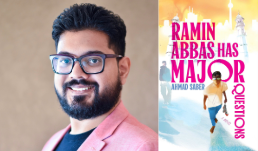
Elisa McIntosh of The Bookstore Plus in Lake Placid, New York, served on the panel that selected Saber's book for Indies Introduce.
“A beautiful (and funny!) story about a young Muslim boy navigating his faith and identity. This story will find its way into your heart like a perfectly-folded origami,” said McIntosh.
Saber sat down with McIntosh to discuss his debut title. This is a transcript of their discussion. You can listen to the interview on the ABA podcast, BookED.
Elisa McIntosh: Hi everyone. My name is Elisa McIntosh. I'm a bookseller at The Bookstore Plus in Lake Placid, New York. I was really excited to be chosen to be on the Indies Introduce Kids panel, and with me today I have Ahmad Saber.
Ahmad Saber is the author of contemporary young adult novels, exploring the themes of discovering identity and belonging. Ramin Abbas Has MAJOR Questions is his debut novel and based on his lived experience as an immigrant and Desi person of color. By day, he’s either working as a rheumatology specialist, or attempting KATSEYE choreo with his niece at home. He lives in British Columbia, Canada.
Ramin Abbas Has MAJOR Questions was one of my favorite picks that I got to read. Even as someone who isn’t Muslim, this book is for everyone. I can't express enough how much I loved this book. It deals with identity, which seems so heavy, but it brings so much joy. I was laughing, I was crying, it gave me all the emotions.
I'm so excited to be able to talk to you Ahmad, so thanks for joining us!
Ahmad Saber: Thank you so much for having me, and thank you so much for that wonderful introduction!
EM: You draw a lot on your personal experience; can you share a little bit about yourself? Ramin was born in Canada, but you personally immigrated at the age of 16. Could you share a little bit about immigrating to Canada from Pakistan?
AS: Yeah, absolutely. The best way I can describe it is high voltage culture shock. My whole concept of the Western world was based on Hollywood movies. Movies like Hard Target and Three Ninjas — they would play them on repeat in our video room break. Once a week, we would get a one-hour video class where they would just play a movie so the teachers could chill out.
So that's all I thought Western culture was, very exaggerated. Movies like The Terminator and The Mask — that's what I thought Canada was going to be like. Coming here, it was somewhat but also nothing like that. Where it really stood out for me was all of the personal freedoms that I suddenly got to enjoy.
It's a huge thing to not have to wear a uniform at school. I show up at school and nobody's wearing uniforms, everybody's in their casual clothes. This ties into the themes of the book a little bit, but there was no gender segregation; boys and girls could not only talk, but I actually saw someone kissing on the first day at school. I thought that only happened in the movies. Hearing students use swear words was another big thing, actually. People were crass with their language, with teachers as well. Students were a lot franker and more open with their teachers. I grew up in a school where there was corporal punishment, so I didn't think you could just joke around with a teacher.
You find yourself in a little bubble floating in this world that’s so different than yours, and you're holding on to all that you know about being 16 and about culture and identity. Floating through high school like that, like a fish out of water, it was an interesting experience. I have a quick story that perfectly encapsulates this tension between wanting to hold on to who you think you are and what the world wants you to be now.
We had a dance class [in school in Canada]. It was unfathomable to have girls and boys dance together in Pakistan, but here we had dance class which was mandatory. My brother got paired with this girl, and he would hold her by the tippy tips of his fingers, because he thought that holding hands was sinful. The PE teacher was like, “Relax, dude, you're not marrying her. You're just dancing.” And it perfectly encapsulates that tension between what you want to hold on to and what the world expects of you. I thought that was a funny thing to experience.
I did become quite a bit more ambitious and driven to succeed in this world where you could really be anything if you worked hard. For a sixteen-year-old, the world was my oyster at that time. In the end, knowing what I know now, it was one of the best things that ever happened to me.
EM: Wow! In the book, Ramin goes to the Muslim school, and it's very much a bubble there. Were you in public school when you came to Canada?
AS: Yes, that's right. I only went to public school, but the story is inspired by more religious schools, which do exist in North America.
EM: So, other than the movies, you guys didn’t have any preparation?
AS: We were poorly and severely under-prepared. The culture shock even began at the airport!
EM: You live in British Columbia now. Did you immigrate there initially? Or did you find your way there eventually?
AS: Yes, British Columbia has been home since I immigrated to Canada.
EM: And you eventually become a doctor. You specialize in rheumatology. Why did you decide to write this novel? What made you set aside that time and just start writing?
AS: That actually came at a very distinct moment, but as you had pointed out, there was already pressure within me, wanting to tell this story, having struggled for a long time with trying to suppress my authentic identity. The story wanted to be told. I actually didn't realize what I wanted to do with all of the pent-up creative energy, whether I wanted to put it into dance or a film script. Then I realized, writing is where it's at, because I was able to actually sit down and start — whereas with other mediums you need equipment and tools.
The moment I knew I wanted to write a novel was actually on the first day of the last year of my medical training. I was sitting at orientation, and there was a rheumatology lecture about drugs and their side effects. I remember sitting there feeling like, “This is important stuff, but I'm feeling so uninspired right now. I am feeling suffocated. Am I at the right place at the right time or do I have more in my life to look forward to?”
I remember thinking, “I'll teach myself all of this later, but right now I need to get out of here.” I literally got out of the orientation, grabbed my laptop, and went to a hall next door, which was fully empty. There was a chair on the side and a chandelier, and I just felt inspired, like “I'm going to write a story.” I started in that moment.
Regarding your question about how to find time to keep writing, I think most authors would relate to this, because all of them starting out have two jobs. They have their day job, and then they have their author dream on the side. I can empathize with everybody who has to find all that time, especially when you get told you have to write every day and all this common writing advice. For me, I am very much a procrastinator, but also a trooper.
Once I knew that I had to do this, even if there were days where I didn't find time, there were days where I would just put a little marathon sprint in. Word sprints helped me a lot. There are some beautiful YouTube channels you know that help authors — I’ll shout out Alexa Donne’s channel — with video springs where you put down a bunch of words on the page.
I knew that I was going to do this, and even if I procrastinated, I would then have these moments where I just sprinted right through and got it done. The real challenge was actually editing. This book has been edited to hell and back.
EM: You’re not the first author I've heard say that, that seems to be the brutal part of it! So how long ago was that day at the conference where you got up and left?
AS: I actually remember the date distinctly. July 17, 2019, was when I got up to go write. I kept working on it, and it took from 2019 to now 2026 for the book to come out. It's a long haul — anybody who wants to do this has to mentally prepare!
EM: Wow, good on you for sticking with it. Well worth it, because, like I've said, I'm obsessed. I've now read it three times. I look forward to reading it more.
Like you said, you knew that you needed a more creative outlet. You talked about dance and I know you are a big musical fan. Ramin’s creative outlet is origami, which I think is so cute. Do you do origami?
AS: I do not know origami at all. In fact, I've never even made a crane or a heart. This is one of the joys of writing is you just get to learn things about the world and about life and about people, and it was just lovely to kind of delve into that.
I've been fascinated with the concept of origami since the days of a video game called Heavy Rain. It was a quite dark murder mystery game, and in that there's a killer called the Origami Killer, who leaves origami at the crime scene. That’s where I first learned about origami. When you actually play that game and learn about the character arcs, you realize that origami is a metaphor for the depth of someone. You have to be a deep soul to appreciate and make origami, with all that sophistication. So that's why I put it into my story.
Fun fact is that actually, in the story, the first drafts had Ramin make real flowers, but that created some plot issues. When I switched to the origami flowers, everything worked plot-wise, but it fit a lot better with his character as well. It became a metaphor for the depth of his soul.
EM: I love that he does have so much depth. There's the cutest scene where Ramin is working on the origami flowers in the art room, and Omar shows up. I love the whole scene, the depth of it, the process of taking the care to actually fold these little pieces of paper, how much skill it takes.
I love that, even though you don't have that personal connection to doing this craft, that you thought about your character so much that you were like, “No, this needs to be his creative outlet.” I feel like he puts so much pressure on himself, between trying to go to med school, wrestling with his culture and his religion and his God, and trying to embrace who he is.
I try to explain to people who have been talking about this book, is that it does sound dire, right? He's dealing with the realization that he's gay while being berated by his religion and his school. He tries to talk to people about being gay, and they're like, “Nope, that's a sin. Cut it out. You can't be that way.”
I love that he has Omar, who comes in and says, “I don't think Allah is like that. I think he's a merciful God. I think he made us who we are.” I love that he brings in this joy. He’s the cutest character. There’s a scene where he giddily skips off. I love your little descriptions of him.
It just brings so much joy to the story, even though you have these heavy topics, which are so important to talk about. Did you have an Omar in your life? Did you find somebody who had that compassion that you're able to see the light in a lot of that darkness?
AS: I really wish I had an Omar. Omar for me encapsulates somebody I wish everybody could experience, gay or straight or whoever. Omar represents the best in humanity. I don't think it's too much to dream about that humanity in people, because we already have so many reasons that try to convince us otherwise, especially in the world that we live in today.
I have an excerpt from my medical office assistant at my medical practice who really wanted to read this book, so I gave her an ARC, and she left a review on Goodreads. I'll read you what she said about Omar, because I think that encapsulates him perfectly.
“There is always someone in the world who knows how you are feeling or similar. I hope this book is a stepping stone to help more people open their minds and be accepting of all human beings. Sometimes hitting rock bottom, and feeling like you have no place to go and nowhere to hide, this is when you'll notice the little light amidst all the darkness. We all need a shining light to guide us, or maybe we all just need an Omar.”
When I read that, I was like, “Oh my God. Like, Ash, you really got the book.” Shout out to Ash, by the way.
EM: Yeah, Ash, come on over to The Bookstore Plus in Lake Placid, you're hired! How perfect is that, though?
That must feel so amazing to know that you put your work out there, and more than one person has already felt that way.
AS: Part of the inspiration was also the fact that there's enough trauma and darkness in the world as it is — especially queer trauma — so why not tell stories of hope and joy? I had to. I needed that for myself as well. Before anybody else, this is a book for my younger self, so that younger Ahmad really does need that story of hope and queer joy.
EM: Some of the best books that I read deal with those heavy topics — that most people can relate to — but they still show you that that's not all it is. There's more to life than that, and there's better things ahead.
What is on the horizon for you? Are you trying to steer away from rheumatology, hoping to write more books? Where do you go from here?
AS: Yeah, that's an excellent question. I have had a mostly positive, overall complicated relationship with medicine. It’s an incredibly rewarding career, and when I think of it from an existential lens, it brings so much meaning. At the same time, the creative element is missing from it. I mean, you don't want your doctor to be creative with your treatments; you don't want your doctor excited. A bored doctor is a good doctor, because they've seen these many times, and you're in good hands.
For me, unfortunately, that’s missing from the career, and for the foreseeable future, I'll have to straddle both. If someone had a magic wand and they could make me a full-time offer to write, I would choose that because that resonates more with me now at this stage in my life. Certainly, that's the hope and the big dream is to write books full time and be fortunate enough to make a living from that.
I know for sure I'm going to keep writing until I run out of stories. Right now, I actually am under contract for the second book — it's not going to be a sequel to this one — but I am in the middle of this dreaded second book syndrome, unfortunately.
I’m actually feeling quite passionate about this next story, it’s going to be about a white family in the heart of conservative America who decide to host a Pakistani foreign exchange student for a year. The government-run student exchange program in the story is now placed on hold and the funding has been withdrawn. The story is about this student, who's a fish out of water, and this family, who hosts him, seeing the world through each other's eyes and ultimately realizing that maybe they are actually more similar than different.
It’s supposed to be an exploration of everything that's wrong with America right now, but also, more importantly, everything that is right with America right now. That's what I'm working on right now.
EM: Oh, that sounds great. If you need a beta reader, let me know! Do you feel like with your characters that you let them take you where they want to go?
AS: Absolutely. I'm a discovery writer. I actually need that in my writing to feel fulfilled. If I know exactly how it's going to unfold, it kind of makes me lose that spark. I know the big touchstones and the overall direction and the premise, and I know some things about character, but the real joy for me comes from actually discovering the characters as I write. Then I rewrite, and then I rewrite, and then I know something else about them.
There is a pain and joy of writing. For me, the pain is worth it. And it's like Stephen King put it in his own writing book: it's like a little fossil, and you're just basically digging around it and seeing what's underneath, and you keep digging and digging and see what you find. That’s where the joy is for me, in writing.
EM: Oh, I love that and I'm so excited. For everyone who's listening, Ramin Abbas Has MAJOR Questions comes out March 3. Everyone needs to buy it. Let's get Ahmad full time writing.
AS: Thank you so much!
Ramin Abbas Has MAJOR Questions by Ahmad Saber (Caitlyn Dlouhy Books, 9781665960694, HC, YA Fiction, $21.99, On Sale: 03/03/26)
You can learn more about this author at saberbooks.ca.
ABA member stores are invited to use this interview or any others in our series of Q&As with Indies Introduce debut authors in newsletters and social media and in online and in-store promotions. Please let us know if you do.