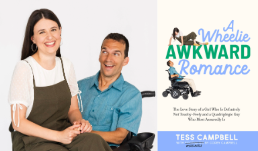
Tess and Corby Campbell are the authors of A Wheelie Awkward Romance: The Love Story of a Girl Who Is Definitely Not Touchy-Feely and a Quadriplegic Guy Who Most Assuredly Is, a Winter/Spring 2026 Indies Introduce selection.
Kristin Pidgeon of Riverstone Books in Pittsburgh, PA, served on the panel that selected Campbell's book for Indies Introduce.
“Tess and Corby’s unconventional romance made me fall in love with falling in love. When Tess tried online dating, she did not expect all of the feelings that arose from her first date with Corby. The idea of falling in love with a man in a wheelchair was difficult for Tess to rationalize. The wholesome honesty and candid account of their romance will give everyone hope that love is worth fighting for!” said Pidgeon.
The Campbells sat down with Pidgeon to discuss their debut title. This is a transcript of their discussion. You can listen to the interview on the ABA podcast, BookED.
Kristin Pidgeon: Hi. I'm Kristin from Riverstone Books in Pittsburgh, Pennsylvania. I'm here with Tess and Corby Campbell for their new book, A Wheelie Awkward Romance.
Tess and Corby wrote this book, but writing isn't usually their thing. They are two ordinary people living their lives — Corby having spent the last twenty years in a wheelchair and Tess having dealt with less outwardly obvious struggles. Corby is a software developer and amateur public speaker on topics such as resilience and gratitude; he even does occasional sit-down comedy gigs! Tess juggles creative projects and side jobs and mostly tries to keep their lives from descending into chaos. They have spent years statistically proving that they are evenly matched at strategic board games. They also play video games, construct Lego sets, and host elaborate murder mystery parties. This list probably makes them sound like nerdy teenagers, but they are, in fact, adults — proven by the fact that someone let them have a Costco membership. They own a house in Utah that is haunted by a sprinkler-system poltergeist.
Tess and Corby, welcome to the podcast!
Corby Campbell: Thank you, hello!
KP: I absolutely loved reading A Wheelie Awkward Romance as part of the Indies Introduce panel. It was one of the first books I read, and I fell in love with it immediately. I would love to know what motivated you to write this account of the early part of your relationship.
Tess Campbell: I met Corby in 2014 on an online dating website. This was right before apps started getting really big, so there wasn't a ton on the internet yet at that time about dating someone in a wheelchair. There were a couple of blogs — there's a lot more stuff now — but back then, I could only find two blogs and they weren't that helpful.
One of them basically talked about everything she couldn't do after getting married, which made me wonder why they got married in the first place. It's like, “Why did you get into this relationship if you hate it so much?” Another was like, “I never saw the wheelchair. It never impacted anything.” And I was like, “That just feels wrong and unrealistic.”
I kept looking for an honest picture of what dating someone in a wheelchair was like, and I couldn't find that, and so I wanted to write that. I didn't start until we got married, and then we ran into a few people who were also looking for that. There've been a couple times in public where random strangers have come up — so far, it’s always been women — and they've asked Corby, “Hey, are you married? Can I talk to your wife? I'm dating someone in a wheelchair, and I want to ask someone what it's like.”
Every time this happened, I was never with Corby and so I've never been able to talk to these people. I wanted to have a book where we could say, “Hey, go and buy this,” or give them a copy.
KP: I love that aspect of the book. You talk about what happened, but at the end, you're like, “We know you have questions and you want to know how this works. Real talk: this is how it works.” I love that.
Another thing I liked about the book is that it's a really great mix of your individual memories, but also the collective memory of how things happened. That's really highlighted with Corby’s “wheelnotes” at the bottom of the pages. What was it like to have access to each other's version of your romance?
CC: It's funny, I've read all sorts of things about how unreliable long-term memory is and how people remember accounts differently, so you'd think there'd be that, but we didn't have any of that really.
One of the reasons the book was even possible was because I had an app on my phone at the time that backed up all my text conversations to Google. When Tess started this project, she went through all of those and compiled them all into a two-thousand-and-three-page document of our text conversations over two and a half years.
In addition to that, she kept a daily journal. She called the document “All's Fair in Love and War” so that it would look like an essay and so no one would read her journal if they got it. Between the journal entries and text message conversations, we had full documentation of the whole era that's covered in this book. It wasn't a big journey to reconcile our memories of the events.
TC: All the text messages and emails in the book are actual ones that happened. Even our dialogue, I pulled from text conversations to get the tone right. Our first date seems more awkward than later in our relationship, because our text messages when we started texting for the first time were just more awkward.
CC: It’s funny because this was ten years ago, so we're slightly different people, if not largely different people. We recorded the audiobook for this, and I would read the sentence of what I said back then, but my brain would try to say it the way I would phrase it now. I'd mess up when trying to record the audio book.
We're just different people now, so it's interesting [that we had this] very accurate documentation of words. That's what made the book possible.
KP: That's cool! Do you still keep all of your text messages?
CC: No, we actually looked. I got a new phone after getting married and you can see the last text message is like, “Hey, I'm going to get the new phone” and we're done.
I didn't even remember I had that app, so it didn't even occur to me to re-download it. It was kind of perfect that I just happened to have it during that era. I don't know why I cared to back up my text messages. It doesn't seem that important. The other thing is that we don't text as often now.
TC: Part of the reason is because we're married. But part of it is because when we were dating, I hated talking. It made me so uncomfortable — you can see that in the book — and so we did most of our relationship building over text for those two years. Now we do it in person. We don't have that written record anymore because we don't need it.
CC: If you look at our text conversation, it's just me being at work and texting her “I love you” most days. So, it’s just like “I love you. I love you. I love you. I love you.”
TC: We had a bigger struggle in the publishing process than we did writing the book, because we are still very, very different people, and it wasn't as evident until we had to do a project together. We were choosing between my preference of giving the book to the ten people who specifically asked for it, who were dating someone in a wheelchair, who I wrote it for, and Corby's personality, which is, “Oh my gosh. I want everyone in the world to read this, and I want to share it with everybody.” That caused so many conflicts.
CC: And great relationship discussions!
KP: Knowing that it's on bookshelves across the country with little shelf talkers saying how amazing it is, how does that feel?
TC: I have been hiding from it.
CC: I'm delighted.
Tess’ original purpose was writing for those dating people in wheelchairs but as she explored it, she discovered a lot about herself. It is really useful and powerful for a generic audience, and not just for people dating someone with a disability. It’s great that it's on those shelves, and I think people will be benefited by it.
KP: I agree, I benefited from reading it! Is there anything that you left out of the book that you wish you could go back and add?
TC: There are a few aspects to this. The first is just the word count. When we published, we had to cut a lot of fun things. I wish that there we could include more fun dates that didn't add to the plot.
CC: She often said while editing, “No one's even going to be rooting for us. They're going to just come away from this book being like, why did you get married?” I have read probably eighty reviews at this point, and no one has said that, by the way.
KP: Did you have anything about these elaborate murder mystery parties? Because that's what I'm really excited to learn about.
TC: No, that’s something I allude to in the epilogue of this book. I started writing this book about Corby and his wheelchair, but because I was writing it, it turned more into a story about my growth. That made me kind of mad, honestly, because that's not what I meant to write. When I met Corby, I could never, ever, ever imagine myself being in a position where I was fine in a big crowd, running a murder mystery party.
In the epilogue it shows the growth, like I started out hiding in the basement, and the epilogue is where I'm running a murder mystery party.
KP: I'm interested in knowing what’s next. Tess, you were such a natural on stage at Winter Institute. What is next for both of you?
TC: I have no idea. It depends on how this book turns out. Corby has been doing amateur motivational speaking. We don't charge for anything that we do. Over the years of us being married, I've started participating more and more in those speaking events.
One thing I can say is that I'm not going to write more, at least not books. If people have specific questions that I can address in blog articles, I'd be open to doing that, but I would never have been able to write this way without the text messages and emails and journal entries that I had.
Dating Corby and choosing to marry Corby was one of the most stressful things I've ever done, and writing about that was almost as stressful. I don't think that I want to touch that for quite a while. This was a really hard project for us to do.
CC: Editing it for a third party was a big struggle. Part of the journey was that we didn't attempt to get published at first. We had a friend who was like, “I heard you were self-publishing. No, I know someone. I'm going to submit it to them.”
TC: She used to plan book release parties years ago. We knew her through church.
CC: She submitted it to the head of the publishing company. He sent this email that essentially said, “When I saw that the title of the book, I was like, ‘Oh, this is sure to be awful, but I'll read it.’”
TC: At the time, the working title of the book was, My Husband Is Lame. That's partly why he thought that. Because I was just writing this for fun, and I was like, my husband is lame.
CC: He was like, “Oh, the title is poor, certainly the book will be poor,” and he found himself drawn in. The fact that we got published at all has been a big surprise. It's been a fun surprise for me and a stressful surprise for Tess at times, but, yeah, taking it on again anytime soon? Probably not.
KP: I think the most beautiful part of the book is that it really feels, as you're reading it, like we're best friends. I don't know if that's because it's so honest or so raw, but it really does feel like, “Okay, these are my two best friends, and they're going out on a date, and they hung out in the parking lot of Texas Roadhouse.”
CC: It surprises me because a lot of the reviews say they love how honest and raw it is. It’s a memoir, what does everyone else write in their memoirs, if not their actual thoughts?
TC: I don't know how else to write. Everyone that we know is like, “It sounds like you” and I'm like, “What were you expecting?”
KP: What do you hope readers take away from your story?
TC: This is another thing that grew out of writing this. I was targeting people dating someone with a physical disability — if you want to know about quadriplegics and catheters and bowel care and whatever that's in the book — but it grew into stuff that I struggled with, which is invisible disabilities. I have a lot of things that I struggle with, and one of the hardest things about being married to Corby is some of the random comments we get, where people are like, “Oh my gosh, I could have never married someone in a wheelchair. I don't know how you guys do it.” I'm like, “You’re looking at us and making a bunch of assumptions based on what Corby looks like.”
If we had to rank things in our marriage that are hard, the wheelchair wouldn't make the top five most of the time. It's stuff that we're dealing with in other aspects of our life, or with my things, or just life in general. The very last chapter in the book is called “Everyone is Lame” because everyone does have at least one thing, if not five or seven or ten things, they're dealing with at any given point. You shouldn't look at people and make assumptions based on what you can see.
Corby worked through the whole book with my things while I was working through his things. There's also a lot about relationships in there and how you can learn how to communicate better.
One thing I’d want readers to take away is that not all relationships look like Hallmark. It took me two years to move on and accept Corby. Some people might be like, “Oh my gosh, that took so long.” That’s the time I needed. It's okay that I had so many questions, and it's okay that I had so many doubts and fears. It didn’t make our relationship not work out. It ended up being fine. It just didn't look like the standard media relationship.
CC: That really covers it. Just the phrase: everyone is lame. We worked through our stuff, but you know, I feel like getting in a wheelchair so you can drive around is much easier to solve than crippling depression, or a spouse that lives away from home three out of four weeks a month, or addictions, or toxic family members. There are all sorts of challenges that are not at all obvious when you look at somebody.
Yes, we have some challenges, and some of those are invisible ones, but so does everyone. I hope people are motivated to take on their own challenges and work with the people in their lives. Everyone is lame but you can all work through it if you tackle it.
TC: Some people have said, “Oh, you shouldn't have given up dancing to marry Corby. You shouldn't have given up those things that you loved.” The implication is that you shouldn't change for somebody else.
One of the biggest things that I personally took away, both from both dating Corby but also through publishing, is that even when you're an adult, you can still grow. You can still change a ton for the better and for the worse. But this book, hopefully, is for the better.
I've changed a lot in the past two years just doing this, and I feel like I changed a lot in the book. It was really painful and really exhausting and really awful at some points, but looking back now, I can see the growth.
KP: I love that it can be personal to each individual reader, but there is a larger message about hope and change and resilience.
Thank you so much for speaking with me today. It was really wonderful to have you on this podcast. I'm so glad that we had time to do this!
CC: Thank you.
TC: Thanks, Kristin.
A Wheelie Awkward Romance: The Love Story of a Girl Who Is Definitely Not Touchy-Feely and a Quadriplegic Guy Who Most Assuredly Is by Tess Campbell with Corby Campbell
(Shadow Mountain, 9781639934690, HC, Memoir, $27.99, On Sale: 03/03/26)
You can learn more about this author at wheelieawkward.com.
ABA member stores are invited to use this interview or any others in our series of Q&As with Indies Introduce debut authors in newsletters and social media and in online and in-store promotions. Please let us know if you do.