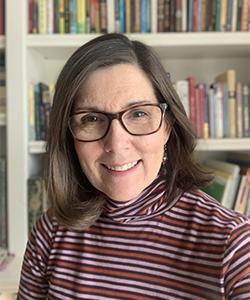
Now that Winter Institute 2026 has ended, the annual Board election is underway, and the annual report and Annual Meeting and Community Forum are on the horizon, Bookselling This Week sat down with ABA Board President Cynthia Compton to hear about her first year as president and what the Board’s been working on.
Bookselling This Week: Do you feel that there has been an overarching theme or a word describes your first year as president?
Cynthia Compton: Definitely our focus on community.
I'm going to talk about this for two straight years — I repeated the word “community” several times in the online Community Forum last year after the Annual Meeting, and have said it over and over since then at every opportunity. If I had a mission for ABA during this period of our history, it is that we focus on community between booksellers.
As booksellers and businesses, we are continually confronted, battered, challenged, and forced to deal with a wide variety of outside influences — some of which are sinister, some of which are just the challenges of the market, and some of which are the rapid changes of technology and how they impact our work. Because of that, bookselling, more than at any other time in our history, is forced to continually evaluate and adapt.
I say that with a full acknowledgement of our history and the people that went before us, because I know that they adapted to a million things too. Right now, though, most days feel like standing under Niagara Falls with a bucket.
And bookselling, particularly owning a bookstore, even though it's a very community-based space, is a very isolated job.
You alone as an owner (or perhaps with your partner), are confronted with a million quandaries for your business and you might not have a peer colleague within your company that you can hash that out with.
But we have each other. Nobody understands our exhaustion and our successes like other booksellers.
One of the things that ABA provides is a set of very structured ways that we can get together to talk and build relationships, but also a permanent passport that allows us to reach out to anybody else in the membership. If you see something about their store in Shelf Awareness or PW, or you hear about something they're doing from another bookseller, you can jump right in and connect. Just based on the fact that you are a fellow ABA member, they are your colleagues.
That community, we need to shout about it more. We need to build it up more, we need to celebrate it more, we need to lean into it more, and we need to use the strength of it to face the external challenges we have.
So, community is going to be my answer.
It's going to be my answer for this first year. It's going to be my answer for next year. It's always going to be what I think about as my priority within this organization.
BTW: Winter Institute — for everybody, but definitely for a Board member — is one of our best opportunities to really talk to other members.
How are you feeling after this Winter Institute, having had so many conversations with members from all over the country?
CC: In spite of the fact that a number of people had weather related travel challenges getting there, I loved the physical location — both Pittsburgh and the downtown setting that we were in.
This convention center and this Institute’s schedule provided more opportunity for hallway conversation than any Institute I can remember. There were gaps between sessions to facilitate those conversations, and we weren't running from one end of the world to the other to get to the next event.
There was actually time to stop and have a conversation, and I just felt like that really supported connection and community.
From a Board perspective, we expanded our physical office hours, and people are accustomed to us having that table. It is becoming an expected part of the event.
I met colleagues in elevators and buffet lines who specifically said, “Okay, I'm coming over to talk to the Board at this time on Wednesday. That's the time I've set aside to talk to you.” I appreciate that so much. It’s a tough schedule, and members found a way to prioritize those conversations.
I wish that we could grow our online Board Office Hours to that same level of attendance, but we'll work on that. That's part of the community theme of the next year.
One of the things that I kept hearing is how much booksellers crave talking to each other. They want to be able to check in and share what’s happening in their community. They want to hear if other booksellers are facing the same issues.
It’s a physical check-in, but also an emotional check-in. The validation that comes with being around a group of people who are facing the same challenges is huge. I could see people's shoulders physically relaxing in conversation, when they felt seen and understood.
That piece strikes me over and over, but also, just the absolute resilience of booksellers. I am astounded at what our members do every year — this year in particular — and how much they can do while still having the capacity to support other people who are going through challenges.
There were times that we were in large meeting groups when you could physically feel the sense of support. I am so encouraged by that spirit, and I take such strength from it each time we gather.
BTW: What is something that the Board has worked on this past year that you are proud of or that you have noticed members benefiting from?
CC: As you know, the Board’s role is very much in setting and monitoring Ends Policies, not in means — the day-to-day operations of ABA.
One of the things I think the Board has done well this year is help to educate ABA members about the difference between ends and means, and what the Board does versus what the ABA staff does.
The reason we're able to do that is because the ABA staff is so competent. Information is powerful, and information constantly flows out from the ABA team. You can see their activity, they’re transparent: “This is what we're working on. This is what we're doing. Give us feedback on this.”
If you read BTW, check BookWeb, or attend any online Open House or focus group, you can hear the culture of curiosity and genuine caring for members.
Because of good conversations with members, we’ve been more comfortable talking about how we work and I think the membership has a better handle on the Ends Policies and their role. (I am particularly pleased that we added the value of reading to our Ends Policies last year.)
And finally, the process of joining the ABA Board or committees. There's always been this invisibility about how members are nominated or invited onto the Board and other committees.
It's been a bit of a mystery to the average member. How does this happen? How does somebody get on the Board? What's the secret handshake?
The Board has established a Pipeline Committee, whose role is to share information about Board service, and to identify members who are interested in future service on Board committees or the Board of Directors. This permanent committee, which includes a Board member and several general members with different regional and leadership experience, is charged with year round outreach. Their efforts will be crucial in developing a diverse pool of candidates, both for succession planning and to assist us in identifying new members who bring needed expertise.
The Board, both in establishing the pipeline committee, and through conversations about the representation and the kind of diversity that we need on our Board — diversity in identity, but also in region, size of store, and experience — has recognized the ongoing work of reflecting changes in our membership. We see the need to continuously work at representing our changing membership base.
I'm proud of the people that have stepped up, looked at who's on the Board, and said, “I want to work with them.” I want to create a welcoming, transparent process for Board service so that a bunch more people are raising their hands and saying, “I can add value to that.”
BTW: So, let’s consider the opposite. What are some of the challenges ABA is facing?
CC: Member outreach and community. Our strengths can also be our challenges.
Our membership is highly hands-on. We have more members than I can ever remember who are newer to the businesses, or who run smaller businesses, that often don't have anybody else to get help from. Their outreach to ABA is more frequent, and problems are more immediate. And we're all facing challenges that we've never faced before as an industry, in addition to all the usual challenges, so it seems that we all have more reasons to call.
I also want to emphasize and improve member connection with the Board. I already mentioned that we host regular Board Office hours, but we also have a Board e-mail address that people can email to share experiences and needs with the Board that help us define the Ends Policies for the association. I check that email account ([email protected]) regularly.
Working on creating that awareness and building that into a relationship is a goal for the next year.
Which all comes back to my original theme of community, right?
BTW: Given that the theme here has been community, and transparency, and getting people on the Board and committee, is there more you’d like to say about getting people involved with ABA?
CC: Everything I have ever attended or been involved with in ABA, in terms of volunteer time or effort, has been multiplied by 10 in terms of what I’ve gotten back — both as a person and as a business owner.
The opportunity to have relationships with peers, who are infinitely smarter than me, who have faced problems that I am just now beginning to diagnose — it’s of immeasurable value. The opportunity to use those colleagues and professionals as both sounding boards and advisors is an immense gift.
So, when people talk about contributing to ABA, I'm always thinking, “You're being offered an outlet to plug in your power cord and literally recharge your entire business. Plug in!”
This is such an amazing, sharing community — and I belong to other professional organizations that, while valuable, are not nearly as collaborative as ABA.
Take that opportunity to join a network within a network by joining a panel, a committee, the Board of Directors, a task force, or contributing to some small part of something we're doing. Those kinds of connections, again, in an industry that is incredibly isolating, are really hard to describe. They’re invaluable.
If you want more from this organization, come inside. If you need more, come inside. If you don't think you need more, come inside, because somebody else does.
BTW: Is there anything else that you’d like to take this opportunity to tell our members?
CC: Come to the online Community Forum on May 28.
This is an opportunity for you to share the challenges your store is facing, what kind of support stores need from ABA, and thoughts about the future of bookselling — all things that help inform the Board’s review of the ABA Ends Policies.