Clíodhna O'Sullivan is the author of Her Hidden Fire, a Winter/Spring 2026 Indies Introduce selection. 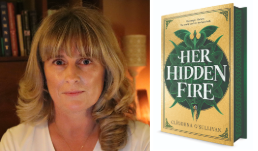
Jenny Chou of Boswell Book Company in Milwaukee, Wisconsin, served on the panel that selected Campbell's book for Indies Introduce.
“In Clíodhna O'Sullivan’s YA romantasy debut, Éadha is a servant whose unexpected magical talent thrusts her into a patriarchal world of the wealthy and influential at an academy of magic. Dazzling, Irish-inspired worldbuilding and a meaningful look at what it means to be powerful make Her Hidden Fire an unforgettable read,” said Chou.
O'Sullivan sat down with Chou to discuss her debut title. This is a transcript of their discussion. You can listen to the interview on the ABA podcast, BookED.
Jenny Chou: Hello everyone. I'm Jenny from Boswell Book Company located in Milwaukee, Wisconsin, and I'm so pleased to be here today with Clíodhna O'Sullivan, who is speaking to us from Ireland. Clíodhna O’Sullivan is a writer based in County Louth, Ireland. She works as a legal counsel and plays in a band, Molasha (you can find them on Spotify!). She's married with three children, as well as far too many cats and a dog.
Now Clíodhna, can you pronounce your name correctly for us and the name of the county that you're located in?
Clíodhna O'Sullivan: Yeah, it was perfect! Irish names are weird, because they started off as being names in Irish that then, because we were part of the British Empire, they anglicized the Irish names. It totally makes sense that people can't pronounce them because they have this really weird way of having come into existence.
JC: Speaking of Ireland, how did Irish mythology inspire your worldbuilding in your book?
CO: Her Hidden Fire is a fantasy, absolutely. The Irishness runs through. I was very much inspired by the Irish language and the landscapes and myths and so on in coming up with the world. For example, many of the names in the book are based on old Irish, which is called Ogham. It’s this ancient language that was done in hieroglyphics; you can still find standing stones all around Ireland now that are thousands of years old, that have Ogham script on them.
We did put the glossary at the start of the book, we don't expect people to be fluent in Old Irish. For example, they live in Ailm’s Keep, but “Ailm” as a word, is actually the letter “A” in Ogham, and it's also associated with the Scots Pine because it's a tree-based language. Similarly, Beith, her name comes from the from Ogham for the letter “B”, and it's the birch tree. Each of the central characters has a name that's taken from Ogham, and it's also associated with a letter and a tree and so on.
I thought it was quite nice that there's a sense of authenticity and a depth to it. A huge part of fantasy is the world — being able to immerse yourself in the world — and it's easier to immerse yourself in a fantasy world if it feels fantastical but also authentic, and as if it has a real depth to it, and as if there's a real love to it. For me, I used Irish landscapes, because they do have a real depth in the sense that they're coming from something that's thousands of years old.
The places in the story are also based mostly on real places in Ireland. When the characters go to the magic academy, called the Masters House, and it's on the island of Lambay. The Masters House is actually based on a real castle in North Dublin on the east coast of Ireland, called Ardgillan Castle. It’s a place I go to a lot because it's really beautiful, and it's this amazing setting. The Irish Sea is behind it, and it's surrounded by forests, and it's really beautiful, but it's also slightly scary and forbidding. You can completely imagine Masters keeping secrets from their students while they're there. I took this castle and I transplanted it to a real island off the coast of Ireland called Lambay, just to raise the stakes for the central character a little bit more.
Another example would be, I grew up looking at the Blackstairs Mountains in Ireland. I thought Blackstairs was the coolest name for a mountain range, especially if you want it to sound a bit scary. The book is made very much of Irish language and Irish landscapes because they're things that I already knew and love. I hoped that sense of wonder and affection would come through on the page, so the reader could really get into the world; it would feel fantastical, but also a little bit real.
JC: You did a wonderful job of bringing the setting to life in the book. It’s wonderful that I can actually go and visit. So many times, you read a fantasy novel and you think, “Oh, I would love to see this place.” Well, in your book, I really can go and take a look for myself! I look forward to doing that someday.
How would you describe the dynamic between your two main characters, Éadha and Ionáin?
CO: I grew up fairly poor and isolated in rural Ireland, and there were no kids that were my age. My main job was looking after my youngest sister, who is ten years younger than me. During the summer, I wouldn't see another teenager for weeks on end. Literally, the only guy I would see was it was a guy whose father used to own cattle in the field up above us. He would send his son, who was about my age, up to drive the cattle down the road, and that would be the highlight of my day. I would be hanging out at the gate and just going, “Hello, how are you?” as he went past and he’d go, “How are you?” That was it. That was my exciting social interaction with another teenager for the day.
When I sat down to write Her Hidden Fire, it was complete wish fulfillment for the main character. She also grows up somewhere rural and isolated away from the rest of the world, but she would have a best friend — someone to be with her and do everything with, and that would eventually grow into realizing that maybe they feel a little bit more for each other.
In terms of the relationship itself, I tried to show a relationship that is genuine — that they do really care about each other — but is put under a lot of strain when each of them starts making decisions.
Éadha discovers that she has a magical gift to channel power, but it's Ionáin who is the person who desperately needs to have that gift. He's the last heir of a failing noble family. If he doesn't have the gift, his family is going to lose everything. In the first chapter, at his really big, very public moment of reckoning, she gives him her power; she gives up her opportunity to be a star and gives it to him instead, because she thinks he needs it more.
That's a huge sacrifice that she's made, and it's the thing that changes her fate, and his fate, and the fate of their whole world. For the first time in their lives since they were tiny kids together, she's introduced a lie or a secret into their relationship, and of course, that's going to change the dynamic. As the book goes on, she suffers for that secret, because he's being celebrated as this golden boy who's amazingly gifted and talented, and she's been treated as a nobody who has no real gift and who can be bullied. She's the only one who knows that, she's the powerful one.
It's not his fault, but she still feels a little bit of anger towards him, because she's having to suffer so much because of the sacrifice. She’s carrying the burden of that sacrifice, and it's poisoning her relationship with the guy she loves because she's resenting him, even though it's not his fault because she didn't tell him. You're asking yourself the question, “Can you ever have a healthy relationship with someone if it's based on a lie?” She’s seventeen, of course she's not thinking these things through. Obviously, I'm a little bit older, so I’m going, “Are you going to tell him that he's not gifted? Then what happens, when you've made a lie out of his life and who he thinks he is?”
There’s stuff that she does that — unintentionally and with the best will in the world — puts a big strain on their relationship as well as on her. Similarly, he goes to a very fancy Academy where he's being treated as this golden prince, and it starts to look as though he's had his head completely turned by that. Everybody wants to marry him, and there's huge pressure on him from his parents to make a good match. Because she's a servant girl, she's definitely not a good match. It starts to look as though he’s gotten swept up in that, and he's not looking out for her.
It’s more nuanced in the sense that, because he's very much a classic son of a noble family who understands you have to play the game, but it doesn't mean you mean it. It just means that you make the right alliances, you make the right friends, you smile when you're supposed to smile. That's all stuff that he's really good at, because he's been trained to do that because he's from a noble family, where she hasn't so she can't understand why he is being like this.
It’s interesting, taking a really strong relationship and then putting it under massive strain where they're not talking to each other enough and not accepting what the other person needs.
JC: And the whole time the reader knows about the lie. The whole time we're reading and under so much tension as to what's going to happen when and if he finds out. It was brilliantly done.
CO: It's funny, because when I look at some of the reviews they're going, “I was screaming at the page at her for being so stupid. Why didn't you do this? Why did she do that?” But to be fair, when you're writing the story, that's what you're trying to do; you're trying to ratchet it up. Each time, she is put in these situations where she could use her power to get out of it, and she could use her power to be celebrated and treated like the Golden One. Each time, the test is will her loyalty to protecting Ionáin hold?
JC: She had valid reasons for doing what she did.
CO: She did and it was absolutely done with the best of intentions, but sometimes you can do something with the best of intentions but it still doesn’t work out. That's something that gets explored quite a bit in Book Two.
JC: What draws you to romantasy both as a writer and as a reader?
CO: I can very much remember where it began. My dad is an alcoholic, and back in the day in Ireland divorce wasn't allowed, so my parents were stuck together. They fought a lot and there was a lot of conflict in the house, so books were my outlet. Back then, it was more split as a category: you had romance books and you had fantasy books, but they were the two genres that I read.
Part of it is when you get to be a teenager, you want to understand how love works. Partly because I'm autistic, I feel like I don't instinctively get how things work with people, so I tend to study people as if I'm an anthropologist. What draws me to reading things like romance or romantasy novels is trying to understand love because, as a kid, I saw the bad version. I wanted to read about how love can really work and how transformative it can really be.
Romantasy is a beautiful way to do that because usually it's done in the context of big stakes in the world as well. That’s how romance works in real life.
I’ve been with my husband thirty years now, and we've been through so much. Real romance happens while big things in the real world are also happening. I love that romantasy is not only romance. The romance is happening, and it's very intense, but it's always happening in the context of the real world getting in the way, which is what real life is like.
JC: Who was the most challenging character to write?
CO: It's not the character's fault, but Gry was actually the one I found the hardest to get right, because I had two issues.
Number one, I was against love triangles. I thought, “I am not doing a love triangle. I'm doing childhood friends to lovers, and she will have a chum, who is called Gry, who she will meet at the college and who will be useful for providing information when she gets there. But that's it, he's just a friend.” Then friends of mine or my husband would read early drafts and go, “Hey, I'm Team Gry. I really like him.” I was like, “No, there's no love triangle!”
Another part of it was the fact that I didn't have a lot of dialogue in the early drafts of my book. When I was younger, I was bullied an awful lot for saying the wrong thing, having no filter, or being too direct. Ireland, in particular, very much works by silences and secrets and not talking; it's very much about how you have to know automatically what not to say. I don't have that ability and I'm very aware of it. I got bullied very severely in secondary school. I came away kind of convinced that I wasn't any good at human interaction.
In the early drafts of the book, Gry was just a chum, and the characters were barely talking to each other. I sent the manuscript for review, and the reviewer was very nice. She said, “It's a lovely book, but you really do need to get people to care for your character. They do need to talk to each other a bit.” I had to get over my own self-sabotage and lack of faith in my ability to write intense, relationship-type conversations.
I realized that the reason people were drawn to Gry was because he was doing something different. There was a really nice review put it really well, where it said, “It's not just about her choosing who to kiss, it's about her choosing who she wants to be.” I thought that was a really nice way of putting it.
In fantasy, that's heightened, because this is her coming into her power. The relationship between her and Ionáin as kids is that he's the one who has the destiny, and she's just a servant, whereas now she's become someone who has power and the potential to change the world. Ionáin and the people who know her from home are probably the last people who are going to see that, because they have their very set idea of who she is. Gry meets her on the island and actually sees who she's becoming because he sees who she is now and actually sees the potential in her. The attraction between them is very different, because their power is drawn to each other. He represents that challenge, like, “Well, what are you going to do about it? How do you want to use it to make a difference in the world?”
The love triangle is love versus power and stability versus challenge, and ultimately, who does she want to be? So that is what made writing Gry difficult.
JC: I see exactly what you mean. He's an easy character to like, and I thought it was interesting that he doesn't have the same background with her that the rest of the characters do, so he can love her from where she is right now and moving forward.
Part of what makes Her Hidden Fire such an unforgettable read is the way that you examine what it means to be powerful. Some characters crave power for its own sake, others desperately need it to feel safe, and still others use it reluctantly. What drew you to explore power in the world that you're created?
CO: As I mentioned earlier, things were tight at home as a kid, because my dad was an alcoholic and he was addicted to gambling. I was your classic eldest daughter of an alcoholic. I took on a lot of responsibilities, and I also tried to be perfect.
I got the maximum score in my exams in Ireland, and I had a place to study medicine in college, but I couldn't go because my father's gambling debts were so high. So I was at home, I was sixteen, I couldn't go to college even though I had the place and the points — which is weirdly an echo of Éadha. I had this very coveted thing of magic, this power, but then I chose not to use it, because my mom had said the only way I could go to college would be if she went to money lenders because of my dad's debts.
It was really hard to come by job, so I was lying about my age, working as a fruit picker and a factory worker and a cleaner and a waitress and a singer to try and make enough money to go to college. While working these jobs I was seeing how there's so much exploitation, and that the people who do the exploiting get to be the big man around town. It’s just this old trope of paying young, vulnerable people like me under the table.
Why were some people so prepared to exploit other people when other people have no interest in that at all? Because there were also people who were really good to me at that time and who helped me find jobs. They’re the givers of this world.
That was the seed of the idea for Her Hidden Fire. Sometimes you write books because you're trying to answer a question you don't know the answer to yourself. I was seventeen, asking myself, “Where do I fit in all this?” I always thought, “I'm going to create this fantasy world which takes what is a real issue in our world, and really amps it up.”
The magic system in Her Hidden Fire is based on exploitation and drawing the life force out of people. Then the central character, Éadha, is someone like me going, “Where do I fit in this?” The central question when I set out to write the book was, can a giver ever win out in a world that's run by takers? Because the whole point of takers is that they're because they're willing to exploit people and use them as resources to use up. That was my experience.
She is the giver in this world of takers, and the takers are very powerful because they can draw on the strengths of many people to puff themselves up. She just has her own heart. The question I was asking is, is there a way a giver — the nurses and the firefighters and the teachers in our world — can prevail against the masters?
If you're in a world that's run by takers, and that only celebrates exploitation, what she's done with Ionáin at the very start, without realizing it, is something incredibly subversive. She makes a sacrifice. As the book goes on, you realize that she's someone they absolutely loathe and she's walking herself into a lot of danger.
JC: While I was reading, I was thinking about the parallels between the power dynamic and structure in your book and our real world.
CO: That was something that was really important to me. Love is the thing that saves you in a very difficult world.
JC: When I am thinking about how to handsell this book to teens, teens are at a place in their life where they're looking for their people.
Then it's also a book that would definitely appeal to adults because of the way that the power dynamics are structured, we can see the parallels to what's going on in our world right now. This is a great book to handsell to both teens and adults.
CO: Thank you very much.
JC: Many of us are asking that question, “How do we survive in the world right now?” Thank you so much for being with me today and having this conversation.
CO: Thank you so much to you and then to Indies Introduce as well. As a debut author, you're starting from zero so I'm just so grateful for any help finding readers.
JC: You're very welcome.
Her Hidden Fire by Clíodhna O'Sullivan (Viking Books for Young Readers, 9798217040506, HC, YA Romantasy, $22.99, On Sale: 03/03/2026)
You can find this author on Instagram @cliodhna.osullivan.
ABA member stores are invited to use this interview or any others in our series of Q&As with Indies Introduce debut authors in newsletters and social media and in online and in-store promotions. Please let us know if you do.