Georgina Chadderton is the author of Oh Brother, a Winter/Spring 2026 Indies Introduce selection. 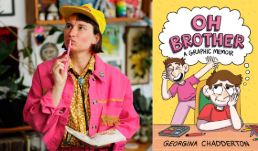
Katie Orphan of Orphan Books in Los Angeles, California, served on the panel that selected Chadderton's book for Indies Introduce.
“This is a great graphic novel memoir about growing up with a high support needs sibling. It doesn’t shy away from the hard aspects of that situation, and depicts them in a matter of fact and love-filled way. The author’s art and approach to her story draw readers in from the very first page, making it hard to put down once it’s been started,” said Orphan.
Chadderton sat down with Orphan to discuss their debut title. This is a transcript of their discussion. You can listen to the interview on the ABA podcast, BookED.
Katie Orphan: Thank you for joining us today. My name is Katie Orphan, and I am all the things at Orphan Books in Los Angeles, California. I'm in conversation today with Georgina Chadderton. She is an Australian cartoonist. Her work has been featured in outlets including The Nib and Voiceworks Magazine. They are a cofounder of Papercuts Comics Festival, an independent annual celebration of graphic novels held in Adelaide. When they're not drawing, Georgina enjoys eating pizza and playing roller derby. And, as I have just learned, Georgina is a former bookseller themselves in a number of themselves in a number of venues, so I am excited to their perspective on having a debut book as a former bookseller herself.
I get to be here as a member of the most recent Indies Introduce panel for young readers. Oh Brother was one of my very favorite books from this season. There is a lot to love about this book. It’s a graphic memoir and the art itself is delightful and charming. It is accessible, and I hope people understand what I mean when I describe it as friendly. I look at the art and I'm like, “Oh yeah, no. I feel comforted by looking at it.”
It's about some really important subject matter. It's about Georgina's adolescence, growing up with her brother Rob, who — as we would describe it here in America — has high support needs autism, and what that looked like for her family, and what a pivotal time in their life specifically looked like, such as the start of high school, the wonderful changes that puberty brings, a new home, and all of the challenges of adjusting, especially for anyone who is unfamiliar with the neurodivergent difficulties in transitions. All of those things bring their own special challenges. The way that Georgina writes about their family, their childhood — as I have described it previously, it doesn't shy away from some of the difficult parts — but the amount of love they have for their brother shines through in everything.
I'm really excited to get to be talking today with Georgina! Thank you so much for being here.
Georgina Chadderton: Thanks for having me. I'm excited to talk to you about the book, and thank you for so many nice things.
KO: It's funny, because in this book, you have both a lovely introduction to the reader, as well as some really charming after-matter where you talk about your process and your family, but I still have questions about your process and your family.
GC: I could have definitely done another book that is just about the process and family.
KO: Perfect, we'll cover some of that ground today during our time together. Was there a specific moment or incident that led to you wanting to write this book?
GC: I don't know if there was a specific moment. It was a collection of events, like growing up and not seeing my experience and my brother reflected in media of any type, whether it was a book or a TV show or a movie. The closest thing that we had was Rain Man and I Am Sam, which are obviously very specific examples. Even though my brother has what people would actually associate with fairly poster child autism, in some ways, he still wasn’t actually reflected in either of those two movies.
There wasn't really anything set in Australia as well. Those two movies are American, so it was the combination of not seeing my experience, and not seeing my environment. Both of those things were fairly instrumental in why I wrote the book.
There were lots of little things that led to it; no specific thing. It was just something inside me that I wanted to share and connect and make for other siblings, young people, and even older people. It took ten years to write.
KO: In writing a memoir, and in writing Oh Brother specifically, were there new things that you realized about yourself? Either who you are now, or looking back at your adolescence and seeing things you hadn't noticed before?
GC: The big headline fact is that I also got my own autism diagnosis while I was working on the book. When I was 32, I was diagnosed as autistic as well — obviously very different from my brother. I followed up the diagnosis because it gave me permission to be autistic.
Working on the book, and working with young people and seeing them go, “Oh, that's kind of what I was like as a kid” encouraged me. It’s similar to my own queer and gender identity, like, “Oh, I have terms now for what I didn't have as a young person.” From the point of view of how it affected the book, I tried to focus on me and my childhood. I didn't say in the story that I'm autistic or that I'm genderqueer or any of these things, because that's not what I had the terms for at the time. I wanted to keep it as time accurate as possible.
I also didn't want siblings who don't have a diagnosis to feel like they couldn't have a sibling book. There are still lots of people that have a sibling that has different and more complex support needs, but it's still good to see similarities. Obviously, my experience is its own thing, it's not everyone's experience. Hopefully we'll get more and more people writing and sharing their stories.
As a kid, I was always like, “Oh, every time someone describes Rob's autistic traits, that's kind of how I feel. But I'm obviously not Rob. I can communicate using words which my brother cannot.” Rob is nonverbal or non-speaking, so he uses sounds and echolalia. They might sound like words, but they don’t necessarily mean the same thing to him. It's all about vibes. When you spend more time with him, you understand those vibes a bit better.
The communication differences seem to be the main thing, but we both have certain sensory things, particularly around clothing and material. We both love watching things over and over again. But because of how I can mask and present, I can push myself to not have to do those things, whereas Rob can't. Masking can be to the detriment of my mental health, but it's getting better now, so there's a positive end.
Even though I didn't have that in the book, I wanted to make sure it was in the back of the book, to make it clear that this is a thing that I'm happy about and it's good. In my next memoir, I want to delve into more about the queer and gender identity elements of my teen life, and the “who am I?” stuff which was sort of hinted at in this one.
KO: Since you are writing about your family, what has their response been?
GC: I'm very lucky that, as my parents are presented in the book, that's what they're like. They're very lovely and very supportive and are just nice humans.
My dad is a retired doctor and is very into science. He has aphantasia, so he can't visualize anything. Both mum and dad love problem-solving, but they do it in slightly different ways. Mum loves sharing things with people, she loves — I believe the term is pebbling — finding little things and gifting it to you. She loves making sure there's no waste as well. They're both very good at making sure we can reuse things as much as possible. Mum is craft, Dad is woodwork and tech, that’s their split, but both like figuring out things, which was very useful for Rob.
They figured out how to make a really hardy iPad case, because he got so excited, he'd often bend the iPad.
Mum similarly figured out how to make clothes that are comfy for Rob. Particularly when he was younger, he found it hard to keep clothes on just because they weren't comfortable. But there are certain situations when you leave the house, when it's not acceptable to be naked. So, she’d make fun onesies for him to wear, which were reasonably comfortable and in fun colors, like his favorite colors pink.
That’s what my parents are like. They were very supportive. I made sure that they read early versions, particularly once they were in the comic stage. I'd ask them to read it and make sure they were comfortable with what words I put in their mouth.
I interviewed both of them at the early stages to see their point of view of what it was to have Rob and me. It was really interesting talking to them and reflecting on what it would have been like for them. That was a really interesting process and they've definitely been involved. They tell all their friends about it and make sure everyone's reading it, which is very nice.
Obviously, a lot of people ask me how Rob thinks about the book. If you read the book, you'll probably realize that he can't tell me that.
One lovely story — in classic little brother fashion — is that I got a few author copies before Christmas last year. We were showing him and his support workers. Rob looks over and takes one of them, and he puts it under his arm, like, no one's getting this. Which is great, it’s a high compliment. Apparently, he does get it out and flip through it, which is lovely. But of course, he stole my copy because he is my younger brother and it's the most little brother thing you can do.
We don’t know if he can recognize himself in them, because obviously the pictures are cartoony. I'm just glad that he likes it enough to keep it in his space.
KO: Yeah. Him taking your copy like that does fit very well with some of the story.
GC: It really does.
KO: Like his unerring ability to find your stash of candy. Yep, peak little brother.
GC: It’s because he loves me, right? Your younger siblings always want to be like you, because they think you're cool. Let's go with that.
KO: What has the reception to your book been like in Australia specifically?
GC: Just a little sidebar: generally, I've been surprised at how many people from the US have been contacting me. There's been teachers and there's been parents, through emails or Instagram. That's really lovely.
When it was initially picked up, there was a lot of concern around it not being relatable because I really wanted it set in Australia. One of the suggestions was, “Can you make it more general, or maybe set in the US?” And I was like, “No, I can't write about the US. I've never been there, and it's not my life.”
There were a few changes that were suggested, particularly to make it easier for international audiences, because it got picked up by the US, Canada, UK, and Australia at the same time, which I now know is quite uncommon. Working with lots of different editors at the same time to make sure the book fits in their slightly different markets was interesting.
In general, the reception has been really good. My partner, Owen, who very kindly did all of my lettering for the book, has been vetting the reviews.
It’s been really lovely. The highlights for me have been my friends reaching out, who maybe don't have the specific experience of growing up with someone like Rob, but have connected to it because one of their friends was like me or they can connect to some of the hints at gender and awkwardness.
It's really great having people ask questions, which is what I really wanted from the book. I want people to be able to connect to it if they've got that experience, but also if they don't. I want them to feel more comfortable asking and talking about it, because I think people are concerned about talking about disability because they find it scary. I can understand that for sure, but let's talk about it, because that's how it gets better. It's not a bad thing. It's just a different thing that we need to make sure we learn about. Empathy. It's a good thing. We should all be more empathetic, right?
KO: We should.
GC: A highlight was a young reader at an early launch event. At the start, I was like, “Oh, has anyone read the book yet?” assuming maybe one or two, but everyone raised their hand. I said, “Oh, that's actually quite good. Well done, everyone. Has anyone read it more than once?” Then this kid was like, “Yes, I read it three times!”
They came up and showed me their copy of the book. You know when a kid loves a book, you can see it? That was really lovely, being able to see the love in the book and then sign it and stamp it. I made myself a little author stamp so I can officially sign all the books.
KO: Oh, I love that. That part is especially fun, getting to interact with readers. And to already have a reader who is that excited about your work, that's magical.
GC: I feel very privileged to be in a position to have a book so widely published and to be able to connect with these young people because I know how important that would have been to me as a young person.
My partner always tells me that I never emphasize that the book is funny. So apparently, it's funny. I wanted it to be funny, but humor doesn’t always necessarily land.
KO: I didn't realize Oh Brother was picked up for all four countries at the same time. Were there any other things that had to be adjusted between the four different countries?
GC: Between Australia and the US, there are two main additions. The UK, for some reason, despite using the same spelling as us, have used the US edition.
They did different printing, so the four different editions are all slightly different — different paper stocks, different cover colors, and tag lines. There are some footnotes in the US edition to help explain things that aren't necessarily in the Australian edition, so when I use terms like “op shop,” there's a little note saying, “a thrift shop.” Some words changed: mine was “sandpit,” and it got changed to “sandbox.”
One that I did not let anyone change was Vegemite. If you've read the book, you'll notice how prominent Vegemite is in the book. For those who don't know what Vegemite is, it’s a — delicious to me, disgusting to others — black, salty paste that you put on toast with butter.
That was the one of the big changes that they wanted to push for in the US book. They were like, “Can we make it peanut butter?” and I was like, “No!” Not only because it wasn't accurate, but also because I would have to redraw everything. I pushed for that one and managed to get that through.
I did lose something. I'm in Adelaide, South Australia. We are the only state in Australia where coke is outsold by an iced coffee. Because of the age of the character and how, in the US, kids don’t drink iced coffee, it had to be taken out. I replaced that with milkshakes, so every time you see a milkshake in the book, it's actually an iced coffee. Fun fact.
KO: No shade to any editors, but I feel like they are underestimating the number of American kids who are familiar with Australian things at this point. There's a whole generation of children who say certain things with an Australian accent thanks to the power of Bluey. The kids are hip with Australia.
This is a book that can be read and enjoyed by anyone, but I think there's a special place for it for people who grew up in families that look similar to yours, or who grew up in close proximity to them. This does a lot of great empathy-building for people, and this is the kind of book that hopefully will help young people feel seen and not alone in their own experience, or will help them to see and understand people who are in their lives.
You did a great job, it’s important work, and it's just visually delightful as well.
GC: I really appreciated, right at the start, that you talked about it being accessible to read. That was something that was a big consideration for how I wrote and created this comic. I make a lot of comics and I read a lot of comics, and people often like to do wacky things with the medium, which is great. It's very interesting, but it's not necessarily easy to read.
I wanted people who have never read a comic to pick it up and go, “I can read this. This is not hard to read,” because I wanted it to be as accessible to as many people as possible. Obviously, it's written in English, and fingers crossed, it will get picked up for translation in other languages. But even if it's not, I hope that the visuals and art can help break some of those barriers as well. It's just such a great medium for building empathy, because you've got that instant visual hit as well as the context with some speech.
You can play around. I don't think I could have represented my brother in any other medium. When you read the book, you'll notice that everyone else has my font handwriting, whereas Rob is all hand drawn. I drew all of Rob's speech to represent how it is different from how we communicate. I really wanted to emphasize that communication and sound difference. In other mediums, how do you get those sounds across? In a comic, you can get it across quite naturally. It's part of comics language.
KO: For whatever reason, I had not really thought about the way that a visual medium works best to represent someone who is nonverbal, and the way that Rob expresses himself. I can't imagine another way that you could have done it nearly as effectively.
Thank you so much for your time, for this conversation, for writing Oh Brother and for sharing it with the world. It was such a pleasure to get to talk with you.
GC: Thank you so much for having me and for such interesting questions as well. I often get fairly similar questions, so it was really nice thinking about different things about the book, particularly from a bookseller point of view. As an ex-bookseller, it's like, “Ah, this is interesting information. I wish I knew this about books that I was selling at the time!”
Oh Brother by Georgina Chadderton (Random House Graphic, 9780593488270/9780593488263, HC/PB, MG Graphic Memoir, $21.99/$14.99, On Sale: 02/10/2026)
You can learn more about this author at georgerexcomics.com.
ABA member stores are invited to use this interview or any others in our series of Q&As with Indies Introduce debut authors in newsletters and social media and in online and in-store promotions. Please let us know if you do.