Sandy Bigna is the author of Little Bones, a Winter/Spring 2026 Indies Introduce selection. 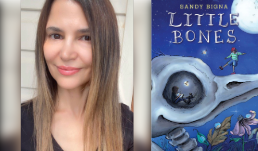
Sydne Conant of Ink Cap Books in Stoughton, Wisconsin, served on the panel that selected Bigna's book for Indies Introduce.
“While other middle grade books definitely touch on grief, this one is unique in its delivery in verse. With a small amount of words, Bigna paints a gorgeous world where friendship, healing, and a little magic can flourish,” said Conant.
Bigna sat down with Conant to discuss this debut title. This is a transcript of their discussion. You can listen to the interview on the ABA podcast, BookED.
Sydne Conant: Hello! This is Sydne Conant from Ink Cap Books in Stoughton, Wisconsin. I'm here today with Sandy Bigna. She is a writer of children’s stories, a former children’s librarian, and a mum of three from Canberra, Australia. She is also a passionate advocate for children’s books and literacy and reviews kid’s books on her social media accounts Her writing has been shortlisted for awards and published in anthologies. We’re here to talk about her debut book Little Bones, a novel in verse for middle grade readers, and one of my favorite books this year.
Welcome Sandy!
Sandy Bigna: Thank you so much for having me!
SC: I really got into your book, even though novels and verse haven't historically been my favorite. What I really loved about it was that you captured a lot of feeling and meaning and different subjects — friendship and grief and being yourself — and you did it all in really beautiful, spare prose. Thank you for putting that out into the world.
I listed all of your accomplishments and accreditations here, which gives you a really good perspective to tell us what you think are the key ingredients to a great story for kids.
SB: Thank you so much for that lovely introduction. I did work for quite some time as a children's librarian, and I also review quite a lot of books on my social media platform. There are so many ingredients that go into making a great story for kids. The answer can also vary depending on your focus. For example, when I worked as a children's librarian doing story time with young children, I looked for books which offered ingredients that would make a successful read aloud experience — books with short, expressive sentences, use of humor and anticipation and really eye-catching illustration.
What makes a good middle grade read is my area of interest. I read a lot of middle grade books to review on my social media, and I obviously love writing in this space. I would say the best children's stories in this space have a compelling plot. Obviously, you want it to be a plot that hooks the reader in from the beginning, and you can't put that book down. Another important thing, from my perspective, is well drawn and non-cliched characters. Characters written with depth, written with heart, these are the sort of characters that young readers are going to identify with and then empathize with. Young readers like to be challenged when they read, and they like to see new perspectives on things. Stories that make young readers think about things or see things in a new way are really going to stand out.
From a book reviewing perspective, I'm particularly drawn to stories that have a really unique and compelling voice that's distinct to that particular author. When I read a story that has this voice, it hooks me in straight away. A strong voice helps the reader empathize with the characters and it makes the story memorable, at least for me.
When I was writing Little Bones, for example, the voice of Bones came to me so clearly. It was almost speaking directly to me and I was transcribing her voice onto the page. It felt like a dream-like process. Voice is one of the things that I particularly look for, along with beautiful use of language and beautiful description, that can elevate a story from good to brilliant.
SC: That's why I loved this book. In a small amount of words, you really painted gorgeous pictures for readers. Especially in talking about Bones and her character, and how you not only related her feelings, but her place in the world. She's like, “You might think I'm weird, and maybe I am,” and she does do things that are not conventionally normal, but most kids have those moments in their life where they do something that's weird because that's what they love, or that's what they relate to, that's how they see themselves. Bones was a very relatable character.
SB: I love that she didn't want to change herself for anyone, even though she was getting picked on. She embraced her unique self, which is an important message for kids. You don't have to change yourself to try to fit in, just embrace who you are and you'll find your people.
SC: I love how that tied in with being yourself and finding the people who allow you to be yourself. You can find friends like that. This also relates to grief too. You said that kids like to be challenged, and grief is a topic that comes up a lot in middle grade books because children experience grief, but don't always have the words to express it.
This leads me to the magic in your book. It made me remember times when my niece and nephews got old enough to say they didn’t believe in magic and how heartbreaking that was. But I remember as a kid, wanting to make magic or have magic — to experience it.
Do you think that kids do experience magic? Is it something adults forget or is it something that imagination gets the credit for?
SB: I love this question, because when I was a kid, I desperately wanted to experience magic. My sister and I were the sort of kids who thought that our toys might come alive when we left the room. We'd set them all up, and then we'd creep out of the room and look around the corner to see if we could catch them in the act of moving and talking. We thought they had these whole other lives that went on when we weren't there, and sadly, we never did catch them in the act, but sometimes one would be in a slightly different position, and maybe…
I do love the concept that perhaps we do experience magic as children, and then as we grow older, we either forget about the experiences or we try to explain them with logic and science.
But if we look at just the wonders of the world around us, so much of it is magical, even from the perspective of an adult. Take something as basic as the way a chameleon changes color, and here in Western Australia, we have a lake that is this gorgeous, vibrant shade of bubblegum pink. From my perspective, I think, “Gosh, that would make a beautiful setting for a magical story.” I know there are scientific explanations for these things, but to me, these things are just magical.
This is the way my mind is always ticking away, looking for the magic in things, even as an adult. I also think that our imaginations can create much of the magic in our lives, particularly when we're children. A child's imagination is so strong. A lot of children create imaginary friends for themselves and these friends become real in their own mind, just through the sheer power of their imagination. This can actually be quite helpful for some children in helping them cope with stressful situations. You can get a lot of comfort from magic and imagination.
In my own writing, I love to capture that power of a child’s imagination and blend it with magic and keep the reader guessing, in a way, as to whether the magic is real or if it is the product of the child's powerful imagination.
The magic in fiction does need to serve a purpose. It can't be completely random. In Little Bones, the magical elements serve to highlight Bones’ journey from isolation to connection. Bird is symbolic of Bones longing for reconnection with her brother. Children who do utilize the power of their imaginations can develop a strong sense of empathy, because they can imagine what it might be like to walk in the shoes of another person. Story, of course, is so important for this reason, because it offers a glimpse into what it might feel like to experience certain issues or family situations that are different to their own experience.
I absolutely think that children who are encouraged to dream and play and ask, “What if?” often grow up to be storytellers themselves, creating these magical, imaginative tales for others to enjoy as well.
SC: I love that you brought up empathy because I feel like that's such an important message to encourage people and children to read books. Books are just such a perfect way for children and adults to learn about things that they either never experienced or have experienced and don't have language to express it.
This is the kind of book that kids would relate to, but as an adult, I related to it as well. So, it's something that kids could read with their parents or share with their friends, and it's not just limited to a children's book.
SB: It's great to hear because I hoped that it could be enjoyed as much by adults as kids. It could be read aloud in a classroom, or read with a parent or carer with the child. A lot of adults have come back to me and said they've read it themselves and shed a tear and got quite invested in the characters and in Bones’ journey. It's really lovely to hear you confirm that as well.
SC: Absolutely. I also loved the connection to the natural world and all of the different descriptions you gave about going out to the tree and into the swamp and being close to the ground and seeing all of the little things. It gave this overall message of noticing.
SB: As adults, we tend to forget to notice things; we're not looking down and digging in the dirt with sticks. It was such a lovely experience to delve back into that childlike wonder of discovering all the small little things in the ground and insects and bones and shells and leaves and feathers.
I've actually started my own little collection again as an adult, inspired by my own character's journey collecting little things like that. I've got a little bird skull that sits on my desk. There's a lot to be found in the magic of nature.
SC: A lot of adults, especially in the state of the world right now, are looking for the little things to appreciate and notice the beauty in. Hopefully adults pick up this book too and find some sort of escape in it as well.
One of my other questions was about when you think we lose our ability to be as succinct as we are as children. This is a good book for adults to come back around to the noticing.
SB: When we get older, we become a bit more verbose, and perhaps lose that ability to get quickly to the heart of things.
That's why I love listening to the conversations that kids have. As adults, we often say that kids have no filter like that's a bad thing, but in fact, that's the beauty of having a conversation with a child. They don't waste words. They're often quite honest and say what they mean.
That's why I'm so drawn to the reading and the writing of verse novels. While verse novels have all the characteristics of conventional prose — they've got plot development and a narrative arc and character development — they're written as a series of connected verses, most often in free verse.
I just love the spare lyricism of them, and the way they can cover really emotional and powerful topics in such few words. The spare format means that they are really suited to capturing that succinct voice of a child. There's no capacity with a verse novel to waste words. Every word on the page needs to have a purpose. There's no space for long, flowery descriptions or long conversations. Everything has to be stripped away, and you've really got to reveal that little shining seed at the heart of the emotion that you're trying to express.
That’s the beauty of verse novels: their capacity to explore challenging topics such as grief, loss, fractured friendships, and bullying, in a really spare and lyrical way that makes that topic seem a bit less confronting than in a traditional prose narrative. Perhaps this is because verse novels lean on the use of symbolism and metaphor, with lots of white space on the page, which helps ease the reader into the topic. I often say that reading verse novels is quite similar to looking at song lyrics. They've got the same energy and musicality and flow and rhythm.
For kids who enjoy music and song lyrics, verse novels are definitely something I would recommend them picking up.
SC: It's a great way to get reluctant readers to pick it up, because it's not intimidating. Do your kids have a sense of magic about them still?
SB: I think they still do. The oldest is turning fourteen soon, so probably less so, but I do tell him not to ruin the magic for my youngest, who is nine. The nine-year-old is at the cusp, he has one foot in magic, one foot in the real world. I know he still wants to believe in magic. Even if his rational mind is telling him these things can't be true, he still has that longing to believe in magic and hold on to it.
It's such a source of comfort, so I encourage it as much as possible. The day that he stops believing in magic will be a very sad one for me. My twelve-year-old has moved towards the fourteen-year-old a bit more. I sometimes still see it in his eyes; he's still looking for the magic in the small things as well. I encourage them to hold on to it as much as possible, for myself as much as for them. I love it.
SC: Thank you for keeping the magic in the world. I'm really happy the American market can experience Little Bones. Do you plan on writing more books?
SB: I absolutely do. The problem is whittling down the ideas. I have so many ideas that the challenge is choosing which one to work on at any given time. I've been working on two new ones. Why work on just one?
The one I'm currently focusing on is another verse novel. It has some strong environmental themes, exploring the connection of all living things and the fragility of the ecosystem, but also looking at those beautiful themes, again, of friendship and family and the power of community working together to enact change.
Of course, there's a sprinkling of magic. All my stories at this point need to have that sprinkling of magic, like fairy dust sprinkled around the plot and the narrative.
I'm looking forward to sharing that one hopefully soon with my publisher and go from there. More to come!
SC: Sounds perfect, I can’t wait. Thank you so much for talking with me today. Thank you so much for putting Little Bones out into the world and continuing to write more of your magical writing. I look forward to seeing everything else that comes out from you and hopefully it's all very successful for you!
SB: Oh, thank you. It's been so much fun chatting with you, and thanks so much for having me!
Little Bones by Sandy Bigna (Simon & Schuster Books for Young Readers, 9781665985086, HC, MG Fiction, $17.99, On Sale: 04/07/26)
ABA member stores are invited to use this interview or any others in our series of Q&As with Indies Introduce debut authors in newsletters and social media and in online and in-store promotions. Please let us know if you do.