Heba Al-Wasity is the author of Weavingshaw, a Winter/Spring 2026 Indies Introduce selection. 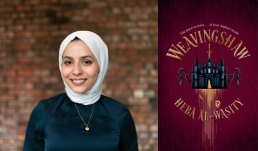
Haley Calvin of The Novel Neighbor in St. Louis, Missouri, served on the panel that selected Al-Wasity's book for Indies Introduce.
“This book is literally the luxurious gothic fantasy of my dreams; words cannot describe how hauntingly beautiful it is! Balancing colonial commentaries, a crumbling entombed estate, and splashes of magic and romance, one girl will do whatever it takes to save her family. Heba Al-Wasity crafted a masterpiece that had me ready to spill my own secrets to uncover the mysteries woven within Weavingshaw and once this book has you, I think you will too!” said Calvin.
Al-Wasity sat down with Calvin to discuss this debut title. This is a transcript of their discussion. You can listen to the interview on the ABA podcast, BookED.
Haley Calvin: Hello everybody, welcome back to the show. My name is Haley, I am the Assistant Director of Events for The Novel Neighbor here in St. Louis, Missouri, and I'm super excited to get to interview one of our Indies Introduce authors for the Winter/Spring 2026 season, Heba Al-Wasity, for her book, Weavingshaw.
If you don't know about the Indies Introduce experience, I would love to tell you about it. It is truly one of the best bookselling experiences; you get to work with other booksellers to pick the best debut novels for the next season. It is so amazing, so lovely.
I was so excited that I got to read Weavingshaw as one of the debut manuscripts. This one was one of my top picks, so this feels extra special. The book is this delicious Gothic fantasy romance that is genuinely so, so good. If you have people that love a romantic fantasy, who love general romantasy, this is the book for them.
I'm super excited to get to introduce to you guys to Heba. Heba Al-Wasity was inspired to write by her own experiences of being born an Iraqi refugee in Libya, growing up in Canada, and attending medical school in the UK. She has worked in emergency care and most recently in primary care, gaining firsthand insight into the ways that poverty and deprivation can lead to social inequalities. She currently lives with her husband near Manchester, England, just close enough to the moors to set her imagination alight. Welcome, Heba!
Heba Al-Wasity: Thanks so much for having me! I'm so excited to be here.
HC: This is really a dream come true. Your manuscript was one of the first ones that I read, and it was one that I had to push for people to finish, because it’s long. I'm so glad that everyone trusted me enough to keep going and keep pushing, because I genuinely am obsessed with it.
Weavingshaw is so beautiful in terms of the writing and the imagery. What inspirations did you draw from when you wrote the book?
HA: The idea first came to me when I was a teenager. I have two older sisters. My eldest sister, her name is May, she was inspired by Mary Shelley and Lord Byron. She gave us a prompt to write our own books. She was like, “Write about a building that has a soul.”
I had the idea for Weavingshaw, but I never thought about writing it because life got very busy. I went to university and I graduated early during COVID, so I was forced to work the wards during the worst crisis in modern medical history.
It was really depressing. It was really hard on me. I got really depressed during that time, and I also developed insomnia. I'd come home and I couldn't sleep, because in my head, I would just be hearing the beeps and thinking about all the patients I've seen. The only way to be able to pass the time into my next shift was to write, so I wrote as a way of therapy.
I did not think it was very good, so I did not think I was going to get published. I wrote just to help me through the things I was seeing. My experience on the ward and seeing a lot of people dying directly influenced Leena, who can see ghosts.
I live in Northern England as well. I live near the moors, like Brontë country, that also very much influenced me as well.
HC: I can totally see that. First of all, thank you for working in the public health realm. I cannot imagine going through that, especially during COVID. I fear I would collapse, so thank you.
I think that's so interesting. That feels like a good inspiration, but since it's a fantasy world, did you have to do any research going into it? What did that research process look like for you?
HA: At first, I thought it was going to be a historical novel, so I had prepared for it to be set post-Industrial Revolution, Victorian, like proper historical novel. Then I realized I didn't have time to do any research. I was like, “Oh, I'll just make it a fantasy novel, that's so much easier.” And of course it wasn't!
HC: Probably not.
HA: Definitely not! And I'm dyslexic, so at that point, I barely even knew how to use a comma. I got a bunch of grammar books. I had to learn how to use a comma, a semicolon, everything.
HC: That's dedication, because I still don't know the difference between a colon and a semicolon as someone who studied English.
HA: Neither do I! I'm shivering every time I use one, like, “Is this right? Is this not right?”
HC: Punctuation will be the death of me. I'm a really big fan of the Oxford comma, but apparently there are people out there that despise the Oxford comma.
HA: I read that! Whenever I put an Oxford comma, my copy editors always take it out. I'm like, “Am I right? Am I wrong? I don't know!”
HC: I think you're right. I'm fully convinced that an Oxford comma is the correct grammatical comma. You heard it here first, you guys, the Oxford comma is canon.
You mentioned that you wanted it to be a historical novel at first, did you base it off of the Industrial Revolution? Was there anything else in history that you wanted to draw upon?
HA: The French Revolution. You know, the lower class trying to rise up against the ruling class. I based that a lot on the French Revolution, especially because England, at the time, was really scared the same thing might happen in their land.
The aristocrats were trying to do everything they can to keep everyone happy, so that they didn't rise up. That inspired how I built my country, in which the ruling class wants to starve out any signs of revolution.
HC: Your magic system is so digestible in the sense that the reader touches on it super easily at the top — it's just that Leena sees ghosts. But as we go through the story of Weavingshaw, more and more gets unlocked to you as the reader.
How did you develop your magic system, specifically through the eyes of Leena, as she's discovering more and more of this Gothic world that she is now a part of?
HA: That's such a good question. My sister, May, is my first reader. She's also really mean, so she'll tell me exactly what I need to change.
HC: As sisters do.
HA: Exactly. She'll read line by line, like, “Oh, that's not very good. That's not very good. Change this, change that.” But everything she says is actually true. Her main thing is that magical symptom systems must follow rules, and must be logical as well. You can't just have magic for the sake of magic. There has to be rules to it.
She really enforced that, and I really had her voice in my head every time when I was writing. I wanted the system I was writing to follow its own rules and regulations, for it to have grounding in this world.
HC: That's so cool that your sister was actually your first editor.
HA: Oh my, she still is. She's still just as mean.
HC: I love that for you. It really paid off, because your book is so beautiful. You blend so many things together — story, characters, atmosphere, the magic system — into this Gothic atmosphere. How did you weave all of those different things together?
HA: When I went into the book, I had a goal. There's three main characters. One is Leena, one is Silas, and the third is Weavingshaw itself. I wanted to make Weavingshaw as fully faceted and as multi-layered as all the other characters, and I wanted that atmosphere to be a thread through the entire book.
I actually didn't know I was writing a Gothic novel at first. It was only when I sent to agents and they started saying, “Oh, this very Gothic” that I realized. So, I went back and I rewrote it. I threw in all the Gothic metaphors and Gothic themes that I absolutely loved. I had so much fun just throwing like all I could into the story.
HC: I feel like we've lost the art of a Gothic novel. The Brontës did it best. You live in the best area to write a Gothic novel, like your bio says.
You've really hit the heart of what a Gothic novel is, especially in modern times. As we are in modern times, we do have to talk about romantic fantasy versus romantasy, and how this genre specifically has been shaped by the internet. Because there is a difference between romantasy and romantic fantasy.
How do you feel like the current state of both of these genres affected Weavingshaw? How do you think you've expanded this really popular subgenre within the fantasy space?
HA: First of all, I'm really excited that romance and romantic fantasy is getting the popularity and love it deserves. I feel like just ten years ago, no one was taking it seriously. If you were a woman and you were writing anything romantic, it automatically became chick-lit. I love chick lit, but that's not really what it is. You weren’t taken seriously.
In this day and age, we've shown that it’s not only a good business move to publish a lot of romantic fantasy, but that that's what people want. We get so many cool authors doing cool things in the genre.
I thought I was writing a romantasy, and then my agent was like, “No, you’re not. You’re writing a romantic fantasy.”
HC: It’s distinct! If you go into something thinking that it's a romantic fantasy, and it ends up being a romantasy, it's such a different reading experience.
The current state of the internet is back and forth between the two, and as you know, as a writer and as a bookseller, we're able to differentiate that. It's just so interesting seeing how the book community treats both of these genres, and how they kind of go hand in hand.
HA: The way I see it, romantasy is propelled by the characters falling in love with each other, but in romantic fantasy, it's the plot that propels them and then those characters happen to fall in love with each other as they go along. Both are so good.
One of the basic aspects of all books is character development, how characters relate to another, and a very basic facet of that is love. How both genres explore that is so beautiful. I love the genres so much.
HC: Me too! I love to say that I am The Novel Neighbor’s number one Romantasy reader.
I knew that this book was going to hit for me. Even if you are a romantic reader, or if you're only a romantic fantasy reader, it has such crossover appeal.
I love a little love story when there's stakes, and this feels like so many stakes in this book.
HA: It gets even worse in the second book.
HC: That's what I was going to say! You left us on such a cliffhanger that I need to know if my girl is going to make it out okay! It’s going to be a trilogy, right?
HA: It is.
HC: Phenomenal. What has the process been writing your debut novel and going into writing your sequel then?
HA: I was very lucky. I wrote my second book while still in edits for my first book, so there's a lot of foreshadowing in my first book that ties in directly to the second and third because I had that time to write it all out. There's a lot of very small things, like insignificant things, that you see in the first book that become really big in the second book. I'm excited for everyone to read it.
HC: Can you tell us anything about the sequel yet? Or are we still under wraps?
HA: We're still under wraps, but it’s going to be slightly devastating in some ways. There's a big secret that comes out. I feel a bit mean doing it, I won’t lie.
HC: So that means the third book is going to taste so much sweeter when we get it!
HA Hopefully, yeah!
HC: Oh my god, I'm truly so excited! Thank you so much for taking time with us today. I had so much fun. Weavingshaw is already out for you guys to buy, stock in your stores, and sell it to everyone. You can trust me as a fellow bookseller, this is my favorite book, and you can put that as a stamp of approval.
Everyone, thanks you for tuning in and reading! Heba, thank you so much for taking time out of your day and joining us.
HA: No, thank you, it’s been so fun!
Weavingshaw by Heba Al-Wasity (Del Rey, 9780593982570, HC, Fantasy, $30.00, On Sale: 2/24/26)
You can learn more about this author on Instagram.
ABA member stores are invited to use this interview or any others in our series of Q&As with Indies Introduce debut authors in newsletters and social media and in online and in-store promotions. Please let us know if you do.