Soraya Bouazzaoui is the author of Aicha, a Winter/Spring 2026 Indies Introduce selection. 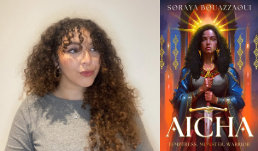
Cassie Goodwin of Loudmouth Books in Indianapolis, Indiana, served on the panel that selected Bouazzaoui's book for Indies Introduce.
“Soraya Bouazzaoui brings a refreshing new voice to fantasy with a bold and timely retelling of the mythical figure Aicha. This electric debut is a page-turning glimpse into the people behind a resistance, and the depravity of colonization. Overflowing with love and feminine rage, this is an ode to the strength, resilience, and bravery of those who dare to resist occupation,” said Goodwin.
Bouazzaoui sat down with Goodwin to discuss this debut title. This is a transcript of their discussion. You can listen to the interview on the ABA podcast, BookED.
Cassie Goodwin: Hello, I am Cassie Goodwin from Loudmouth books in Indianapolis, Indiana, and I'm here today with Soraya Bouazzaoui. She is a born and bred London babes raised on Jacqueline Wilson, R. L. Stine, and Malorie Blackman. Stories — in all their forms — are a central part of who she is. Soraya’s day job is book editing, and she has also written for publications such as Stylist, Bad Form, Strategist UK, Metro and Aurelia. A lover of contemporary, commercial, SFF, horror and YA fiction, her head is full of nonsense and daydreams, but she likes it that way.
Soraya, welcome! I'm so happy to have you here today to chat about your wonderful book.
Soraya Bouazzaoui: Thank you. I'm really excited to be here. Thank you to all the other indie booksellers who have been so incredibly supportive of this book in the States.
CG: Oh absolutely. During this process of Indies Introduce, your book was one of the first ones I picked up and started. We're assigned a certain number of pages to read, and then you take a break and you make notes. I couldn't stop. I finished the entire thing in two days. I'm very happy to talk about it with you today.
SB: Thank you so much for reading it so quick.
It's such a short book, I'm really glad when people say they read it really quickly, because if somebody's like, “Oh yeah, it took me a while to read,” I'm like, “Oh my god, it must have been so fucking boring if it took you ages to get through it.” I'm really happy to hear that.
CG: I mean, maybe if you can't handle the emotional damage, I could see that.
SB: Someone had written a lovely review, but her review was so funny because she was like, “It took me two months to read this, not because it was slow, but I knew the damage that was coming, so I tried to prolong it as much as possible by just not reading it.” And I was like, “That's totally fair. Protect your peace babe.”
CG: That's valid. The first thing that stood out to me while I was reading Aicha was that, for most of the story, we're just following regular, everyday human beings. Even though this is a fantasy and a myth retelling, most of the story is focused on our characters being human, without magic, just living their day-to-day life.
Even with this siege that is coming up in the story, we see the characters living daily life. They go to work, they have jobs, they have chores, they have relationships, they're falling in love, and they're still fighting for their freedom. Was that a deliberate choice for you to humanize Aicha’s story in that way?
SB: Yes, it was a deliberate choice. The myth is very, very short. It's orally passed down from generations, so when you do research online, for instance, of Aisha Qandicha, it has less than a two-hundred-word synopsis. When I started building the story, I was like, “Okay, it’s going to be short no matter what.” Outside of who she becomes, you don’t know her origins; you don't know much about her family, you don't know much about who she was in a very intimate way.
For me, I was like, “If this is going to happen in a short time span, how can I raise the stakes so that the reader is emotionally connected to where this is going and where it's building?” Because it's a story of resistance and rebellion, you can't just care about one person. You can't just care about Aicha. You have to care about her community. You have to care about her homeland. You have to care about the infrastructure that's been built around them, that continues to oppress them. You have to care about all these tiny little things in a short space of time.
I always wanted to focus on her family, particularly her relationships with her sister and her father and the immediate community surrounding her — her neighbors, the market barterers, and things like that.
I hope it's interesting to see the tedious intricacies of what life is like for an entire community, not just one individual person, so that you completely understand what's at stake for them in terms of going against their occupier.
CG: That makes so much sense, because that's one of the reasons I connected with the book so strongly. We could actually see who these characters were.
The familial relationships were so well done. They were loving, but they also encompass the intricacies of dynamics of siblings being older and younger, and parents and their hopes and dreams for you and wanting to be your own person. That really makes it easy for readers to connect and understand these characters. It brings them to life.
SB: I'm so glad it came through.
CG: We talk about humanizing the characters and understanding why Aicha has this really strong reaction. One of the questions that we keep coming back to is how far she would go for her family, for the freedom of her people, for the freedom of her land.
You did a really good job of exploring this gray, nebulous area of, “What do I have to do to liberate my people? Where is the line that turns me into a monster, or is there a line?” Why did you think that was something important for her to reckon with in the story?
SB: This is such a good question. Aicha is twenty-years-old when the book begins, so it's something she's grown up with. Pretty much as soon as her brain starts developing, she has to grapple with this moral dilemma: is killing someone for the sake of my freedom okay?
Separate from what my opinion is, if she was immediately like, “Yes, and anyone can get it,” you wouldn't really connect with her. You have to see the community, and her family, and her home. You have to connect with all those external aspects of the story in order to fully connect with her journey and understand that grappling. Though I'd say, even at the beginning, Aicha has very little sympathy for her occupiers.
It's not necessarily a huge moral dilemma for her, but it's something that she wonders about more in the context of how it affects her people. When we talk about the blockades, and the siege, and how the first people to be affected by them are her people, at one point she's like, “Maybe this is my limit, when it hurts my own people.”
Outside of that, I found it really bizarre that when you look at historical context — and in particular, the Algerian War of Independence, South African Apartheid, and, of course, the Palestinian liberation against the Israeli apartheid regime — you see the pattern of people who are pro-armed force, pro-armed resistance, and pro-violence as resistance, history sanitizes it often.
One thing that drives me absolutely fucking insane is when people use Nelson Mandela as a voice of reason and peace and against using violence. I'm like, “Did you actually read anything about that man? He took his people to Algeria to go and train to become armed resistors.” It's such an interesting conversation to me, because so many people talk about armed resistance as if the people who partake in armed resistance are completely void of empathy and they're not.
One thing you consistently see — throughout the Algerian War of Independence, throughout Morocco's history of independence against oppressors, throughout Palestinians’ fight for Palestinians, and throughout the South African Apartheid — is that every person who has turned to armed resistance has at first wanted a more peaceful avenue. They've tried to appeal to the sympathies of their oppressor. They've tried to use peaceful protests or negotiations, and it's always ended quite viciously for them. Violence has always been seen as a last resort.
No account I've ever read has documented someone who's been quite unapologetic about it. It's something that they had to come to terms with themselves, and it's hardened them, and it has to harden you, because it's such an integral part to the liberation of a people.
Side note, I think something that really did this really was the TV show Andor. It tends to put into words what I struggle with, in that there's many different avenues for resistance and that they're all integral to liberation. There's espionage, there's diplomacy, there's armed resistance — all these things are integral, one cannot exist without the others.
For Aicha, she's very much coming to terms with, “These people will never see me and my family as people. They will never see my friends as people. They will never see the people I grew up with as people. They will never see my neighbor as a person.” So, it is their final choice.
CG: I think that's something that a lot of people struggle to accept and understand, especially the different roles in liberation. Even in the story, they talk about tunnels that were dug hundreds of years before by their ancestors. This is decades and generations of planning and work and liberation and people all carrying different loads for a common goal. Aicha’s is just a more bloody one and that's okay. We support that.
SB: We support that all the way. Her father has always really fascinated me as a person, because he acknowledges that armed resistance is a necessity, but he tries to avoid it when he can. For instance, when they're talking about using cannons for the siege, he’s like, “Well, we don't want to destroy our home, so we want to avoid that as much as possible.” I really liked having Aicha be like, “Well, no, I'm going to take it really far.”
It's different for everyone within the story, and I hope that came across. Ultimately, the message I wanted to be taken away is that armed resistance has always been, and will always be, a legitimate form of resistance against your oppressor. Anyone can get it.
CG: Anyone can get it. Put that on the tagline. That ties in perfectly with my next question, which is about her rage. We've talked about it to an extent, because of everything Aicha endured at the hands of her oppressors, but it is a main part of her character.
I think right now a lot of people can identify with that based on the things that are happening in the world. Is there anything outside of what we just discussed that you want readers to take away from her story and her rage?
SB: Rage can be really cathartic, and rage can be useful if you know how to use it the right way. The one thing I'd like people to take away from it is to question what they're told, to question what they've learned.
For instance, when it comes to South African Apartheid, I didn't even know Nelson Mandela was pro-armed resistance until I read outside of what school taught us. I want people to walk away and be curious, not just about Aicha herself, but about the entire concept of resistance and why resistance in the context of violence is such a necessity and to stop policing people for it.
Before the bombing of Gaza began, I remember writing the book and saying to my agent, “Do you think this is heavy handed? Do you think it's a bit too didactic in what it's saying?” Then, post-October 7 and the bombing of Gaza, I thought it was insane, the type of takes people had in terms of policing what a victim needed to be.
That ties into a lot of issues with women and feminism and how survivors react to their abusers — two completely different things — but I thought they intersected as well. When it comes to survivors like that, a lot of people say the only “good” survivor — the only easily sympathetic survivor — is a dead one. People do that to Palestinians quite a lot, and if they step out of being the perfect victim, they're automatically bad; so many people's sympathy was capped as soon as Palestinian people stepped out of being the perfect victims that were crying for help.
They weren't allowed to be angry, they weren't allowed to be violent, they weren't allowed to criticize how people were reacting to the bombing of Gaza. I just want people to think about that more, to question that more, and to read more. Because for me, that was the crux of the issue.
CG: Period. I definitely made that connection while reading. You nailed it.
The book is set over eight days, and throughout that time you're doing complex character development, you're world building, there's action, there's multiple heists, all the while the pacing remained fantastic. We never lost tension, we didn't have dull moments, we just kept a nice, steady pace while the tension kept building. Is that something that came naturally to you during the writing process, or did being a book editor help you with that?
SB: No to all of the above. It turns out I am like other girls, in that I am like every other author that just panics and can't see through the trees and has to have extensive edits done. I really thought I'd be different. I was not at all. I am very open about how the first draft was a pile of shit. It was thirty thousand words; it was slow as hell. The pacing was really bad, if I'm honest.
It took a lot of ruthless line editing on my agent's part and on my part to learn how to finesse the pacing. Even though I am an editor, I'm a contemporary romance fiction editor. I don't think the genres cross over as much as people think they would. In the industry, science fiction/fantasy editors are skilled in a completely different way than myself, a contemporary romance editor, is skilled.
Thank God for my editor and my agent for helping me mold this into something that was much better.
I'd say the only thing I'm confident that I did well from start to finish, because it didn't change at all, was the romance strand. The romance strand was the only thing that stayed and wasn't edited in terms of the pace or the development of their characterizations. I wrote every single scene, and I was like, “Yeah, I ate.”
CG: It's so funny to hear experiences like that. Just like how stories are told so differently between genres, that's just fascinating. Obviously, you're very experienced in editing, but now this is your debut novel. How has that been? Is there anything in this process that surprised you or that you didn't expect?
SB: Nothing necessarily surprised me. But as an editor I call myself a “gentle parent.” I like to gentle parent my authors, because it's a very intimate relationship. You know that they're very emotionally attached to the book. Authors are very anxious because somebody's touching their baby, their book, and a lot of authors go into it without having any idea of what the process is and how things go. I try to be as gentle parent-y as I can be.
But I became even more of a gentle parent after this book, because even me — someone who came into it knowing how the industry works, knowing about all the background meetings work with sales teams and retailers and booksellers and the design team — I was still an incredibly anxious mess and I needed reassurance.
CG: That's so sweet though. I feel like you have to feel safe for your art to be able to blossom to its best ability. That definitely makes sense.
If you were to meet Aicha — the myth, the legend — would you take the chance? And what would you say to her?
SB: It's really funny, because I didn't realize I did this, but one review of the book said Aicha was very Aries-coded. I don't know astrology that well, so I went and looked it up, and I was like, “Oh my God, I've written my mom and my sister.”
So many of Aicha’s qualities are in both my mother and my sister. One of my cousins just read the book recently, and they were like, “She reminds me of your sister so much.” So, I kind of have already met her.
I think the only thing I’d do differently is probably give Aicha a hug. I feel like that's what she needed. She gets a lot of hugs, but I feel like she needed another one.
CG: Thank you so much for joining me and chatting. Aicha is a wonderful book. Everyone should read it. Everyone should go buy it. It has something for everyone in it: there's romance, there's action, all of that, and it's going to make you think about the world outside of your own experience.
Thank you again for joining. It's been such a pleasure.
SB: Thank you so much for meeting me and taking the time to read the book as well. I know, as booksellers, you guys have so many to read through, and you have so much work to do during your days, on the ground and in the bookshops itself, so I really appreciate you taking your time today.
Aicha by Soraya Bouazzaoui (Orbit, 9780316582018, PB, Fantasy, $18.99, On Sale: 03/24/26)
You can learn more about this author on Instagram.
ABA member stores are invited to use this interview or any others in our series of Q&As with Indies Introduce debut authors in newsletters and social media and in online and in-store promotions. Please let us know if you do.