Liv Mae Morris is the author of The Last Dragon House, a Winter/Spring 2026 Indies Introduce selection. 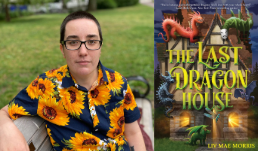
Elisa McIntosh of The Bookstore Plus in Lake Placid, New York, served on the panel that selected Morris' book for Indies Introduce.
Morris sat down with McIntosh to discuss this debut title. This is a transcript of their discussion. You can listen to the interview on the ABA podcast, BookED.
Elisa McIntosh: Hey everyone, my name is Elisa McIntosh. I'm a bookseller at The Bookstore Plus in Lake Placid, New York. I'm super excited to be talking with Liv Mae Morris, the author of The Last Dragon House.
Liv Mae Morris was a 2022 Lambda Literary Fellow and 2024 recipient of the Binc Foundation’s Susan Kamil Prize for Emerging Writers; equally importantly, she is the steward of two cats and one beautiful, chaotic husky/chihuahua/German shepherd mix. Originally from Kentucky, she now lives with her wife in Boston, where she works as an indie bookseller as well as a writer.
I'm so excited, Liv, to talk with you today. I absolutely adore this book. For those of you listening, The Last Dragon House is the funniest, smartest, cutest book there ever was, I swear. It's about a young boy named Olly who accepts the mysterious job posting that turns out to be at a boarding house for dragons, and there's so much more, and I can't wait to dig into it. Thanks very much for joining us, Liv.
Liv Mae Morris: Thank you for having me. I'm excited to be here.
EM: Something that was really cool to learn is that you are a bookseller. One of us! Booksellers are surrounded by books all the time. We have access to so much. Are there authors that inspired you to branch out from bookselling into actually writing books?
LMM: I’ve basically been writing since I could hold a pencil. The first stories I wrote were about a mouse named Lisa, and they were definitely inspired by Kevin Henkes. I really loved all of his works. He was my first favorite author. I especially loved Sheila Rae, the Brave and Lisa was a lot like Sheila Rae, she was adventurous and brash. As an older kid, I was really obsessed with The NeverEnding Story and A Wrinkle in Time and everything Louis Sachar wrote. You can probably still see those influences.
As an adult, as a bookseller, I have been exposed to so many amazing books that have expanded my sense of what fiction can do and say. I've been really inspired by authors like Erin Entrada Kelly, Kelly Barnhill, Mariko Tamaki, Jillian Tamaki, M.T. Anderson, as well as adult authors like Nana Kwame Adjei-Brenyah and Jeff VanderMeer.
I wouldn't really compare my work to any of theirs, because they're all geniuses, but those are the authors where I read their books and I’m like, “Wow, I hope one day I can write something that good.” It really has been exciting to work around so many books and meet authors as a bookseller. I really have been able to read much more widely because of that.
EM: I'm so excited that you said Kelly Barnhill, because when we talked about your book on the Indies Introduce panel, multiple people mentioned that you gave them Kelly Barnhill vibes.
LMM: That's so exciting! The Girl Who Drank the Moon was one of my comps when I was querying agents. I adore Kelly Barnhill — When Women Were Dragons, obviously I vibed with that book very hard.
EM: Something that's really different about The Last Dragon House, that I thought was really unique and very cool for middle grade, is that it's almost written as a history from the Royal Chronicler’s point-of-view. You have all these fun little footnotes of his little comments here and there, but really he's trying to tell the story of Olly and his sister.
What made you step away from a dual point-of-view and go in from the Royal Chronicler’s point of view?
LMM: It's honestly hard to remember. I wrote the first draft of this in 2017 as part of an MFA program for children's writing, and then I put it away for seven years because it was a very long, messy draft. I was like, “I can't. This is unsalvageable.”
The footnotes occurred to me randomly and I immediately knew it was a good idea and would help the book stand out. I thought the Royal Chronicler would be a good narrator for that, who would be funny to butt in occasionally. I came up with this academic, who's stuffy and prickly and very opinionated, so that when he interjects, it's good for humor. I had read children's novels with footnotes before, so I had thought a lot about the potential of those, especially for humor. It was fun to construct a character completely through marginalia. He isn't super present until he is and what those moments say about him.
EM: Cool. That's crazy. It always blows my mind at how long the process of writing a book is.
LMM: I spent a lot of time, basically, until I realized, “Oh, this can be a series. I don't have to fit everything in one book.” Then it kind of clicked.
EM: It's phenomenal. The footnotes are interjected perfectly throughout. When I read that first footnote, I started cracking up. I was just like, “This is going to be excellent.” It’s so funny for a young reader too, especially some of those little squirrely kids who might be trying to read along with you. The footnotes are perfect little grab-you’s to bring you back in, and to just remember, what was so funny about that passage? So good.
So, dragons — they're so unique and they have so many little personalities. You've got one that looks like a dog, and its habitat is on a volcano, and you've got a death wyrm, and little-fairy dragons. There are dracorgis. They’re pupas, little larvae that look like actual corgis. That is hilarious. When I read that scene where all the little corgis come out and they were wiggling their butts, I died.
How did you come up with some of these?
LLM: One thing I've always loved about dragons is that they can look and act so many different ways and still qualify as dragons. When I first came up with the idea for the book, I was playing a lot of Pokémon. I love how dragon types can truly just be anything.
I knew from the beginning that I wanted a wide variety of dragons. I really wanted this ragtag group of different body types and skills and clashing personalities, because the contrast between a shy little fairy-dragon and an aggressive, destructive giant death wyrm can be really funny.
I do actually remember where a lot of them came from, even though it was a long time ago. Mindi was the first one I thought of, because I love bats. So I took bats and dragons and mushed them together. I want to say I didn't steal that directly from Pokémon, even though there is a Pokémon who is a bat dragon as well.
Amy, Brutus, and Pebble were all originally footnote jokes. I don't even think Pebble’s original footnote is in the final version, but they just took on a life of their own. In part because I knew I needed a group of dragons to go on this quest.
And sometimes you just latch onto an idea. As soon as I added Pebble, I had this really clear sense of who she was. I was like, “This dragon is tiny and she's aggressive and she's obsessed with women's wrestling. I love her so much. I must see more of her.” She just burst on to the page.
The dracorgis were very intentional when I rewrote the book. Basically, the first third of the original draft was good and then the rest was very bad. I wanted to take that original third and shape it into its own book, and I was like, “Okay, what do kids really like?”
I remember lying in bed, I was falling asleep, and my eyes snapped open, and I was like, “Dracorgis!” So that's how the dracorgi happened.
EM: Getting introduced to all these different dragons is so special. But the fact that you thought the corgi is the larva, they're not the full dragon yet? I love that idea, it’s just so funny. If I see a corgi walking down the street, I now think it's gonna be a dragon one day.
I want to bring it back to Pebble. Pebble is a fairy-dragon who loves women's wrestling. I also thought that was hilarious. You so brilliantly pop in these kooky, hilarious little tidbits about your characters. That's what makes this book so special.
What I try to explain to people is that all these dragons are so special, and they're so funny, and that’s what is going to bring in so many readers, but you have expertly woven in so much more in the book.
I'm curious what you're hoping readers will pick up on. We've got the labor movement, you explore socio-economic status, there's so many things that are so important to talk about today.
LMM: The Last Dragon House is a political book in many ways. All books are political, but this one is political on purpose. It's definitely a book with messages, and some of them are very pointed, but I try not to be too didactic because I do trust young readers to form their own relationships with the story.
I hope they find it encouraging, or they recognize some of their own love or anger or joy in the characters. I really, really hope they find it funny. I honestly can't imagine anything more devastating than a ten-year-old not liking my jokes. I've gotten that from my niece and nephew before and it is really humbling, so I hope they find it funny. I hope it helps fuel even one kid's dragon obsession, because I was absolutely that kid.
EM: That's why middle grade is my favorite age group to read. Middle grade authors so expertly weave in such important tales, and, like you said, they trust their readers to find the message. You did a really great job with all of that.
It’s so interesting to hear that your early draft was messy because you realized you were trying to cram too much into one book. I'm so glad that this is going to be the start of a series, because I can't get enough of it. You have set it up in a way where you really could go anywhere. I love that Olly’s sister is finally coming in towards the end of the novel. Olly’s sister is younger but she does have the ability and she actually sees the first dragon which is very cool.
Can you share a little bit about where the series is going? Are there certain dragons that you have yet to explore?
LMM: The second book is almost finished. I actually just turned in the final-ish draft. The Last Dragon House primarily follows Olly and sometimes cuts to his sister Jenny, and the second book is the opposite.
Most of the focus is on Jenny as she tries to wrangle her magic powers. Pebble gets a lot more page time in this one. She's probably the dragon with the most page time in this book. There are new dragons — I won't spoil them — but they were really fun to write. One of them is one of my favorite characters I've ever written.
There are also new humans, and it expands the conflict. You see more of the labor movement, and also the efforts to squash it. I've barely started writing the third one, so I can't tell you much about where the series as a whole will go, but it definitely leads into a larger story that's gonna wrap up in the third one.
EM: Cool, so it's going to be a trilogy?
LMM: Yes, that's the idea right now at least.
EM: I love that, and I just love the idea of being able to just jump back in. It’s so special that the books invite you to join the quest; I'm ready to put on my backpack, to jump on Amy, the death wyrm, and head out there.
I'm super stoked for this book to be out there. It's got cool sprayed edges, which I love that middle grade is starting to get. Liv, you wrote the coolest book. I hope everyone gets out there, shows those sprayed edges, shares those dragons, and let's go.
LMM: Thank you so much.
The Last Dragon House by Liv Mae Morris (Amulet Books, 9781419784613, HC, MG Fantasy, $19.99, On Sale: 05/12/2026)
You can learn more about this author at livmaemorris.com.
ABA member stores are invited to use this interview or any others in our series of Q&As with Indies Introduce debut authors in newsletters and social media and in online and in-store promotions. Please let us know if you do.