P.C. Verrone is the author of Rabbit, Fox, Tar, a Summer/Fall 2026 Indies Introduce selection. 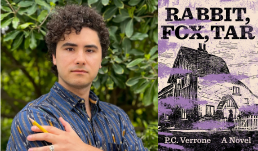
Amani Jackson of The Ivy Bookshop in Baltimore, Maryland, served on the panel that selected Verrone’s book for Indies Introduce.
“Rabbit, Fox, Tar may be one of many retellings of the fable of the Tar Baby, but it is, in a way, completely original. A novel with the spirit of a folktale, Rabbit, Fox, Tar is destined to be a classic. Stories like that of the Tar Baby take on new meaning as they are passed on, and the same will happen with this book as it is passed from person to person. I will continue to come back to this book and I will undoubtedly take away something new each time,” said Jackson.
Verrone sat down with Jackson to discuss this debut title. This is a transcript of their discussion. You can listen to the interview on the ABA podcast, BookED.
Amani Jackson: Hi, I'm Amani Jackson from The Ivy Bookshop in Baltimore, Maryland, and I'm here with P.C. Verrone, who is the author of Rabbit, Fox, Tar. P.C.’s work has appeared in FIYAH, PodCastle, Nightmare, and numerous anthologies. He has been a Tin House Resident, a Playwrights’ Center Fellow, and a WNDB [We Need Diverse Books] Black Creatives Revisions Workshop winner. He graduated from Harvard College and holds an MFA in creative writing from Rutgers University–Newark. He lives in Dallas with his husband, a historian.
Hi, P.C. How are you?
P.C. Verrone: Hi, I'm doing well. I'm very excited to be talking with you today.
AJ: Me too. Happy Pride!
PCV: Happy Pride!
AJ: We're here to talk about this crazy, incredible book. The whole panel could not stop talking about it from the very beginning. As we cut titles, nobody wanted to cut Rabbit, Fox, Tar — it just wasn't an option.
I love retellings. What made you decide that you wanted to retell Tar Baby? Did it start as Tar Baby, or was there a message you matched to a folk tale?
PCV: I am also someone who has always loved fairy tales and folk tales and different reimaginings. The idea to adapt the Tar Baby folk tale came actually because I was reading Toni Morrison's novel Tar Baby. As I was reading that novel, I kept thinking that her approach to this story was so different than what my interpretation would be, and that got my mind thinking, “Okay, what would my contemporary novel take on this folk tale look like?”
The Tar Baby folktale, in particular, is interesting because it's probably the most famous Br’er Rabbit story. The most common version of that comes to us through Joel Chandler Harris, a white folklorist who took the stories and folk tales of Black southerners and published them.
They became incredibly popular and were the subject of minstrel shows and all kinds of racist anti-Black depictions from the 1800s through the twentieth century. So that story, and particularly the image of the Tar Baby, has a lot of baggage on it.
That became a really interesting challenge, working with this story that has African and African American roots, but has been twisted with the white gaze. It became this really fruitful question of, “How do you wrestle with that? How do you add something new to a story that has that kind of history?”
AJ: It did feel new. It didn't feel specific to any time; it felt like I could read it at any point in time and it would still feel relevant or natural. But that's what folk tales are, right? They travel with us through time, they may shift, they may have a different storyteller, but at the basis, they are one story somebody told to get some message across. I love stories like that, stories that just never die, that keep taking on lives.
PCV: Absolutely!
AJ: You're also an Afro-Indigenous person. Do you have any Indigenous folk tales that you think would be fun to adapt?
PCV: That's a really good question. The interesting thing is there are Indigenous American versions of the Tar Baby folk tale. I was looking into the history of the folk tale through writing this book and I started thinking about the ways that Tar Baby itself is sort of an Afro-Indigenous story because of the ways that African people brought the West African version of the story and melded together with Indigenous stories.
There's a Kiowa story that is about how the Seven Sisters constellation ended up in the sky. It's about these seven sisters who are playing with their brother, and then their brother transforms into a bear, and he chases them up into the sky. I wrote a short story that the Tar Baby folk tale reimagined this as a werewolf story, and that's going to be in the sequel to Never Whistle at Night, which will be coming out sometime later this year.
AJ: I'm prepared, I'm waiting, I'm already tuned in. It’s interesting because there's so many folk tales or stories that, in my head I'm like, “Yeah, these are African American stories. We've been telling these forever.” And in some version of that story, there is a Latinx person who's like, “Yeah, these are our stories. We've been telling these stories forever.”
Folk tales and storytelling and myth telling is the most basic human part of us, and it's incredible to keep going with that.
PCV: Yeah, and they're supposed to be retold and reimagined. The tradition of oral history is really deep seated in African American communities, but also communities across the globe. It feels within a legacy to continue adapting and reinterpreting these same stories.
AJ: You also give an element of that with Auntie Riri having to retell her story over and over and over again about the neighborhood and what's happened and it all depends on who hears it at the right time. If something actually happens, it's just true of every story we tell.
PCV: Yeah, absolutely. There's a real power in telling stories, and something that I realized through the process of writing this book was how the way you tell a story can really change the world around you. It's sort of that “butterfly flaps its wings” kind of thing; the really subtle ways that you decide to tell a story can have these huge effects down the line.
AJ: Yeah, even how Tar Baby can be a story with the moral to work hard or it can be a really racist, minstrel, blackface story. It just depends.
You're a storyteller in a lot of ways. You're now a novelist — congratulations! You’re also a playwright and a poet. What form of writing are you most comfortable in?
PCV: I feel at home in all of it. Well, poetry is a little newer to me, but certainly fiction and playwriting, I feel at home in both. I like being able to hop from one to the other. I feel like they're exercising different kinds of writing muscles.
AJ: With the dialogue in your novel, you can tell that you write people talking well. How do you feel the editing process differs from plays to novels to poetry?
PCV: For plays, I'm able to get into the flow of it a lot more easily. Once you know the characters, you can sort of just put them in a room and then let them go and see what sparks fly.
The editing is a lot harder for that because then you have to pick apart this juicy dialogue scene. In fiction, it's much more meticulous in the first draft and it's a lot more about building out this world for a reader and a lot more about the language itself. In a play, the audience is not going to see the stage directions that I write, that's just for the director and the designer and the actors to interpret, but in fiction the language is the medium. So, I find myself paying much more attention to things like repetition and wordplay and that sort of direct interaction I'm able to have with the reader.
In this novel, in particular, I wanted to use the word “tar” very intentionally and very sparingly, because my hope was that anytime someone saw the word "tar" it would sort of ping in their mind.
AJ: That's exactly what happened!
PCV: Oh, good!
AJ: That definitely worked. I saw in one conversation online you said that there's only one straight character in the book, everyone else is pretty queer-coded. Besides Nia, who is the most queer-coded character?
PCV: That's a good question and a hard question. There is a spectrum where you have a character like Nia, who identifies as a lesbian, and then you have Lucky, who is a bisexual man, but has such a restrictive grip on his self-image that he doesn't believe that his attraction to men really fits within that, and then you have Baby, who is such a fluid person.
AJ: Queen Baby!
PCV: Queen! She doesn't really understand why anyone would limit their desire, and her approach to life is an exploration and curiosity towards desire, and so the idea that there would be any limit around your attraction to another person is so foreign to her.
That was really fun. I loved writing the conversations that they have in the book around Lucky's sense of himself and his sexuality, and that their reactions to each other are so unimaginable to the other person.
I think Gina's got something going on too.
AJ: That was my answer. My answer was Gina. In one scene, when she kisses the wall or something, I was like, “Oh yeah, that's a queer lady right there.”
PCV: She never quite gets to live it out, and I was writing around it. She's using the language of motherhood a lot of the time, but there's other stuff going on.
I think Auntie Riri is also probably straight.
AJ: Yeah, I'll give her that. In my head Auntie Riri has so much happening, is she really thinking that hard about all of that at this point?
PCV: True, true. I think there's also an argument that she could be asexual.
AJ: You talked about Baby not really getting why one would limit themselves. I think that's part of why I loved this book so much, because that's how I've always tried to explain my own sexuality to people, like, what's the difference? We're humans.
She's not human but she's trying to understand these humans. I think everybody feels that way about something, especially when you've dropped into a new experience or a new place where people have a different culture or way of thinking. You're figuring it out and you're loving it, and I think that that's also cool to see.
PCV: I think that Baby was really a way to explore my own view of the world, because I have that same feeling most of the time, where I really feel like I don't get all these rules. I don't get why living in a society is so hard, everyone just seems to be making it hard for themselves.
Her perspective was so fun, but also so intuitive, because it allowed me to really talk about how all of this is fake. All of these rules that we put up, all of these borders that we create are fake.
AJ: None of it is real. Especially if you're trying to explain the rules to somebody, that's when you start realizing the rules don't make any sense.
PCV: Exactly.
AJ: I like to pair my fiction with nonfiction, like a wine and cheese kind of thing, right? I read Rabbit, Fox, Tar next to Darkology: Blackface and the American Way of Entertainment by Rhae Lynn Barnes. It's a history of minstrelsy in America.
Is there a non-fiction book that you would pair with Rabbit, Fox, Tar?
PCV: I'm really not a big nonfiction reader, but this book was very much inspired by a lot of Black feminist and post-humanist writing, specifically the essays on coloniality by Sylvia Wynter and “Mama's Baby, Papa's Maybe” by Hortense J. Spillers, which is where one of the epigraphs comes from.
I read both of these essays in college in a class by the absolutely brilliant Dr. Durba Mitra, and together these essays completely changed my brain chemistry and the way that I looked at the world. I wanted to attempt to integrate these very theory heavy, academic ideas into a work of fiction, and I hope I did a good job.
AJ: You did a great job!
PCV: If you read the book and you like it, and you're in the mood to read some academic theory alongside it, I think both of those essays pair well. One fun little Easter egg is when I was trying to figure out how to end the book, I ended up going back to the very end of the Hortense J. Spillers essay, and that told me exactly how I was going to end the book.
AJ: Reality informs fiction. I feel there's no way for us to not write within the context of very real things happening around us.
What was going through your mind when you put everybody in that house? I kept starting that part over, and I was like, “Oh my god, the whole neighborhood is really in this house.”
PCV: That's a good question. I just had so much fun with that. It was something where I was just thinking, “All right, let's try this.” On top of folk tales, or sort of intermeshed with folk tales, I love haunted house stories.
There's a little bit of that going on, but I was really trying to break down this idea of a town that is both self-important and insular that it just keeps getting smaller and smaller and smaller. They keep refusing to engage with any ideas that are going to make them question their sense of themselves, and so they keep compressing, compressing, compressing, until they're literally inside. Everyone is inside the same house and just ignoring the fact that they're all living on top of each other. It was a lot of fun.
AJ: I'm so glad that we get to do this and we get to do this during Pride. Your book is so, so, so, good, and it's out in the world and I'm pushing it on my customers already. I had a shelf talker on it before it made it to the floor. Congratulations!
Booksellers everywhere, you're going to hear P.C.'s name. Stay tuned, it's not over.
PCV: No, absolutely not. Whether anyone wants it or not, I will continue writing.
AJ: Oh, I'll take it directly to my inbox. You can send it here.
PCV: Of course, absolutely!
AJ: Thank you so much for coming today and good luck on your tour!
Rabbit, Fox, Tar by P.C. Verrone (Catapult, 9781646223176, HC, Fiction, $28.00, One Sale: 6/2/2026)
You can learn more about this author at pcverrone.com.
ABA member stores are invited to use this interview or any others in our series of Q&As with Indies Introduce debut authors in newsletters and social media and in online and in-store promotions. Please let us know if you do.