Independent booksellers across the country have chosen Ben Reeves' Everything Was Beautiful and Nothing Hurt (Avid Reader Press/Simon & Schuster) as their top pick for the July 2026 Indie Next List. It is also a Summer/Fall 2026 Indies Introduce selection! 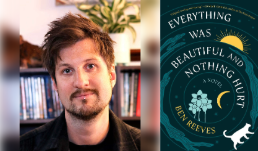
Coco Zephir of An Unlikely Story in Plainville, Massachusetts, was on the panel that selected Reeves' titles for Indies Introduce.
“Death comes calling in Everything Was Beautiful and Nothing Hurt — a modern take on the role personified as a 30 something Londoner who falls for the humanity around him, causing hiccups for his calling. You’ll laugh, you’ll cry, you’ll turn the last page with a clearer outlook on life as only death can give you. For anyone fierce enough to look at death in all its forms and relish the humanity in us all,” said Zephir.
Reeves sat down with Zephir to discuss his debut title. This is a transcript of their discussion. You can listen to the interview on the ABA podcast, BookED.
Coco Zephir: Hi, my name is Coco Zephir from An Unlikely Story in Plainville, Massachusetts, and I am here with Ben Reeves. Ben Reeves lives in Peterborough, UK, with his wife and two children. An early draft of Everything Was Beautiful and Nothing Hurt won the international 2024 Bath Novel Award. When he’s not writing, he paints, makes music, and works as a web designer for a book printing company.
Welcome Ben, I’m so excited to talk to you today!
Ben Reeves: Thank you, Coco. It's a real pleasure to be here, and a real honor to have been chosen.
CZ: Everything Was Beautiful and Nothing Hurt absolutely blew me away. From the first page to the last, we were all taken with the beautiful prose and moving story.
BR: That means a lot to me. It's quite a sad book, isn't it? But it's got its uplifting moments as well. I'm enjoying that people are getting that from the book.
CZ: They are. Can we talk about the title? What was your inspiration for it?
BR: The title is actually taken from the late great Kurt Vonnegut's Slaughterhouse-Five, which is a personal favorite of mine. That book is so much about death, which my book is as well, albeit in a completely different way, and it's just a beautiful line.
It's never quite clear exactly what it means in Slaughterhouse-Five. “Everything Was Beautiful and Nothing Hurt” is actually written on a tombstone in the book, and there's a sense that it's meant almost ironically. There's a real hopeful determination about it that I really love, because obviously lots of things hurt and it's nice to think that even in the darkest times we can actually find a bit of beauty and a bit of hope. That's one of the things I really wanted to get across in this book. It just seemed like a no-brainer, really. It's an honor to use that phrase, because it's quite a popular, well-known quote.
CZ: It's so beautiful. So, speaking of death, the perhaps obvious question is: why death?
BR: I've always been really interested in death, not even in a macabre sort of way, but just the fact that we are all going to die and we don't really talk about it. I think about it quite a lot and I've always had this real sense of time running out.
It actually enriches my everyday life, because I don't get stressed very often and I try to pay attention to the things that really matter, because there's always that little voice in my head that knows that actually one day this is going to end.
When you really believe that and know it, it's hard to get stressed about being stuck in traffic or the normal everyday inconveniences that we get so caught up in; they sort of fade away if you just have that little bit of an awareness of death. I really wanted to explore thinking about it a bit more and paying attention to it a little bit more, and I did that by making Death the main character.
CZ: Exactly. In your book, Death, the main character, befriends a mother and a daughter across the hall from his flat in London. Could you talk a bit about the choice to humanize him in this way?
BR: Absolutely. As well as wanting to explore death, I also wanted it to be a compelling story with a main character that we could really root for. I wanted to make him feel as normal and as human as possible, and he really is just a guy, isn't he? He wears jeans and a T-shirt, he lives in an apartment, he's got a cat that visits him, and he's just this very sweet, patient, gentle man.
The reason I got him to befriend the midwife and her two children who live across the hall is because I thought, “What can Death possibly learn throughout a story?”
I think the answer is the value of life and the value of an everyday family, and relationships, and the small things that we can take for granted every day. It's against his better judgment, because he really tries not to get involved with anybody, because he knows that every single person he ever meets, he's going to watch them die, because he's Death. But he just can't help but be drawn to this beautiful little family, and we get to see where that goes.
CZ: So beautiful, and in this story your prose is electric. It jumps off the page from the very start. As a debut novelist, could you speak a bit to your writing process?
BR: Thank you for that, that really means a lot, because one of the things I really love to focus on is the language.
I walk a lot, and I wouldn't be able to write if I didn't walk, because walking is where I have no distractions — no screens, no voices, nothing, it's just me and the walking. While writing this novel, I was taking direct inspiration from my surroundings because — I never say it in the book, but it's very much set where I live — I could really pay attention to tiny details and wonder, “Who's in that house over there? Why is there an ambulance parked over there? There's a little toy that someone's dropped or left behind, what does that mean?”
I would really think about those things. Beautiful prose or electric prose is about those hyper-specifics. They're almost so specific you feel like you could only get it from real life, so then when you put it into the fiction it makes it feel really rich and alive.
CZ: It does! Speaking of being rich and alive, the ending of your story, without spoiling, is exquisite. It's both emotional and hopeful. Could you talk for a second about what you hope readers will take away from Everything Was Beautiful and Nothing Hurt?
BR: From what I've read of reviews — and I try not to read reviews — people have said that they came away with such gratitude and newfound respect for their own lives and for the people around them, which is incredible. That is the best thing I could possibly hope for, because it takes you to some quite sad places, but it does ultimately, at the end, lift you up quite unexpectedly.
I never ever wanted to depress anyone for the sake of it. I always wanted it to have this wonderful, all-encompassing, bittersweet ending. It's bittersweet, but ultimately, it does leave you with a sense of appreciating the time that we've got on this planet.
CZ: It does, and we love it so, so much.
BR: I really appreciate that.
CZ: Thank you, Ben. Thank you so much for being with us here today, and thank you so much for writing Everything Was Beautiful and Nothing Hurt.
BR: You're very welcome. Thank you so much for including me on the Indies Introduce list.
Everything Was Beautiful And Nothing Hurt by Ben Reeves (Avid Reader Press, 9781668216361, HC, Fiction, $28.00, One Sale: 7/7/2026)
You can learn more about this author at benreeves.co.uk.
ABA member stores are invited to use this interview or any others in our series of Q&As with Indies Introduce debut authors in newsletters and social media and in online and in-store promotions. Please let us know if you do.