

F. A. Davidson is the author of Flickerstate, a Summer/Fall 2026 Indies Introduce selection. 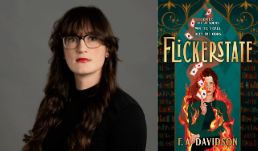
Elizabeth Bosscher of Schuler Books in Grand Rapids, Michigan, served on the panel that selected Davidson's book for Indies Introduce.
“What would you do if you could influence the future? Flickerstate is a delightful boarding school modern day magical story that wrestles with questions of power, corruption, unity, friendship,and a fight for the greater good! This story will capture your imagination and leave you wanting more!” said Bosscher.
Bosscher sat down with Davidson to discuss this debut title. This is a transcript of their discussion. You can listen to the interview on the ABA podcast, BookED.
Elizabeth Bosscher: Hello and welcome. My name is Elizabeth Bosscher, and I'm from Schuler Books, which has four locations in Michigan, but I'm in the Grand Rapids location. I am here with the author of Flickerstate, F. A. Davidson. Hi, F. A.!
F. A. Davidson: Hello!
EB: F. A. Davidson is a freelance writer based in North Carolina. She holds a B.A. in English from Yale University, where she studied creative writing. She is an alum of Viable Paradise and the Tin House YA Workshop.
I'm thrilled to talk to F. A. today and gush about Flickerstate.
Flickerstate is an incredible, magical boarding school YA story that brings all of the nostalgia of classic YA books with very relevant topics to today. I absolutely loved this book. Our Indies Introduce panel absolutely loved this book, and I was hooked by the idea of this probability magic, which we'll talk a little bit about, and with the boarding school setting, you just can't go wrong.
So, F. A., thank you so much for being here today. Thank you for letting me gush about Flickerstate with you. I'd love for you to kick us off with giving us the elevator pitch for the book.
FAD: Thank you for your very kind words. I think of the elevator pitch as having two levels: the very short one and then the slightly more extended one. The very short elevator pitch is just sort of a series of exclamatory sentence fragments:
It’s STEM-based probability magic! Dark academia! Interdimensional beasts! Cursed incurable wounds! Deadly trials! Almost certain death!
The narrative version of that, the version that contains full sentences is something like:
Our protagonist, Norah Sullivan, is very probably going to die, for the following reason: the same day that she learns that she is a navigator — which is a person who has the innate ability to manipulate probability — she and her father are swarmed and bitten by flickerbeasts.
Flickerbeasts are these mysterious, interdimensional predators whose bites increase risk of death by any cause. If a flickerbeast bites you, it's not that the physical damage of the bite kills you, but that once you're bitten, your risk of dying by murder or grisly accident or sudden disease or an anvil falling from a clear blue sky, all of that, just becomes radically more likely. There's no known public cure for these bites, and rather than getting better over time, they actually get worse.
But Norah hears this uncredited but persistent rumor that there's a secret cure for flickerbeast bites in a locked archive at the Academy of Navigation, which is the oldest and most prestigious probability magic school in the world.
So, she's like, “Right, let's do this. Let's go!” and she gets through the application process and applies to transfer to the academy. She eventually gets there, but once she's on campus, she learns that students mostly aren't allowed into the archives. Actually, the only students who are allowed into the archives are the senior archive assistants, and you can only become an assistant by winning a series of increasingly deranged magical trials as part of a three-person team. Norah is flawed but self-aware. She knows that she is a sort of cranky control freak, and she's like, "Oh no, please not teamwork, anything but that.”
And then we're off to the races.
EB: I love that because I love how our teenage character — who is maybe not sure about making friends or has a hard time making friends — is forced into a situation where she has to at least work with people, if not become friends with them.
FAD: Yeah, I enjoy that dynamic a lot and it informed a lot of the way that Flickerstate plays out.
EB: Absolutely. I got the privilege to talk to you a little bit before we started this interview, and you told me that you have been writing for most of your life, so what does it mean to you now that you have a book published and on shelves for readers?
FAD: It's pretty wild. I don't know that I've fully cognized yet the idea of having readers. I'd actually had two previous books that were submitted to editors that eventually died on submission, and I had to not think about having readers. I had to think about, you know, “Is it worthwhile to me to continue writing if no one except my long-suffering family and friends ever reads my work?”
The answer for me was yes. The intellectual and creative challenge of writing and the virtue of perseverance that it forces upon you and all that kind of stuff made writing books worth it, even if nobody read them and nobody cared that I was doing it. That's the stoic position to take on your writing, and I think it is healthy because otherwise you're living and dying by every email about your books and whether or not they're gonna go anywhere.
You know, that said, as the very probable future of my book being out in the world comes ever nearer, there is a segment of my brain that's just devoted to a high-pitched scream related to the idea of having a general readership. You know, this idea that people who don't know me, who are not my family and friends, and have no reason to care about me as an individual will pick up my books solely because they are interested in the world and in the story taking place in that world. I'm really delighted by that possibility.
EB: Yeah, I love that. I want to go back to the magic system because the joy and problem of every fantasy book is how to build a magic system. Your magic system is based on probability. Where did this idea come from for you, and how difficult was it to create something that made sense?
FAD: It's funny. I have a zero draft of this book — a sort of proto-Flickerstate, although it didn't have a title at the time — that I wrote 30,000 words of and then abandoned. That proto draft, that zero draft, has Norah. Although for some reason her name lacks the ending H in this particular draft. It's just N-O-R-A in that one, and it's told in the third person for reasons that are unclear.
EB: It's like Norah's evil twin at this point.
FAD: Right! So, it had Norah and it had creepy beasts and it had a slightly ominous boarding school, but I was just writing vibes for 30,000 words and not quite knowing what was going on, or what the beast bites did, or why the school was so ominous, or why Norah had no H at the end of her name.
I think what happened is that I got a revise-and-resubmit on one of my previous novels from an editor, and so I shelved proto-Flickerstate to do that, and when I finished, I still had no idea what was going on in proto-Flickerstate.
So, I wrote an entirely different novel, and then I finished that novel, and then it was COVID and I was reading about morbidity and mortality articles — because it was lockdown and we all had to make our own fun — and I suddenly had this thought, “Wait, those creepy interdimensional beasts. What if their bites increase your risk of death by all the ways you might have died anyway, instead of killing you directly?” And I was like, "Oh, okay, yes, let's go with that. Who fights them? Obviously, probability magicians.” That was my immediate next thought. I'm like, "Okay, Norah is a probability magician. That's clear. Also, there's an H at the end of her name now.”
That was how I started with probability magic; I actually began with the monsters, and then tried to figure out who would fight them, and it was people who could change the probability that certain future events would happen.
In terms of how to make it make sense, there are two ways of addressing that question. One is a craft question about exposition. Nobody likes an info dump. Actually, some of us do. I will read your historical appendix in your epic fantasy novel, but not everyone will, and it's better to not put the appendix right in the middle of a chapter, that's what appendices are for. So, it's like, “Okay, how do we dramatize and make immediate an abstract and mathematical magic system?”
One way is that pretty much all of the exposition occurs at the same time as a plot goal, like something that contains stakes and also some interpersonal conflict.
For example, the first chapter is Norah's interview at the Academy of Navigation after she's applied to transfer, and part of the interview requires her to demonstrate understanding of concepts related to probability magic and also to demonstrate her own navigation, her own probability magic. This actually requires a conflictual dialogue or negotiation between Norah and her interviewer about what is true about probability magic and it requires Norah to enact some of these things.
In that chapter, there's some interpersonal conflict between Norah and her mother, who's chaperoning her to the interview, and from whom she is keeping an important secret, and then there's conflict between Norah and her interviewer, who's an odd bird and an interesting character, and then there's further conflict that I'm not going to spoil. There's a lot of stuff happening as the information about the magic system is being explained and illustrated, which I think is very important. Like a scene should always be doing multiple things; it's like the Swiss Army knife of fiction.
The other thing to consider, though, is does the magic system make sense conceptually? Whether you think it makes sense — “you” generally here — is going to depend on certain presuppositions or commitments you have about the deep structure of reality, right?
EB: Fair, fair.
FAD: When it comes to influencing possible futures, what do you have to believe about the nature of time, or whether free will exists, or if we exist in a multiversal reality or not. So, there are no appendices about that in Flickerstate, I just made some choices.
In Flickerstate, it's not a multiverse. There are uncountable and possibly infinite possible futures, but they all sort of funnel ultimately into a single present and a single past. People do have free will. It's not that the past is a closed physical system and it determines the present and the future. People do have genuine choices. So, if you believe in freedom of will and the reality of the past and present and a Growing Block theory of time, then all those implicit presuppositions will make sense to you.
But if you're like, “No, we really do live in a multiverse, but also free will doesn't exist.” Maybe you're like, “This is not true!” and that's okay. Because, for example, I read or watch time travel stories and enjoy them, even though I think that traveling to the past and changing things would probably create a reality-destroying paradox. I can enjoy it even if that doesn't happen. We just have a philosophical disagreement.
EB: No, I love that and I genuinely feel like the probability magic in this book is not too complicated to understand. That's one downfall of some fantasies, like I kind of get the concept, but I don't really understand. There seems to be more in the author's head than what they've written on the page.
In Flickerstate, the probability magic makes sense, and we're writing for a teen audience. It's something that teens can really grab onto but it will still make sense. This is also for teens who maybe don't want the entire world-building experience. There are so many familiar parts in this world, there's just this twist that changes a decent amount, but does not leave the world unfamiliar to where we currently are.
FAD: Yeah, it is an alternate history. They discovered the probability magic, or the probability magic invades our reality, in 1945 and things spin off from there. It is an alternate-history-funhouse-mirror United States that they're living in.
EB: As we're thinking about maybe the readers, one of the themes that is throughout is power. We have this group of people that can influence the future through this magic, but not everyone can do it. It's a select group of people. There's a lot of conversations about power, and if power can be altruistic, or if it's always going to be corrupted, and things like that. That's how I read it. What themes do you hope readers recognize?
FAD: I endorse this reading that you’ve just given. It is a lot about unearned power and influence in a certain sense because navigation powers simply appear statistically randomly, throughout the population. All of a sudden, any random person can just manifest navigation. It's not hereditary, it's purely random, which leaves open the possibility that multiple people in the same family can have it, but that would just be an even more outlandish coincidence, right?
Nobody has done anything to earn the power or influence that they get when they become a navigator, and it's also quite rare. One of the characters does a little Spiderman riff on this at one point, like, “Does great responsibility come with great power, or can we just take the money and run?” That is definitely a big throughline.
Another one has to do with the way that your social status and your class status impact your baseline risk of death. I was writing a lot of this during COVID, and I was thinking a lot about death. I was working from home and had no relevant pre-existing conditions, and was in my pajamas most of the time, and my dad was working in an ICU in his 60s before the vaccines were developed, intubating people. He was at much greater risk.
I was also aware that there were people who were at greater risk because they couldn't afford not to work. If they had to choose between exposure and unemployment, they were gonna choose exposure. Or there were people who couldn't afford to live alone, they lived with roommates, or they were living in shelters, or they were unhoused, and all of those people just had an automatic, much higher baseline risk because they had less money or no money. In theory, a pandemic is an existential risk to everyone. In theory, we're all in it together. But, in fact, some of us are a lot more in it than others. That dynamic did inform the way that I extrapolated the impact of the Flickerbeasts.
They're native to Flickerstate, which is metaphysical realm that the navigators enter to see the possible futures and manipulate them. But they can manifest in our reality and they manifest statistically randomly most of the time, although they are slightly attracted to strong navigation, which means that in theory everybody is at risk from Flicker Beasts.
But because their manifestations are probabilistic, navigators can de-manifest them. They can see the possible future where they simply go back to Flickerstate rather than attacking and push probability toward that outcome, which means that navigators, who are rare, are in demand as bodyguards from politicians and businessmen and ultra-wealthy people, which means that there are, of course, fewer navigators to work in public service and emergency response.
The inciting incident that occurs before the narrative actually starts is a swarm manifests in Norah's front yard, and there's no way the emergency response team is going to come in time because they are simply too overworked and understaffed. There's a whole subplot about the government cutting funding for emergency Beast response that is not foregrounded, but it's definitely present.
So, that question about social and economic status, and the question about how we allocate public resources, and the question about whether we should use our talents to make as much money as we can and protect ourselves, or maybe be in a riskier situation ourselves and help other people — all of that is very present in the subtext and sometimes the text.
EB: That's something that I think you have done excellently in this book, it brings up concepts and realities of our real world, but in a way that's not like, “Oh, I'm gonna tell you the direct correlation to this.” You're gonna make your own assumptions and you're gonna make your own conclusions from this. But you can process those things in a different world and then be like, “Oh, that's a lot like our world, and I wonder how that works in my life.” This book will bring up a lot of those conversations, which I'm excited about.
What elements of your own personality or your own personal life have you brought to life in the characters of your book?
FAD: That's a funny one for me because my knee jerk instinct is to say none of them. There are six or seven main characters, and not one of them is me, but at the same time I'm thinking, you know, “What are their goals? What are their desires? What is their psychological architecture?” I do try to give myself a point of identification or an in, so that I can inhabit that different mental space and try to make them as real as possible.
My point-of-view character, my first-person narrator, is Norah Sullivan. The main point of identification for me with her was that she is absolutely determined to accomplish this goal or die trying.
It's not optimism, it's not a perky can-do attitude. She does not want to die in a stupid way for stupid reasons. She doesn't want that to happen to her dad, and she doesn't want her family to have to live with what will probably happen if they both die. She's like, “Right. I am clinging onto the world by my fingernails, and if I get kicked off the ledge of reality, I'm going to leave claw marks.” That's her attitude. That bloody-minded perseverance was very much animating my writing.
I've been writing for a long time, and for a long time what I wrote wasn't good, and then for a longer time, it was starting to get good, but I still wasn't really succeeding. I just had to keep going and going and going and I wanted her to have that sense of, “All right. I'm going to do this thing because I think it's worth doing, no matter what.” She's very determined, and that determination was my in with her.
The other thing that is sort of funny, is that when I started writing the proto-draft of Flickerstate, I also was getting nonspecifically and ambiguously sick. I would go to the doctor and I'd be like, “I can't stand up all day anymore. Like I will collapse face first onto the sofa and not be able to move for like an hour in the middle of the day. Like, what's going on there?” And they'd be like, “Well, you know, sometimes adults are just tired.” I was like, “I don't know. I run marathons. I know what it's like to be physically tired. I've done a lot of academic work. I know what it's like to be mentally tired. This doesn't feel the same.”
They would they would do tests and they'd be like, “No, you're fine.” Then I was like, “Okay, I guess it's just a weird time, things are happening, whatever.” Then I kept going, I kept working, I went back to Flickerstate, and my physical condition was getting worse for ambiguous reasons. I was even more tired, brain fog, joint pain, muscle pain. Didn't know what was going on, kept writing, and then after Flickerstate was sold, and after I had completed developmental edits, by this point I had realized that I was severely iron deficient but I didn't know why.
Eventually, the hematologist was like, "Right, let's order you some additional tests because this is actually kind of weird.” And then I was running my first half marathon in a long time, and I was like, “I gotta be responsible because I've been feeling so tired. Maybe I'm under-fueling. I'm gonna really carb load responsibly.”
I ate like seven bagels, and I PR’d the half marathon, and then I get my tests back from the hematologist, and they're all normal except my celiac reflex panel, which measures immune response to gluten which causes a serious autoimmune reaction in people with celiac disease. After my carb loading for the half marathon, I nearly ended up in the ER. They did an endoscopy, and they were like, "Oh, you know, usually we have to take a sample, and we will do that, but the damage to your small intestine is actually visible to the naked eye.” I was like, "Oops.”
So, all the descriptions as I was going back through for copy edits of Norah feeling exhausted and sick and full of dread, I was like, "Oh, I guess that was some somatic projection.”
EB: Maybe processing a few things!
FAD: So that was funny. Not at all necessary to understand the novel and not actually part of the reality of the novel, but a funny Easter egg for me as I was going back.
EB: I'm sorry you had to go through it, but I'm glad you found answers, but also it may be reassuring to some readers that chronic illness actually did play a part in this, even if it is not explicitly stated. A lot of people experience some vague sickness that is hard to identify, and they have to work through on a daily basis.
FAD: Yeah, and that causes a fair amount of existential dread!
EB: Yeah absolutely! Well, F. A., I could talk to you literally all day. I'm having such a great time.
I want to know: is this a planned standalone, or will we see this world again? And if we won't see this world again, what else are you working on?
FAD: The short and unsatisfying answer is that I don't know. Flickerstate was pitched as a standalone with series potential, and that is true in the sense that there is a self-contained plot arc and a self-contained character arc in Flickerstate and so it is a standalone.
There is certainly room for other things to happen. I tried to create an ending that was simultaneously satisfying in itself and would allow for more events, as life always does. I was contracted for two books with my contract, two standalones and I'm writing the other one right now.
I'm sort of hip-deep in the super chaotic zero draft right now, which is always an interesting experience for me. I have written three or four thirty-page-each synopses for this project, and I've written a whole bunch of first draft material, and even so, anything could happen. I write synopses to prove that I can and then I almost immediately deviate from them. So it's a wild ride.
I will say it’s young adult fantasy, but where Flickerstate was contemporary fantasy — alternate history fantasy that takes place in the contemporary moment — this second book is second world fantasy.
It's a world that I'm inventing from the ground up, and that is very fun, but also very galaxy-brain-inducing. I'm still working through all of the ramifications and deciding what technological level the characters have access to, and exactly how I want the magic system to work and all that kind of stuff. Figuring out who knows what, you know, which is fun. It's like the pure, messy, anything-could-happen stage, which is great.
EB: I love that! Well, thank you so much. I cannot wait for Flickerstate to be in the world, to sell it to all of the people that I interact with, and I can't wait to follow your career. As we know, this is just the beginning, and I hope it is a long one.
Thank you so much for talking to me today.
FAD: Thank you! I hope to chance to visit your bookstore sometime!
EB: Absolutely, we would love to have you!
Flickerstate by F. A. Davidson (Sourcebooks Fire, 9781464266195, HC, YA Fantasy, $18.99, One Sale: 7/28/2026)
You can learn more about this author at fadavidsonauthor.com.
ABA member stores are invited to use this interview or any others in our series of Q&As with Indies Introduce debut authors in newsletters and social media and in online and in-store promotions. Please let us know if you do.