Roberta Kwok is the author of Lost in Curiosity, a Summer/Fall 2026 Indies Introduce selection. 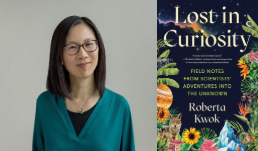
Jocele Skinner of Shared Stories Books in Caldwell, Idaho, served on the panel that selected Kwok's book for Indies Introduce.
“What an accessible view into so many fields of scientific research! I never knew how much I wanted to know about frogs, the aquifers below the ice of Greenland, and the search for moons in other galaxies! Roberta Kwok has made hard science available and relatable to all of us,” said Skinner.
Skinner sat down with Kwok to discuss this debut title. This is a transcript of their discussion. You can listen to the interview on the ABA podcast, BookED.
Jocele Skinner: Hi, my name is Jocele Skinner and I am a bookstore owner. I own Shared Stories in Caldwell, Idaho, and I'm here today talking to Roberta Kwok about her new book, Lost in Curiosity.
Roberta Kwok is a science writer whose work has appeared in the New York Times, NewYorker.com, Nature, New Scientist, Audubon, and other publications. She has received a fellowship from the Knight Science Journalism Program at the Massachusetts Institute of Technology, a grant from the Alfred P. Sloan Foundation, and awards from the American Association for the Advancement of Science and the American Geophysical Union. Before becoming a journalist, Kwok worked in a genetics lab at Stanford University. She lives in the Seattle area and is originally from Canada. Her new book, Lost in Curiosity, is available now from Sourcebooks.
Welcome, Roberta!
Roberta Kwok: Thank you so much for having me here. I'm excited to talk to you!
JS: I'm so excited to talk to you. Our Indies Introduce panel loved your book, and I am a scientist by trade, so I especially loved digging into the various topics that you wrote about.
RK: I'm so glad to hear that!
JS: Can you tell me a bit more about your background and your science training? You've done a lot of science in addition to writing.
RK: Science is kind of in my DNA. My dad is an astronomer. My mom worked in a genetics testing lab at a hospital. When I went to college, I started out studying biology, and I worked in a cancer lab and an immunology lab, but I really was not very good at it. My experiments would often go wrong, and I wouldn't know why. I feel like people who are true scientists know how to troubleshoot their way out of that — they can MacGyver some kind of solution — but I really didn't have that scientific instinct. I switched to software engineering.
I was coding at a bioinformatics startup in Silicon Valley for a while, but on the side, I was taking night classes in fiction writing because I always loved reading and writing. So, I eventually took another left turn and went to an MFA program in creative writing.
While I was there, I started getting interested in nonfiction after taking a class in essay writing and science journalism. That was the turning point where I realized, “Oh, I can write about science even if I'm not doing it because there's so many amazing stories to tell in science.” I've been a freelance science journalist now for almost two decades.
JS: That's wonderful. How did you come up with the idea to write Lost in Curiosity? Where did that inspiration come from?
RK: The seed for that was planted almost exactly 20 years ago. It would have been 2006 — that's when I was in that MFA program in creative writing — I was taking the essay writing class and I decided it would be fun to write a science essay about a friend of mine, Ben. Ben was a PhD student at the same university in Bloomington, Indiana, and he was studying evolutionary biology.
He studied sunflowers and how they enter what he calls puberty. How do they know when it's time to grow up? How does that change depending on how much light they're getting? So, I thought, “Okay, I'll follow Ben on a twenty-hour experiment in the lab where he's collecting these leaf samples every few hours and I'll write about it.”
We started at 7:00 am and we ended at about 3:00 am the following morning, and a bunch of things went wrong during this experiment. At 3:00 am, Ben decided that all the samples we had just collected probably were useless and he was just going to redo the entire experiment.
That made an impression on me — his persistence, his devotion to his research question. Then, if we fast forward ten years, now I'm a science journalist. I'm writing news stories and the point of the news story is to report the result. What did they find? What was the discovery? But I knew from that experience with Ben and my own experiences, that there was so much more happening behind the scenes that wasn't being said in these news stories. There are years of uncertainty and failure and doubt and this valley of the unknown that scientists have to cross to get to the other side.
I wanted to write a book that would go behind the scenes and follow those twists and turns behind the scientific discovery — sort of like the opposite of a eureka moment.
JS: There were times that I was on the edge of my seat, literally, while I was reading, like, “Oh my gosh, are they gonna solve this? Are they gonna do this?” So, you did a great job showing that showing that process.
How did you find projects to write about and decide what topic you were going to write about in a given field?
RK: The book is broken into nine chapters, and each one follows a research team or scientists from a different field of science, everything from biology to chemistry to physics to molecular biology.
For some of those chapters, I had written news stories about the scientists before, like the astronomy one. I'd written a blog post about astronomers chasing transits.
That's basically where a planet crosses a star, and when it does it causes this tiny little dip in light, and you can catch that and it tells you the planet is there. There was so much emotion in these stories about these astronomers chasing transits; one of them talked about how it was like getting drunk, you don't have your best judgment because you want to see the transit so badly. One astronomer who ended up in the book, David Kipping, canceled Valentine's Day plans with his girlfriend to catch a transit because they happen at certain times; you have to be there when the transit is happening.
I felt like there was a human element there that could be explored more, and I knew that David Kipping was searching for exomoon transits next — which is when a moon is crossing the star — and it's an even tinier signal and even harder to detect. That was one example of a case where I had some background and I just went back to him to find out more about the story.
In other cases, I was going into it totally new. I was scanning tons of news stories, tons of scientific papers, making lots of phone calls, talking to lots of people, trying to figure out who am I going to follow. It really was not a scientific process at all; I did not have objective criteria. It was very just instinctual, like, “Do I feel an emotional connection with this scientist? Do they tell me stories that are fascinating that I want to hear more about? Do I feel a connection to them as a person?”
One example of that is the paleontology chapter where the scientist, Meg Whitney, was studying this creature called Lystrosaurus. It's this funny little animal that lived about 250 million-years-ago, and kind of looks like a cross between a warthog and a little hippo. And, you know, is that the most important animal we should be studying? Is it the most important question in paleontology right now? Probably not. But when Meg told me about Lystrosaurus, it just sounded so endearing that I wanted to know more about it. So that's how I picked the remaining chapters.
JS: Very cool. The exomoon chapter was exactly the one where I was literally on the edge of my seat thinking, "Are they going to find these things?”
What did the process of writing look like? Did you mostly spend time interviewing researchers, or did you spend a lot of time digging into the science background on your own to try and understand
RK: There was definitely a lot of reading research papers and tons of interviews — including those with scientists outside the team — just to get my mind around these scientific concepts, which could be pretty hairy.
The most important part was following the main scientist in the chapter for months or even years, and really committing to following that journey, so that meant many, many, many phone calls with them, where they would share what was happening, what the latest problems were, what they were doing to overcome those obstacles. Sometimes I would get to sit in on Zoom meetings with their team, and that was actually fascinating because then I got to hear the dialogue between scientists as they were talking about new challenges that had come up or arguing about ideas.
For about half the chapters, I was lucky enough to get to travel in person to the field site or to the lab and see the science in action. For example, in the geology chapter, I followed glaciologists who are studying this incredibly remote site on the Greenland ice sheet called Helheim Glacier.
It's only reachable by helicopter and they are trying to track the flow of water through the ice sheet through these massive crevasses to better understand how much the sea level is going to rise in the coming years. For that I was able to fly to Greenland, take a short trip to their field site on Helheim by helicopter and actually see their camp, and hang out with the scientists who are still following their teammates' progress on the ice. I got to see the whole drama unfolding before my eyes, so that was an incredible experience.
For our other field reporting trips, sometimes I would try to get involved in doing the science if I could, because that also tends to yield a lot of sensory detail. There's a chapter about scientists and engineers who are devising these things called emerald tutus — it sounds silly — they're basically these big canvas floating mats that have plant matter growing on the top and stuff hanging down the bottom. They were using tulle, which is why they call it a tutu, in the lab, and they were testing them in this big wave lab in Oregon where they have a wave maker machine generate these huge waves. I got to wade into the tank and get to smell the weird funky smell of the mats and feel the slimy tule brushing against my legs and stuff like that. That was great for gathering details to create narrative scenes for the book.
JS: Is there one story that you found especially compelling, that you really took to heart and were especially interested in?
RK: I love all the chapters, but I think one of my favorites is the evolutionary biology chapter, about the frogs. In that chapter, I follow Johana, a biologist who is studying these tiny frogs in the rainforests of Borneo. They're called smooth guardian frogs, and they're an obscure species that scientists know very little about, so she wanted to go there to understand their unique mating and parenting behavior better.
Part of the reason I love the chapter is because the frogs themselves are so fascinating. What's interesting about them is that the male guardian frogs spend a lot of time and energy caring for their young, and so they will look after their eggs. They protect them from predators. When the eggs are ready to hatch, the tadpoles will wriggle onto the father's back, and the father carries his little tadpoles to a pool of water where they can grow up.
The other reason I love the chapter is because Johana is just so passionate about her research and an amazing character to follow and to root for. She grew up in a super protective family; she really wasn't even allowed to do things like play on the monkey bars. But she had this really fierce curiosity about the world and the wildlife around her.
She loves observing animals, and she zeroed in on this one species and really got obsessed with it. You know, she could have picked an easier one to study — this species is so difficult to study, she has to go halfway around the world just to find it. But she told me, “I wanted to study the one that no one else wanted to study.” So, despite all the obstacles she has to overcome, she never gives up on that dream. I think that makes her a character that we really cheer for and want to follow.
JS: Yeah, absolutely. What's next for you now that you've written this amazing book? What's your next project going to be?
RK: One thing that I really loved about the book process was getting to collaborate with an illustrator. Emma Regnier is a wildlife biologist and also an artist who creates these beautiful field notebook sketches.
I'd ask Emma to create a drawing for each chapter in the style of a field notebook sketch, and it was amazing to see those ideas brought to life in these illustrations that really captured the intellectual space of dreaming and thinking and being curious.
I would love to do more collaborations. I could imagine working with an artist on an illustrated chapbook or an illustrated essay. That would be really fun because science is so visual. I can write write beautiful sentences or paragraphs, but when you see the images, it's another way to connect emotionally with the science at a different level.
Writing a book is such a huge endeavor, I think it would be fun just to do some smaller creative projects, to play and experiment and follow my own curiosity in that sense.
JS: Have you ever thought about writing a book for kids?
RK: You know someone told me, "You should do a kids' version of Lost in Curiosity.” That would be really fun because I don't know if kids really read stories of science in action the way that they're shown in this book. There would definitely have to be some editing because there's some curse words in the book, but I think kids would get a kick out of this book too. That’s a good idea!
JS: I just love this book. Thank you for writing a book that shows how important science is and making it accessible to the general public. We really enjoyed it, and I cannot wait to sell it to customers at our store.
RK: Thank you so much.
Lost in Curiosity by Roberta Kwok (Sourcebooks, 9781728275970, HC, Nonfiction, $27.99, One Sale: 7/21/2026)
You can learn more about this author at robertakwok.com.
ABA member stores are invited to use this interview or any others in our series of Q&As with Indies Introduce debut authors in newsletters and social media and in online and in-store promotions. Please let us know if you do.