Darianne Schramm is the author of 72 Hours of You, a Summer/Fall 2026 Indies Introduce selection. 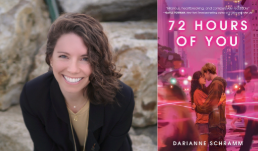
Michael Leali of Mrs. Dalloway's in Berkeley, California, served on the panel that selected Schramm’s book for Indies Introduce.
"I devoured this speculative, romantic debut young adult novel. Sydney Hoffman has a problem: she sees clocks that appear over peoples’ heads 72 hours before they die. And no, she can’t prevent their deaths. She has established strict rules for herself about what to do when these clocks appear, and she is determined to keep their existence a secret. But Peter, a sweet, attractive boy in her class, challenges all her safeguards. This page-turner has a pitch-perfect young adult voice, twists upon twists, and a killer, swoony romance," said Leali.
Leali sat down with Schramm to discuss this debut title. This is a transcript of their discussion. You can listen to the interview on the ABA podcast, BookED.
Michael Leali: Hi, I'm Michael Leali from Mrs. Dalloway's bookstore in Berkeley, California, and I am here with Darianne Schramm.
Darianne grew up in Gainesville, Florida, listening to the sounds of the woods and the music of Tom Petty. When she’s not writing stories about grief, love, and characters who are slightly nihilistic, you can find her eating the darkest possible chocolate and playing overly aggressive games of Scrabble. She has a BA in Philosophy from Elon University and her Masters from the University of Southern California where they reluctantly let her write her thesis on rock and roll lyrics. She is currently getting her PhD in New Zealand where she lives with her husband, daughter, and Goldendoodle.
Welcome, Darianne!
Darianne Schramm: Oh my gosh! Thank you so much for having me. I'm so excited to be here!
ML: We are so happy to have you! I am beyond thrilled to talk about 72 Hours of You. When I first read this book, I just devoured it. I was completely swept up in the world, the characters, the incredibly authentic teen voice, this propulsive plot, and this sweeping romance.
You really have knocked it out of the park with this debut, and I'm just so excited that I get to be the one to talk about this story with you.
DS: Thank you so much. That means so much. I love to start an interview with a lot of compliments, thank you!
ML: Happy to oblige, of course. Before we dive into the interview part of this, I was wondering if you could tell us how you pitch 72 Hours of You. In a nutshell, how do you describe this book?
DS: 72 Hours of You is about a girl named Sydney Hoffman who sees pink neon death clocks counting down over people's heads 72 hours before they die, and this has left her understandably a bit nihilistic, jaded, and alone.
That is, until she meets Peter Beckett, the ultimate sunshine golden retriever book boyfriend, who changes how Sydney thinks about life and death.
ML: We love Peter so much. The whole panel, we were just obsessed with their relationship. You're right; you wrote an excellent book boyfriend. We were all swooning.
This story is so original, from the characters to the world building. I was completely captivated and in awe from start to finish. Can you talk about the spark of inspiration behind this story?
DS: I started thinking about this story during the pandemic. I — very uniquely — was having a bad time. I was not enjoying myself during the pandemic and I was filled with so much anxiety and so much fear that I felt like I was walking around seeing clocks over people's heads.
I felt like, “I don't know what's going to happen. Are we all gonna die? Is someone I love gonna die? How can I live with this much fear?” That is where the story was born. It was: how do we learn to live and enjoy life when we are filled with so much what I call pre-grief, where you are spending so much time worrying about the loss that might occur?
ML: Wow, I love that answer. I'm so intrigued by the art that has come out of that period of time because a lot of us were processing what it means to see such significant loss and such significant hurt on a global level.
This story beautifully captures that exact phrase that you used — that pre-grief — and what it looks like for a young person to experience that. I know that you write for both adults and for young readers, so I'm curious, why did you write this story for a young adult audience?
DS: The characters just came to me as teenagers. Part of it is that the pandemic and this story deal with such heightened emotions. When you are a teenager, you feel like everything is life and death, everything feels crucial and important and meaningful. I felt like this story just really needed to be set with teenagers.
ML: I totally felt that throughout the entirety of the book. It is life or death. This fight for love, for connection, for community. As Sydney is grappling with these rules that she has set around these clocks and how she interacts with people, and she's really established who she thinks she is and how she operates, and then Peter comes in and just totally makes her rethink everything. I love that.
I want to talk a little bit about the world building. Like you said, Sydney sees these pink neon clocks that appear above people's heads seventy-two hours before they die. Can you talk about that process of coming up with that sort of magic system? How did you land on seventy-two hours? Why the color pink?
DS: Seventy-two hours was intentional because one day, two days, that's not enough time to get anything done. Four days — who can do the math for how many hours that is? Not me.
ML: Same!
DS: Seventy-two hours really felt like the amount of time where you can have the shock and awe of “Okay, something's going to happen. Now I have a minute to deal with it. I'm going to decide what I'm going to do.”
I didn't want the clocks to be a color that was inherently negative; I wanted it to be something that was a little bit more neutral or light, even. I wanted to signal that death just is. It's not necessarily the worst thing in the world or the best thing in the world; it's just a fact of life. So, I didn't want the clocks to be blood red or anything like that.
ML: I love that you didn't lean into any tropes around death. That's such an important message for young readers, that death is part of our existence, a part of the human experience.
I gotta say that that color choice really makes for a great cover, and I think that it's really going to pop on bookstore shelves. As we're handselling this to young readers, to their parents, to the teachers and librarians that come into our stores, they're going to look at this and be like, "Whoa, I need to know more about that story.” Well done!
DS: I did want there to be something beautiful about it too.
ML: It really is. For such a dark story, there is so much beauty. It's that preciousness of time that we realize when there's a countdown. That's really profound.
There are so many, many beautifully gutting moments in this story. Without sharing any spoilers, can you talk about what it was like writing about loss and grief for a teenage audience?
DS: It’s similar to writing for an adult audience, and I think that's kind of the point. Teenagers are aware, they know what's going on, they do not want anything sugar coated. They don't want to be lied to. They can tell when you're trying to trick them or make something seem like it's better than it is. When writing for teenagers, I felt like, “I'm going to write like I would write for anybody. I'm going to tell the truth. I'm going to tell the truth in the most sensitive and respectful way that I can, but I'm not going to pull any punches and I'm not going to try to pretend like something is anything other than what it is.”
When you write for teenagers, it's always important to leave the reader with a sense of hope at the end, but it is important to me that that sense of hope feels real and feels earned and that it's the kind of hope that you can hold onto and that isn't just a cliché.
ML: I think that you very successfully achieved that.
DS: Thank you!
ML: It definitely has that impact at the end of the novel. I really respect how much you respect your teen audience because I think you're spot on that they can sniff out any sort of sugarcoating without any problem. They just want to be talked to like full human beings. There is an authenticity with which you write that will really speak to kids. Speaking of that, I'm pretty obsessed with the voice of this story.
Sydney is just electric on the page, and you captured something so authentically teen. Sometimes I feel like we're a little removed from actual teenagers when we read young adult literature. How did you get into Sydney's head? How did you develop her voice?
DS: A lot of Sydney's thoughts and feelings are my own. It was easy for me to tap into that type of anxiety. Like I said, this book came out of the pandemic. For teens, a lot of their emotions are heightened to the 10th degree.
That's how I felt when writing it. My emotions were also heightened to the 10th degree. It felt like everything was life and death. So, it wasn't really hard for me to slip back into that style of voice, and similar to writing about grief, teenagers are just people and their thoughts are pretty similar to the thoughts that adults have.
It's not about using the teen lingo. It's just about trying to be as authentic as possible when describing thoughts and emotions that anybody would have.
ML: Absolutely. I want to switch gears a little bit and talk a little bit about the writing life. This is your debut book. What has it been like so far as a debut author?
DS: It has been really fun! I'm not gonna lie: I had a lot of dreams and hopes about what this would be like, and it feels great. I get to do amazing things like talk to you on this podcast, and it's kind of a dream come true.
I grew up in a house where my mother — instead of whispering to me, "You need to be a doctor. You need to be a lawyer — was always saying, "You should be an author. You have a story in you. I know you can do it.”
So, getting to actually be at this point and have my first book coming out has been such a dream. I got to dedicate the book to my mother, which was really fun. This is the best job in the entire world; you get to just make up stories all the time, that's amazing!
ML: It’s pretty wonderful, and you're so accomplished! You do so many different things, you’re currently working on your PhD, how are you balancing all of these different things and what is it like to juggle?
DS: It's pretty fun. It's a lot of writing in different fields, but I love it. I love to be at the computer and just get those thoughts out, and it doesn't feel that bad to juggle it. I feel pretty lucky every day that I am allowed to toss the balls in the air.
ML: Oh, that's awesome. We, as your readers, are very grateful that you are doing all of the things because your stories are remarkable, and we're so excited to see more come from you.
I don't know if you can tell us, but can you talk about anything else that you're currently working on?
DS: Yes! I have a couple other books in the pipeline. My next YA novel is called — tentatively, we haven't settled on a title yet — Kiss Me Like the Last Time. It’s about a teenage girl who, when she kisses someone for the first time, she at the same time experiences their final kiss. She has a vision of what their final kiss looks like.
She meets a boy who tells her the world is ending, and so she has to run around kissing a bunch of other guys to see if she could see the future far enough to see if they're going to survive. It's a really fun, sweet story that I've been working on, and I'm really excited about that one.
I have my adult debut coming out in early 2028, which is called The Eternal Deaths of Hattie Gold, and that is about a woman who is in training to become Gen Z death, and she is being trained by her mentor Millennial Death, who tells her in order to step into her role as the next generation's death, she must kill the one human boy that she loves. Those are the things that I'm working on right now.
ML: I'm noticing a little bit of a pattern here with death and love and these high concepts. Those sound incredible. Okay, indie booksellers, take note, get these books on your shelves.
I think those are concepts that readers are going to eat up, because you're talking about two of the biggest things that consume our attention: love and death, and the intersection of those two things. I'm stoked.
Is there anything I didn't ask you about that you'd like to share, especially knowing that independent booksellers are listening?
DS: I would just like to express my undying gratitude to the indie booksellers; they have been the biggest support in this debut. I cannot express what it means to me to have them backing this book.
I just want to say thank you to them for their support, and thank you for having these stores that feel like magic and a safe space in what is sometimes a scary world. We need you and thank you so much.
ML: You are welcome, and thank you. Please keep writing, keep telling these stories. There are so many readers who desperately need them. I firmly believe that books not only change lives but save lives, and you are a part of that now.
It was such an honor getting to read your work and share it with the world. Thank you so much, Darianne, for joining us and for sharing some of your writing process and what it's been like so far as a debut author.
DS: Thank you so much. This has been a total blast!
72 Hours of You by Darianne Schramm (Hyperion, 9781368116077, HC, YA Romance, $19.99, On Sale: 9/1/2026)
You can learn more about this author at darianneschramm.com.
ABA member stores are invited to use this interview or any others in our series of Q&As with Indies Introduce debut authors in newsletters and social media and in online and in-store promotions. Please let us know if you do.