Seán Farrelly is the author of Tom Burne Has Left the Chat, a Summer/Fall 2026 Indies Introduce selection. 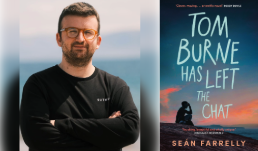
Easty Lambert-Brown of Ernest & Hadley Booksellers in Tuscaloosa, Alabama, served on the panel that selected Farrelly’s book for Indies Introduce.
Lambert-Brown sat down with Farrelly to discuss this debut title. This is a transcript of their discussion. You can listen to the interview on the ABA podcast, BookED.
Easty Lambert-Brown: Hi, my name is Easty Lambert-Brown an owner and buyer for Ernest and Hadley Booksellers in Tuscaloosa, Alabama, and I'm here with Seán Farrelly, who has written Tom Burne Has Left The Chat.
Seán has had four plays produced and two short stories published in the Irish Times as part of a young writers' supplement. He has worked as a writing mentor and workshop facilitator for young people since 2018. He lives in Dublin.
Welcome, Seán. I'm so excited to talk to you today!
Seán Farrelly: Hi, I'm thrilled to be here!
ELB: This is the first time I've participated as an Indies Introduce panelist and I must say that the experience has had a huge impact on me, especially with your book. From the first chapter, you had me hooked with Jamie finding the phone up on the top of the cliff and then how it unfolded into this detective story through social media.
I'm being a huge detective reader and we have a lot of detective readers in our bookstore. So, I intend to handsell this to not only YA readers but also adult readers. It has such an interesting, different take on evaluating someone's life and what happened to them to make them do something this drastic.
SF: Thanks so much!
ELB: In the July 20 issue of Publishers Weekly, you mentioned that the inspiration for your debut novel came from a 2023 New York Times article about “people discovering their deceased loved ones' digital artifacts” and how their phones were perceived as surgically-attached diaries to their hands, which I thought was a really great expression. How did that storyline morph into a commentary on loneliness?
SF: Yeah, so at the time of the New York Times article, I was actually writing a different book and had gotten it green lit with the agent. I flew over to London for the first time to meet her in person and also to discuss this other project. Then on the flight over, I saw this article and it prompted this whole slew of ideas about online legacies and our digital lives as compared to our real life ones. I totally derailed the original plan to have a conversation about this other book, especially with the editor, and stumbled my way into explaining this project.
I hadn't written it at that point, so it was way less concise, and I was like, “It's about a phone, and somebody dies and I'm not sure.” But then, in getting into the writing of it pretty quickly, it morphed into this closer look at grief of a young person and how they're using the phone as a bit of a crutch or a coping mechanism or like a deflection tool. In the article, it was an older couple and they used technology as a tool for remembrance or commemoration. So, it was this idea that, when somebody passes away, there are many online remnants that outlive them.
I aged that down and thought, “Instead of an older couple, what if it was a pair of teenage boys? Instead of them being married, what if they were strangers?” So, instead of this tool for remembrance, it becomes this way of excavating into somebody else's life a little bit voyeuristically and puzzle-piecing or Frankenstein-ing a personality for them based on the digital fragments contained within their phones.
ELB: That's amazing. I love when things like that happen.
SF: Do you guys have the phrase “lose the plot,” like somebody's “lost the plot.” Maybe it's an Irish phrase.
It basically means that somebody loses the run of themselves. That's when the story begins. For me, when you're writing, the interesting thing happens when you begin to lose the plot. So, I went in with this fixed notion of exploring digital legacies and technology with young people and social media, and then very quickly I lost the plot, and it became about grief and Jamie's story and his relationship with his father.
ELB: That's terrific. What a great story. One of Jamie's teachers talks about a new way of grieving, comparing that to a new way of living life through the digital information age. I really like this concept. How do you see this working out for our YA readers?
SF: There's such a feeling of permanence, and especially when you're posting things online. I feel like for a while people weren't thinking about the implications or consequences; they would just post something, and it would feel quite removed or divorced from their real life. Whereas now, there's a desire almost to cultivate that sense of permanence with a lot of age anxiety and — I don't know if you're familiar with this idea of “looksmaxxing” with young people — trying to use skincare products and go to the gym and all that kind of stuff when you're like fourteen, fifteen, sixteen-years-old.
Death is unfortunately inevitable. Having just experienced a bit of a loss in my own family, it is just part of life and part of that cyclical process. I feel like the more that that's embraced and acknowledged, the healthier and less anxious you become and the more you're able to realize that you're a smaller part of a bigger story. There's some comfort in that idea.
I won't spoil anything, but there's a scene where Jamie, the main character, is going for a swim, and it's raining, and he's “basking in his own insignificance.” That's part of that sentiment, realizing that although the things that you're posting might outlive you, your actual life will come to an end. But, instead of that being a terrifying, daunting thought, it's nice to ease into how natural and how universal that is because it's kind of an equalizer in a way.
ELB: It's funny you mentioned how teenagers respond to death. In reading many of the YA and middle grade books for this panel, I was struck by how much death played a role in a lot of these plots.
Is this a new development or have we become more overtly aware of how we talk to our young ones about death? Why is death so front and center right now?
SF: I'm not sure. I was also surprised. I was reading all the synopses on the list, and it struck me as coincidental as well. I definitely didn't set out to write towards a death trend or something like that. It happened organically, but my interest in it, I suppose, was how it can be a force of isolation. We're living in an increasingly isolated world where experiences are quite siloed, and we live in these discrete echo chambers.
It had created a distancing effect that, when compounded with this idea of witnessing a tragedy, already being a bit distanced from your friends, and this potential geographic distance that's being imposed by this hypothetical move at the very beginning of the book, it just felt quite natural.
Then also, with the dad having died before the book begins, it justifies Jamie picking up the phone in a way that it mightn't otherwise. It was a little bit unclear when I was doing the first draft, and it became kind of evolving conversation with the editor as to why he does it because it's such an impulse decision, and it doesn't make sense to him, even though the book is an exercise in self-racialization and justification.
My final answer on it is that he needed to process the death of his father, and the way of doing that was kind of roundabout and using the phone as a backdoor to get into those bigger feelings that he didn't have access to or the vocabulary for ordinarily.
ELB: Makes total sense! I love that Goodnight Moon played such a big part in this story, but was horrified when I read, "Did kids still read books?” which is a question that Jamie asks himself about the state of reading in his world. I literally screamed when I read that, and sadly, I think this is a universal thought.
As a writing mentor, how would you promote reading in a digitally engaged generation?
SF: Yeah, it's interesting because I think my opinion on that has changed. I was more nihilistic when I was Jamie's age than what I am now.
In terms of including Goodnight Moon stuff, originally, it was actually a ticket for them to go to the cinema to see The Philadelphia Story because there's a line in it that's like “I don't want to be worshiped. I want to be loved.” I thought that spoke to Jamie pedestalizing Tom in a kind of a twisted way. Then it became a receipt for a bookshop, and he bought Moby Dick, and there was a metaphor about Tom being a white whale and pursuing something that is un-pursuable, but that felt a bit too bloated and forced.
What actually made more sense is if Tom was going to get a gift for somebody, which we're not sure whether that's the truth, but it's what Jamie thinks is true.
I feel like that act of gift giving is such an important part of books as a community, even if it's just a recommendation, that can be a gift as well. I like the irony as well that, in order to reach the sentiment of “do people read books these days?” you'll have to read the book to get there.
On a structural or technical level, I was also very interested in eliminating the distance between the reader and the author and the main character. I come from a theater background — I wrote plays for kids all through my twenties — so I wanted to have real life transcripts and voice notes and things so that the readers could have their own reactions first and then read Jamie's reactions as a foil to see whether or not they would agree with how he's interpreting things and adding to that detective story.
I wanted to include QR codes in the voice notes so people could scan them with their phone, and instead of it being a tool for distraction from people who are reading, it's a tool for immersion. Those voice notes do exist on Faber's website.
We weren't able to put the QR codes in the book for other reasons, but I was determined that that was a feature that happened. I'm interested in ways of harnessing the power and potential of using digital devices as a means for storytelling, because everybody is very versed in them anyway and most relationships are based around messaging. I feel like that still counts as reading and people are involved in text every day.
In terms of engaging younger people with storytelling, approaching it at their level, and it's not like books and literature are in some lofty distance, the way that Jamie originally thinks Tom is. It can be actually quite accessible and it can be a space that you can belong in, as opposed to feeling intimidated by it, even if you haven't read a book before, or you're in a bit of a slump, or whatever.
ELB: As a bookseller, I'm noticing that a lot of young people, and we live in a college town, are coming in buying classics. Now in the States, there are board books made from the classics, and graphic novels made from the classics. Anne of Green Gables in graphic novel format is a huge seller for us, which makes me a very happy person.
SF: I teach drama classes and creative writing workshops as my money job, and I have this group that I teach on Thursdays. They were asking me to tell them to put away their phones, but they didn't want to ask me because that might be seen as a bit uncool or whatever.
They were the ones who suggested this idea that phones are these surgically-attached diaries, and so what I did was I invented a “phone spa” to give your phone a break. We created these little boxes and we put like these little paper cucumber eyes over the phone and let them have a sleep while we like got on with making stuff.
I feel like creating those books or bookshops can also be that third space where, in a subconscious way, you're seeking out that quietude or that sense of connectivity or community. I think there's a craving for that internally anyway. When that gets facilitated in a way that doesn't talk down to young people, it's taken up readily.
ELB: Yeah, and speaking of talking down to young people, the role of the adults in your book was very positive. The challenges that parents have in navigating the real world, as opposed to the digital one, is remarkable.
There are many times in your book when, honestly, I think I would have thrown my child's phone in the sea and — this sounds terrible — the child right after it, because of the level of frustration in the conversation. Talk to us about how you saw the role of adults in the book.
SF: The mother character is actually my favorite character. When I was writing Tom, and I really empathized with the mom who had Atlas syndrome and was holding the world up on her shoulders, but was also potentially overworking or trying to force the issue of this move when that wasn't where Jamie was at all.
I felt my sympathies were shifting — maybe that's a byproduct of growing up as well — but I felt like they were shifting more towards the adults. It wasn't like a crusade to create positive adult influences, but it was a way of having a bit of an intergenerational foil, so that Jamie could, when he was ready, have conversations about the necessity of these devices or this way of connecting and have other people with lived experience that was contrary of that. Because when you're involved in something, it can become your whole world, and it's important to get different perspectives.
ELB: Without giving anything away, the scene with Tom's father and Jamie and his mother, I did not see the end of that conversation coming. That was a total surprise, and actually was a tipping point in the story of how it could have gone one way or the other. It’s just the sweetest part of the whole story.
SF: Yeah, that was one of the scenes that I had on my wall with all my flashcards. I had a shorthand for it called the “Triangle of Grief”, and again trying not to spoil things, but I loved the whole fatherless, sonless, motherless aspects at different points. That moment I was really excited to write into, because it's heartbreaking when everybody tries their best to understand one another, but everybody is also falling short at the same time. I feel like that can be quite human, and I think also part of it that I was excited in.
I was making the adults complicit as well; to go into the phone being a diary analogy, that you’re also witnessing Tom's life in a way that he maybe didn't intend or has no control over, so in a way you're as complicit as Jamie is in his kind of pursuit for understanding, and I feel like that that that has a humanizing effect on adults. So, as opposed to approaching from a place of moral superiority, they're more level with Jamie, and I feel like that creates a sense of desire to understand, even if that understanding isn't enough at that point.
ELB: That's very well said. It's heartbreaking, but it's the best part of the whole story and is the most hopeful part of the whole story.
The world of influencers and posters can be mind-numbing. Are you making a statement about their relationship, and if so, what is that message? What's your overall message for the novel?
SF: It's a fun question. I'm a big John Green fan — I'm very excited that Hollywood, Ending is coming out — and he talks about how once the book is in the hands of booksellers or readers, it's no longer the author's business. I always shy away from this idea of making a bold proclamation or statement or proselytizing about what my interpretations of what happened were.
That caveat aside, I was really wary to be damning over anybody's use of technology or social media, and I really didn't want to come across as sanctimonious or wag my finger, and that's why I created that character, who's a very small character, but who writes an article to try to capitalize or add to the noise and the outrage of this type of death and what that potentially could mean in broader cultural terms.
I wanted to estrange the point of view from that viewpoint to represent that there's going to be no judgment in this story, in so far as, like for example, the relationship between posters and people who are consuming that content, the viewers.
In general, I wanted two things to be true. I wanted it to be true that parasocial relationships, as well as para-romantic relationships, potentially could be as real and valid as “real life relationships”, while also showing that they can be potentially isolating, and it's important to cultivate those connections in real life too.
My big takeaway, if I had one, was that connection, however big or small, or whether it's online or whether it's in person, is the salve or the antidote to that feeling of loneliness or isolation. Hopefully through conversations prompted by the book, or people reading it, or engaging with it in any way, that can serve as a form of connection ultimately as well.
ELB: That's really an important point. In handselling this book, I would make that exact analogy of connection, loneliness, and how it's so important to stay connected.
Thank you, Seán. I enjoyed talking and seeing you and listening to you and I hope all the best in the sales of your book. We will, as booksellers, do our best to promote it and carry on the good word of Seán Farrelly.
SF: Thanks so much. It was so lovely to have this chat, and I feel wild that it's getting published in the states. It feels like an absolute dream come true.
Thank you for being a champion for the story and other stories. I can't wait to read other books that are on this list!
Tom Burne Has Left The Chat by Seán Farrelly (Faber & Faber Children's, 9780571388219, PB, YA Fiction, $12.95, On Sale: 9/1/2026)
ABA member stores are invited to use this interview or any others in our series of Q&As with Indies Introduce debut authors in newsletters and social media and in online and in-store promotions. Please let us know if you do.