Lenna Jawdat is the author of 70,000: Poems, a Summer/Fall 2026 Indies Introduce selection. 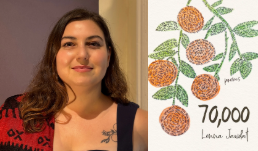
Jocele Skinner of Shared Stories Books in Caldwell, ID, served on the panel that selected Jawdat's book for Indies Introduce.
Skinner sat down with Jawdat to discuss this debut title. This is a transcript of their discussion. You can listen to the interview on the ABA podcast, BookED.
Jocele Skinner: Hello, my name is Jocele Skinner, and I'm the owner of Shared Stories in Caldwell, Idaho. I am here today to talk to Lenna Jawdat about her new poetry collection, 70,000. Welcome, Lenna. We're so excited to talk to you today!
Lenna Jawdat: Thank you so much. I'm really excited as well.
JS: Lenna Jawdat is a poet, writer, and psychotherapist of Palestinian and Iraqi descent. Her writing, which explores trauma, identity and resilience, has appeared in journals such as Poet Lore, The Margins, Passenger’s Journal, Rogue Agent, among others, and in the 2025 Haymarket anthology Heaven Looks Like Us. She was a 2021 Best of the Net nominee for her poem “Ode to the Psoas,” a 2022 Sundress Academy for the Arts summer resident, and has attended Tin House Workshop for poetry and creative nonfiction. She is also co-organizer of the poetry vigil series In Water and Light. Lenna received her MFA in Creative Writing from the Institute of American Indian Arts in May 2024. She lives in DC with her partner and two cats, and we are super excited to visit with her today!
LJ: Thank you.
JS: I served on the Indies Introduce panel for the Summer/Fall 2026 collection, and when your book came up, it was an instant hit. We were just so intrigued by the poetry and the artwork.
Could you tell us a little bit more about yourself, your background, and how it helps inform your writing?
LJ: Sure! So, you heard in my bio, I am Arab American. My dad is half-Iraqi, half-white American, and my mom is Palestinian, but grew up in Lebanon. I was born here and raised in the US. Being an Arab American led me both to become a trauma therapist and a writer.
The news was always on in the evenings in my house. We had a lot of family and friends who would come over and tell these horrible stories of things that they had heard about, or that the people they knew had been through, and I became really good at observing and absorbing the things around me.
I did a lot of reading to try to understand my own experiences, and ended up studying psychology as a way to try to understand that. I went to grad school for clinical social work to become a therapist, specifically a trauma therapist. My program was anti-racism focused, so I also really looked through that literature to try to find some answers about my own experience and see that reflected back.
In a lot of ways, I really struggled to find media representation of my own experience as a fairly white presenting Arab American person. I couldn't find many books, fiction or nonfiction. Thankfully, publishing has diversified a lot and I've found a lot more that resonates and feels close to home.
A lot of what I do in terms of my writing is I'm trying to better understand myself. My hopes with publishing my work is that other people see themselves represented in my work as well.
When it comes to this book specifically, I was reading Rashid Khalidi’s book, The Hundred Years’ War on Palestine, and found this footnote about the theft of 70,000 books from Palestinian homes and private libraries in 1948, and that was when my maternal grandparents fled. They both, separately with their families, left and went to Lebanon in hopes that the conflict would blow over. It, of course, did not, and they ended up staying in Lebanon, losing everything they left behind. That was around that same time that these books were taken by Zionist forces and guerrilla groups, and most of those were destroyed.
Reading about that really resonated and stirred things up inside of me, and so I started writing the numbers in the book to try to process that. I used my training as a trauma therapist to observe my own experiences and help myself move through and process what was coming up, rather than staying in a triggered place with it.
JS: I must admit, I didn't know anything about the book theft, and — and of course, we live in the book world — it's just heartbreaking to read about that and how much was lost and everything that your family went through.
LJ: Thank you. As book lovers in particular, this is really a horrible piece of information to learn. There's so much that we capture in books, and in that archive of cultural experiences and personal experiences, just the thought of all of that being lost is really gut-wrenching.
JS: Absolutely. You wrote about really hard things — the books are the least of the bad things that happen — how did you maintain your own emotional health while writing about these really hard things? Because I think it would be very challenging.
LJ: I used my training as a trauma therapist to guide that. I pay really close attention to what happens in my body, and I try to take care of myself in whatever way that calls for.
I might notice if I'm going into more of a flight response, my legs start shaking, and I might need to get up and go for a walk. Or if I go into more of a fight response and I feel really angry and hot, and I might need to lift something heavy.
One thing that came up a lot while writing this book was what's called the Social Engagement System activation, meaning I felt this need to just call out for help. In some ways, I was doing that through the writing. But definitely monitoring my own experiences, taking breaks when I needed them.
One thing that I think about is pendulation or titration, basically moving between something really hard and something nourishing or a resource of some sort. So, in writing the book, I was trying to do that for myself.
In some ways, creating those images did that for me, but also my hope for the reader is that that serves as a break or a resource as well. There are moments where I'm writing about something really horrible, and then I might move to humor or to something hopeful, and so I also tried to curate that for my readers.
JS: What an amazing thing that your training was able to help you do this and do it well!
You mentioned a little bit about images, and I wanted to talk about some of the images and the artwork in your collection. One of the things that struck me the most was — more than just the numbers — how you shape the numbers into different things like fruit or keys or some of the photos in there.
What was the inspiration for that? Were some of the photos your family photos?
LJ: Yeah, some of those photos are family photos. Others are from open-source media sites, and I have a lot from the Library of Congress’ online photo archive.
In terms of what inspired me for the numbers and the shapes those take: I started this book in my MFA program. My first fall in this program, I was working with Layli Long Soldier, who's this brilliant Lakota poet. She talks about the relationship with your work as a reciprocal relationship, and asking the words or whatever is on the page where it wants to live on the page. She talks about decolonizing the page and the sovereignty of the things that you put on the page.
I had started writing these numbers, and I did not think that this was going to be included in any sort of work. It was by process more than anything.
But I owed a draft, so I sent her this photo of the first page of numbers, and I explained to her what was going on, and I just said, “This isn't the poem. I want to write a poem.” I thought I was going to write one poem about this, so, I was going to write 70,000 numbers, not knowing how long that would take me but to process so that I could write my one poem.
She encouraged me to keep going with that process, but she also said, "By the way, you don't have to keep all of your numbers in neat lines, top to bottom, left to right. That's a very Western way of doing things.” I had the first page of numbers on college ruled paper with, and she just said, “You know, you don't have to do it that way. You can open your mind to things going a little bit differently. Where do the numbers want to go?”
That unlocked something in me, and gave me permission to do whatever I felt needed to happen. They started taking shapes. Some of them were actual shapes, like on the cover of the book. There are these oranges, and the shapes of the oranges and the branches are made up of those numbers. Some of them are images that are related to themes in the writing itself in the pieces, and then others, the numbers sort of form frames around photographs or things like that. Then it became sort of a conversation, between the images and the writing.
JS: It was very striking. Do you do a lot of drawing? I'm a terrible artist, so I find it fascinating that you were able to put those in those formats.
LJ: I don't normally draw, I dabble here and there in collage, but my parents are both artists and so there's that sort of artistic mindset that sometimes comes up. At the same time, it makes me super intimidated to do art, so I’ve never really thought of myself as an artist. For myself, I often play with watercolors or collage, but this just sort of unlocked something for me, and it felt like what the work was calling for.
JS: Absolutely, it adds a huge amount to the collection.
Would you be willing to read us a poem or two from your collection today?
LJ: I would be happy to read. I have two poems here, so we'll start with this one, “The Legacy of Diaspora Is”
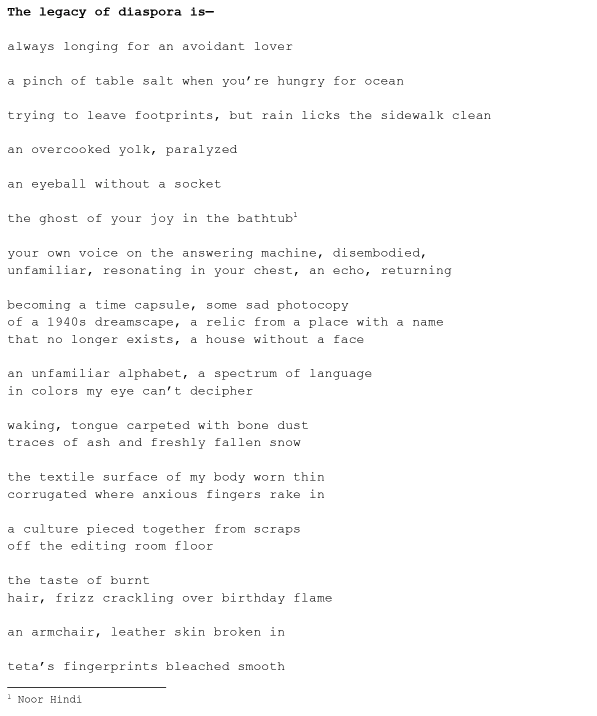

JS: That's lovely. Thank you.
LJ: Thank you. Then, I'll read "Reasons to Live When My People Are Dying.”
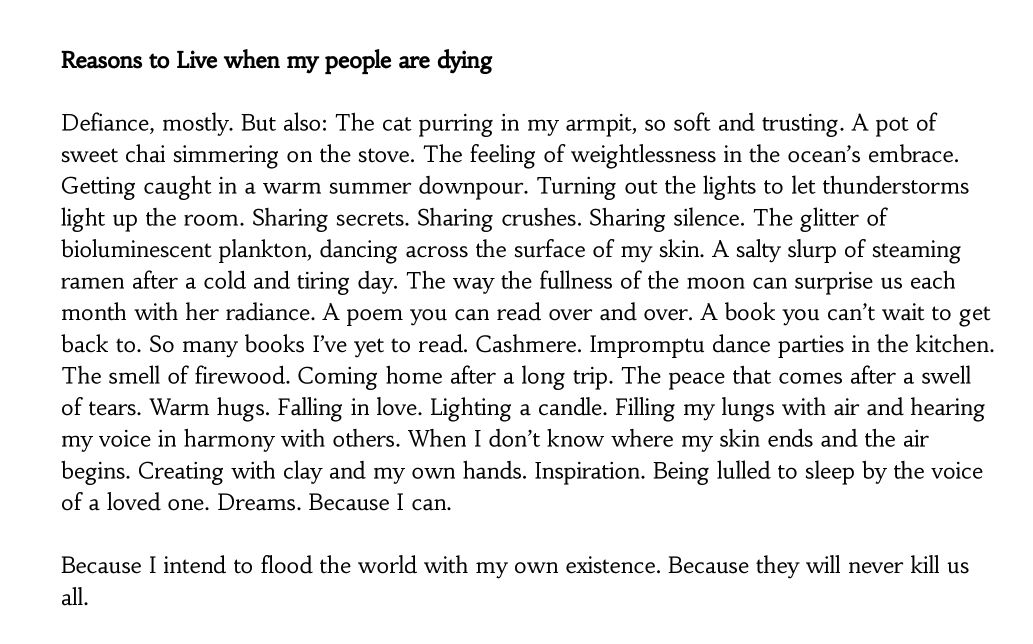
JS: Amazing, thank you. I think we were both getting a little misty-eyed while you were reading that, so thank you.
You did amazing with this whole collection. What would you want us as booksellers and as readers to take from this collection? What is the one thing that you can distill for us about this?
LJ: I would love this to be an invitation to tune into one's own body and one's own emotions. So much around what we think about when we think about Palestine and specifically what's happening right now, we get into this trauma mindset and we think about things in really rigid ways — good or bad, right or wrong — and that prevents us from feeling true empathy and experiencing nuance in the way we think about things.
I would encourage readers to tune into their own emotional and physical experience while they're reading and see what happens for them.
I would like this to nudge people towards more open-mindedness, open-heartedness, and eventually, hopefully, that changes policies and lives.
JS: You did a great job bringing humanity to all of this. So, thank you.
Congratulations on being selected as an Indies Introduce selection. We just loved it and are so excited to sell it in our bookstores.
LJ: Thank you so much. I appreciated this time!
70,000: Poems by Lenna Jawdat (Central Avenue Poetry, 9781771684545, PB, Poetry, $22.00, One Sale: 7/7/2026)
You can learn more about this author at lennajawdat.wordpress.com.
ABA member stores are invited to use this interview in newsletters and social media and in online and in-store promotions. Please let us know if you do.