Booksellers who joined us at Children's Institute 2026 (Ci2026) in Schaumburg, IL, may remember the Pride Bookselling History signage we had displayed at the event.
The display (pictured below) spotlighted several historic LGBTQ-owned bookstores.
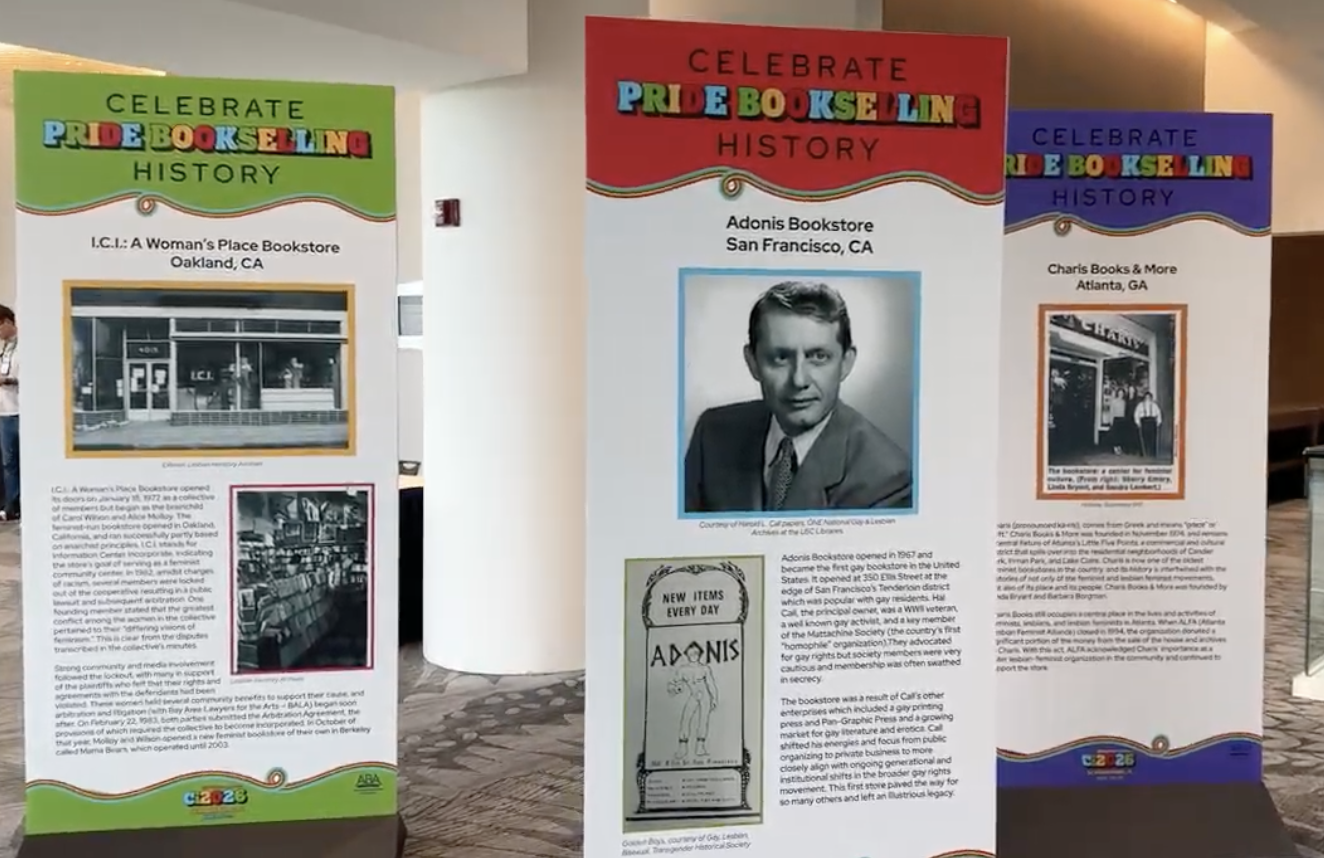
This LGBTQ+ History Month, we've brought all the valuable history from that display to BookWeb.
If you weren't able to join us at Ci2026 (or you didn't have a chance to pause and take in the display!) you can now read about these historic bookstores!
Adonis Bookstore
San Francisco, CA
Adonis Bookstore opened in 1967 and became the first gay bookstore in the United States. It opened at 350 Ellis Street at the edge of San Francisco’s Tenderloin district which was popular with gay residents. Hal Call, the principal owner, was a WWII veteran, a well known gay activist, and a key member of the Mattachine Society (the country’s first “homophile” organization). They advocated for gay rights but society members were very cautious and membership was often swathed in secrecy.
The bookstore was a result of Call’s other enterprises which included a gay printing press and Pan-Graphic Press and a growing market for gay literature and erotica. Call shifted his energies and focus from public organizing to private business to more closely align with ongoing generational and institutional shifts in the broader gay rights movement. This first store paved the way for so many others and left an illustrious legacy.
Oscar Wilde Memorial Bookshop
New York, NY
Oscar Wilde Memorial Bookshop opened in Greenwich Village in NYC in 1967. It continued the trend of bookstores being safe spaces, places of gathering and places of information. Craig Rodwell, opened the very public storefront as a declaration. He was tired of gay spaces being dark and hidden. He created something that was open and daring. The shop stocked books and periodicals that uplifted gay and lesbian issues; Rodwell refused to sell hardcore pornography, in part because of the Mafia-controlled distributors of this content, but he did carry male physique magazines.
Rodwell saw the bookstore as a community bulletin board, carrying announcements of important activities, as a clearing house for those interested in law reform in New York State, and as a spur to writers who would now have a place to sell their gay-themed work. On his letterhead and on the store window, he called Oscar Wilde “A Bookshop of the Homophile Movement.” He modeled the store after the Christian Science reading rooms he had grown up with, which sought to impart a positive image of the world.
At first, Oscar Wilde only offered a limited number of publications for sale and Rodwell had to spread books out so that the shelves would appear full. His first year was a rough one — vandals broke in three times. But eventually, the shelves were filled with more and more LGBT-related publications. A public presence was crucial to Rodwell’s vision for the store: its front window was adorned with slogans such as “Gay is Good” and “Gay Power.”
I.C.I.: A Woman’s Place Bookstore
Oakland, CA
I.C.I.: A Woman’s Place Bookstore opened its doors on January 18, 1972, as a collective of members but began as the brainchild of Carol Wilson and Alice Molloy. The feminist-run bookstore opened in Oakland, California, and ran successfully partly based on anarchist principles. I.C.I. stands for Information Center Incorporate, indicating the store’s goal of serving as a feminist community center. In 1982, amidst charges of racism, several members were locked out of the cooperative resulting in a public lawsuit and subsequent arbitration. One founding member stated that the greatest conflict among the women in the collective pertained to their “differing visions of feminism.” This is clear from the disputes transcribed in the collective’s minutes.
Strong community and media involvement followed the lockout, with many in support of the plaintiffs who felt that their rights and agreements with the defendants had been violated. These women held several community benefits to support their cause, and arbitration and litigation (with Bay Area Lawyers for the Arts — BALA) began soon after. On February 22, 1983, both parties submitted the Arbitration Agreement, the provisions of which required the collective to become incorporated. In October of that year, Molloy and Wilson opened a new feminist bookstore of their own in Berkeley called Mama Bears, which operated until 2003.
Amazon Bookstore
Minneapolis, MN
Amazon Bookstore was a real and thriving feminist bookstore located in Minneapolis, long before the online entity ever was conceived. At one point in its storied history, it was the only lesbian/feminist bookstore in the US. Amazon Bookstore was founded in 1970 by Rosina Richter Christy and Julie Morse Quist. Like many early feminist bookstores, Amazon Bookstore began as a small operation with modest resources. The books were kept in the front room of the collective they lived in and books were only available from 3:00 to 6:00 pm or by special arrangement. This arrangement lasted for about two years before the bookstore moved to Minneapolis' Lesbian Resource Center and then migrated through a series of different storefront addresses.
The shop was named after the Amazons, female warriors of Greek mythology known for their physical agility, strength, archery, riding skills, and combat arts. In 1994, the online company of the same name was founded, bringing problems for Amazon Bookstore with it. In 1999, the cooperative sued the online retailer of the same name for trademark infringement. After a rigorous court battle, the case was settled in November of that year, with Amazon Bookstore assigning its common law rights in the Amazon name to Amazon.com; and Amazon.com giving a license back to Amazon Bookstore Cooperative for use of the Amazon name.
Charis Books & More
Decatur, GA
Charis (pronounced ka-ris), comes from Greek and means “grace” or “gift.” Charis Books & More was founded in November 1974, and was a central fixture of Atlanta’s Little Five Points, a commercial and cultural district that spills over into the residential neighborhoods of Candler Park, Inman Park, and Lake Claire. Charis is now one of the oldest feminist bookstores in the country, and its history is intertwined with the histories of not only of the feminist and lesbian feminist movements, but also of its place and its people. Charis Books & More was founded by Linda Bryant and Barbara Borgman. The store moved to Decatur, GA, in 2019.
Charis Books still occupies a central place in the lives and activities of feminists, lesbians, and lesbian feminists in Atlanta. When ALFA (Atlanta Lesbian Feminist Alliance) closed in 1994, the organization donated a significant portion of the money (from the sale of the house and archives) to Charis. With this act, ALFA acknowledged Charis’ importance as a sister lesbian-feminist organization in the community and continued to support the store.
A Room of One’s Own
Madison, Wisconsin
A Room of One’s Own has been a staple in Madison since 1975. The store was founded by five young women who had recently finished their degrees at the University of Wisconsin: Sandi Torkildson, Moe Doe, Susan Ketchum, Gail Straw, and Sally Stevens after raising the funds to open the store themselves. Conceived as a feminist bookstore that sold new books, A Room of One’s Own carries on as a feminist and liberation focused bookstore through their curation, community partnerships, and events.
Room carries titles in feminist and gender studies; provides literature for, by, and about women, trans people, non-binary people, and queer people; and offers a wide range in fiction, children’s books, local history, and more. Since 2021, the store’s been located in Madison’s near-east side.
Giovanni’s Room
Philadelphia, PA
Founded in 1973 and reborn in 2014 with Philly AIDS Thrift as its proprietor, Giovanni’s Room in the Gayborhood holds the title of oldest LGBTQ+ bookstore in America. The store has continued to evolve to survive the changing times. The store is volunteer-run, stocks the newest LGBTQ+ releases as well as used classics and zines, and boasts a healthy slate of literary events including a monthly queer book club.
To create a literary space, they had to gut the entire structure. The bookstore’s renovation was built up by volunteers who wanted an LGBTQ+ bookstore in their neighborhood. The volunteers left a literal mark — in the basement, their names and signatures are etched into the concrete.
Giovanni’s Room is not just an institution in the LGBTQ+ community for its perseverance. It also has become an inspiration for the queer bookstores that continue to open and serve as community spaces around the country. Giovanni’s Room is both a historical marker and a beacon of hope.