Independent booksellers across the country have chosen Daniel Nayeri's This Is a Door (Stonefruit Studio) as their top pick for the November/December 2026 Kids' Indie Next List.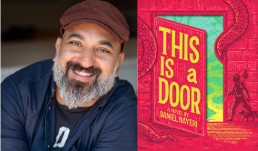
“This book is a visual wonder! A journey that we can all join in and travel along with a boy, a mouse, and a dog. This Is a Door will forever be a book that leads us all to ourselves, our families, and to friendship,” said Becky Anderson of Anderson's Bookshops in Naperville, Illinois.
Here, Nayeri discusses their work with Bookselling This Week.
Bookselling This Week: I read the author's note at the end of the book, and in it you describe how this book started as a challenge to yourself — a challenge using the Hero’s Journey and to create a picture book without illustrations.
Do you want to tell us a little bit more about how you designed that challenge? What prompted it?
Daniel Nayeri: I write by hand. One of the things I love about writing by hand is that when you get stuck — I get stuck a lot — you doodle. I'm not a great artist at all, but I am a really solid doodler. My mind will be working on what the next sentence should be or where the story should go, and I'm in the corner of my notebook doodling something. To me, that’s infinitely more productive than if I were on my laptop, where I'd probably be checking my email.
So, one day I was sitting there and I was doodling the phrase “This is a door,” specifically because it's the kind of phrase we say to young people about books.
I doodled it and I kind of nudged the “A” over and it looked like a doorknob. Obviously, I've been aware of concrete poetry and carmina figurata, but this made me think, “Could I give myself the challenge of telling an entire linear story that way?”
I've done a single poem and tried to have the text in some way illustrate what it is saying, but could I do that over the course of an entire story?
I started by designing the pages. I would think about where the story should go and how I want the spread to look, and then I would count the lines and the number of characters I could have on the page and I would go from there.
So, every page began as a bit of a design challenge, and you can very quickly see where I started to run into certain categories of problems.
The main categories were well-trod design principles, especially in the comic book space. As we read in English, the human eye goes from top left to bottom right, and we read in a linear fashion, so those are the two main principles I derived a lot of my rules from.
Did I want the spreads to be browsing opportunities where you open a spread and there's text is everywhere? Or did I want to really impose that linearity of reading from the top left to the bottom right?
My answer was, I did want to do that. I wanted it to be a story, not a bunch of linguistic collages. I wanted to have a beginning, middle, and an end. I wanted it to feel satisfying and not burdensome to the reader, in terms of compiling meaning.
At some point, you build these rules out of arbitrary preference, not out of objective demand. For example, in a scene where the character is wandering, what kind of wandering line do I like and what don't I?
That's where those early design principles started to pop in.
Then there was the question of whether this is a story that manages such a linear shape that you could have an audiobook for it. That would require every word to be in sequence, so the sequential nature of it started to take on some importance.
Then I thought, “Within those rules, let me see how far I can take this.”
Eventually, I got to some other rules that I thought were really important.
For example, I didn't want to distend letters, because if you take that to its logical conclusion, you could just take a letter and tangle it up and just make an image out of it.
So, I removed that as an option — the letters could get bigger or smaller and they could move, but the letter form had to remain.
I found myself really fascinated by those particular kinds of rules.
BTW: I love it. It didn't occur to me that you would have to start with the design to see the character limit for each page. But of course, now that you say it, it makes perfect sense.
DN: And that's the beauty of the art form. There's a school of writers that I've always been fascinated by, Oulipo, who were known in the late 20th century for giving themselves really arbitrary restrictions for writing their books.
Now, some of these restrictions are so easy to parody.
We all know the classic one, which is writing a novel without the letter “E”. There was a woman who wrote an entire novel with only 3 letter words.
Italo Calvino did several challenges where he laid out an entire tarot deck, wrote a story following the configuration of the deck one way, then shuffled the deck and told a different story with the new arrangement.
I really love it when the limitation gives you just enough restriction to bounce off of. I think most artists can relate to this. We all know that the complete removal of boundaries is actually harmful to creativity. You want to have some restriction, and I think the Oulipo took that into these really fun, interesting, wild directions. I've always been inspired by that, and there is, I think, an art to picking the right limitations for each project.
BTW: Did the story itself change much throughout the process?
DN: By the time you get a little way in something like this, it’s not set in stone, but you do really need to be sold on where the story is going. So, I spent a lot of time on the outline.
Usually, I write with a little bit of an openness. Draft two could really take us anywhere, but I can enact those changes pretty easily. The hero's journey entered the equation when I realized I wasn’t going to be able to be as flexible as I usually am after the first draft.
Thankfully that kind of unlocked the rest of the story for me.
BTW: Are there any other challenges that you're now tempted to tackle?
DN: The short answer is yes. I love it.
I love that sort of experience, that creative prompt. I love interactivity.
I think nonfiction children's books have done such a good job in the past of being really high design, and I love that notion of bringing that to fiction.
When we think of interactive stories, we tend to think of one mechanism only, which is the maze mechanism — famously choose your own adventure or pick a path stories.
And that's a great one! It's a great mechanism. But there's a lot of other mechanisms of interactivity that I think about as well, which are really interesting and were really popular in the ’80s.
Graphic novels, of course, are always their own challenge in terms of how to elaborate a story and tell it sequentially and visually.
All of the above is the short answer. If I could, I would write in every category they let me! So, we'll see what happens.
BTW: You could definitely do that.
DN: I don't know about you, but when I go to a buffet, I only scoop a bite of everything.
You know what I mean? I know there are folks who will pick out foods and make a meal, and that's wild to me. I need just a single bite of every one of them.
So maybe that's just been the heuristic I've taken for all of my life.
BTW: I do have a silly question. It's just occurred to me.
In a book like this, where some of the text is upside down, is your first instinct to turn your head or to turn the book?
DN: Turn my head. Then, turn the book once I hurt myself.
In this book, there’s only a few of those, and I tried really hard to make sure it was only when it counted.
For those of us who've had neck injuries in the past, like myself, I tried to have some thought and care. So they happen, but they happen sparingly.
BTW: This is not your first work that has a theme or through line of finding your purpose. Do you want to talk a little bit about that?
DN: It's a theme that seems to come up a lot in my visits to school.
I'm not ancient, but I span enough years at this point to track a few differences, and I'll tell you one difference that's really popped up in my head a lot. When I was a kid, the first question any adult asked a kid was, “What do you want to be when you grow up?”
It's literally the first thing you had to have an answer for when you were a kid, and it was kind of an identifier of you. You were the kid who said, “I want to be president,” or “I want to be a race car driver.” You were effectively saying what you think you're good at.
I've noticed adults just don't ask that anymore. I certainly find myself reticent to ask that from kids.
I think for a couple reasons, but I think it's a harder question to answer. It's an answer that brings up more negative feelings than excitement. That makes me sad. It makes me sad that you might be able to ask that from somebody and they might not have an answer that they themselves are happy with.
As a kid, we were always worried that the adult might not approve of our answer.
You’d say, “I want to be a rodeo clown,” and they'd be like, “well, that's not good enough.” You were being tested.
Nowadays, I actually feel like the child might not be happy with their answer. And I think that's born out of a pain point — they might not feel empowered or excited or informed on how to find their purpose.
It scares me when I say these kids might not have access to that. As a result, that's a topic I think about a lot.
You can't do the thing that we did generations ago, which is tell them to go be a doctor or something similar. So, what do we actually say?
Put yourself in front of a child and ask yourself what story or statement or advice you would give them? How do they find their purpose?
If you don't know them, it's very hard. You’ll be able to give good advice if you are in community with somebody. But I'm not, I'm just an author who comes in for the day to speak to them. I want to give them good general advice on that front, so I think about it and often my characters end up thinking about it.
I mean, I think about it for myself. I often think about my purpose and what I should be doing.
And the answer is almost always going to be explored best in a story, because of how multifarious we are.
BTW: No, I think that's an excellent answer.
I know I hated getting asked that question when I was little. You're right. You don't hear it as much anymore — and probably in part because we all hated it.
We like to bring these conversations back around to indie bookstores at the end of the interview. Would you like to talk about the role of books or indie bookstores in your life?
DN: Your transition is perfect, because the answer I tend to offer to people is to get good at something.
I actually don't care what it is, but I do want you to get good at it.
That is the amount of prescription I would put on a young person's life, because one of the things I think we’re missing is understanding…how do we get good at things? The answer is that you go through stages.
The first stage is going to be apprenticeship — mapping the landscape of whatever it is you're learning. You learn all the definitions and the names of all the tools and what they do.
The next stage is becoming a craft person. You’re somebody who uses those tools to solve problems.
The last stage, of course, is becoming an artist in that field. You become creative and being creative means you create your own problems to solve.
I don't know how to do without books.
The bookstore is functionally the get-good-at-stuff store — on any topic that you want.
It's the first place to go if you want to find your purpose, to read what other people have said about it.
If your purpose is juggling, great. If your purpose is being a chef, great. If it's poetry, awesome.
You can browse every single one of those aisles. In the fiction section, you get good at experiencing the lives of others and at expressing emotions or options you might never have been able to put words to before.
I don't know what the first step would be if it wasn't a book in a bookstore.
I think that's certainly what it was in my life — it just so happened that my passion also was books. It was a double whammy on my part.
Walking through a bookstore is like choosing a whole new purpose each time.