Independent booksellers across the country have chosen Jane Schoenbrun's Public Access Afterworld (Hogarth) as their top pick for the November 2026 Indie Next List.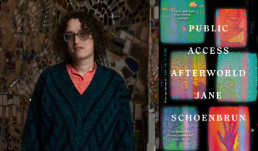
“This gorgeous book feels like the memory of a show about your own life that you woke up to playing in the middle of the night on a static-laced TV. For internet lovers and physical media fans alike, this is a book for the painfully nostalgic,” said Ramona Flores of White Whale Bookstore in Pittsburgh, Pennsylvania.
Here, Schoenbrun discusses Public Access Afterworld with Bookselling This Week.
Bookselling This Week: I saw that you talked a little bit in other interviews about not wanting to hand this story to the film industry, and how print allowed you to take it further than you otherwise could have.
What was the biggest or most surprising difference you noticed on this journey?
Jane Schoenbrun: Probably just how safe it made me feel. There were so many surprises and joys — as there always are when you are learning a new medium.
I’ve done that twice now. I spent years before I made my first film just studying, watching tons of movies and learning the intricacies of the language of cinema, so that I could understand how I wanted to use that language. This is something that there's no way to rush through.
In my experience, it just takes an insane amount of time before you've studied enough to let your ambitions meet your ability, and then you just keep studying.
It was very different, obviously, learning how to write a book. I'd written prose before, but I had never written a novel, and there was so much to learn.
I tried to approach that as a student, humbly and patiently in the same way that I had when I taught myself filmmaking, so that wasn't actually that surprising for me. But because it was the second time I had learned a new medium, I could recognize my progress.
The thing that surprised me most was that once I had finished a draft of the book and was editing it, I felt this incredible sense of fear going away.
It was the fear that when you write a script, this thing that is so dear to you might never exist. There are all of these forces, all of these people and lots and lots of money, standing between you and that vision getting out to people. There will always be this feeling in film that you can't fully be at peace.
Whereas with writing the book, I realized I actually did have the power. If I have something that I really feel like I need to get out, I can get it out of my brain and into something that other people can enjoy, something physical that will be published and that people can go buy.
The most surprising thing was how much that made me feel like I never had to feel that powerless feeling again, because I could always just write.
BTW: I think approaching it as a student like that is a really healthy way to approach a new challenge, and I'm really glad that it was such a joyful process for you.
You got to play with a pretty large cast of characters this time. I feel like the favorite to write would have been our interlude from the monster, but who was the most challenging voice or character to write?
JS: It really was such a pleasure to be writing for multiple narrators, and that is something that you can't do in film in quite the same way.
Their dialogue sounds different because this is a multi-narrator book, but my authorial voice always retains something of me, and it obviously is hopping into the brains and minds of all of these different people. Some of them are very confident. Some of them are deeply insecure. Some of them are super anxious. Some are better educated than others. It becomes like a prism, you’re looking at the same picture from all these different angles, and you get to see how they all see each other. It's such a gift in storytelling.
It can also get really overwhelming and confusing. The process of finding the difference between the voices was probably the hardest thing.
The switch from the first section to the second goes from being loosely in the perspective of a 17-year-old boy in the suburbs to an out trans girl living in Austin, Texas. I remember first confronting the challenge of having gotten used to writing in one way and realizing I needed to find this new person and the way she would be perceiving things differently.
The character that was hardest was probably Jules. I view Bethany and David as two mirror characters. They're our dual protagonists, and to put it really simply, one is my worst nightmare of who I would have been if I had never transitioned and one is like my life goals or who I wish I could be.
Then there's Jules who is stuck in between them. They’re trapped by the world, and they have a lot of anger and frustration. They don’t believe that they can have a better life, even while they know that they deserve it. They're just a fucking mess and they're super self-destructive.
It’s hard to write somebody that you want to grab by the shoulders and tell to take care of themselves. If I'm inhabiting that character authentically, that can't be the character's perspective on themselves. So, I needed to really get into how that hopelessness feels. That was both hard and rewarding. I don't think their brain works exactly the same as some of the other characters. They're not interrogating themselves in the same way, and they feel like a mystery, but only because they're so different from me. And I love them.
BTW: Do you want to talk at all about your personal style or inspirations?
I think people who are already familiar with your work might recognize your voice here, even across the different mediums. And even though it takes place in the modern day, you get that ’90s–early 2000s film vibes.
JS: I try to make things that feel like places that I'd like to go hang out.
For example, most of my first film takes place in a bedroom, and I really tried to make that bedroom one that I would want to spend time in, even if the things that were happening there were dark and lonely.
Even if it’s super low-budget, if something feels authentically like someone's personality or romantic in the way that art can feel romantic, you feel like it can become a home. And in the case of the work that I do, maybe also a place to go on a fantastic journey and to explore painful and personal and vulnerable things.
I've done it enough times now that I try very strongly to have the work reflect who I am, and reflect that inner realm inside my brain that we can all go spend time in. I know how to conjure it and I know the tones, the sense of humor, and the aesthetics that build it. To put it simply, if I'm not having fun, I don't expect you to have fun, so I'm trying to have fun while I'm writing.
To conjure that in the form of a book, I had to learn how to think a little bit differently, but being able to picture it all so vividly, definitely helped me translate it to words on the page.
BTW: I was actually surprised when I learned that this was part of a planned trilogy. I felt like where the story left off was a satisfying ending, but now I'm excited to see where it goes.
JS: I'm happy to hear you say that.
I originally mapped this out as a three season TV show (and wrote two of the three seasons in full as scripts with no one asking me to). I just had to get it out.
I remember when I got to the end of the first season of those TV scripts — which tell the same story essentially as this first book — feeling like if that was all I ever get to write that that would be okay. The journey that Bethany goes on, and this final image we're left with of her, does say something about early transition and the way that becoming yourself can be exhilarating, and totally maddening, and disorienting, and depleting, and thrilling, and maybe will unleash hell on earth. So, getting to the end of it did feel complete to me.
And if you want to end there, you're perfectly welcome to, but don't you want to know what's gonna happen next? There's so much more to tell.
The second book will tell its own story, while also deepening and bringing us further along in the trajectory of where this epic is going and also how all of these characters will continue to grow and change.
BTW: We'll look forward to it.
We like to bring things back around to books and indie bookstores. Would you like to talk a little bit about the role of books or indie bookstores in your life?
JS: We don't really have video stores anymore, and so the closest I can get to feeling like I'm in church is wandering into an indie bookstore and getting lost in the aisles, checking the staff pick sections, and being surrounded by all of these little worlds.
Bookstores are a series of potential portals that you can dive into. That style of dreaming was part of my childhood and so those spaces continue to feel very, very holy for me.
Also there’s the beauty of a physical object. I'd say 95% of what I read is in print. I don't read e-books or listen to audiobooks. I like to sit on the couch with a cup of tea and a paperback.
It's crazy, it’s a very simple medium — a book is just ink on blank pages with a cover — but knowing what went into making the ink form all those specific patterns on the page…
Humanity is in between the covers of any book.