Ikwo Ntekim is the author of Where We Go at Night, a Summer/Fall 2026 Indies Introduce selection. 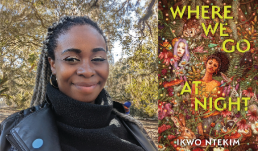
Alyssa Raymond of Copper Dog Books in Beverly, Massachusetts, served on the panel that selected Ntekim's book for Indies Introduce.
“This enthralling, spooky debut lures you into a secret world of fae, where magic lurks in the forest of a South Carolina town. Trixie has been aware of the fae for a long time, just not how much their world is entangled in her family legacy, her town’s folklore and history, and her own biracial, Black, queer identity. Full of intrigue, deceit, adventure, and romance, Where We Go at Night is an imaginatively complex fae fantasy,” said Raymond.
Raymond sat down with Ntekim to discuss this debut title. This is a transcript of their discussion. You can also listen to the conversation on ABA's bookseller education podcast, BookED.
Alyssa Raymond: Hi, I'm Alyssa Raymond, a frontline bookseller at Copper Dog Books in Beverly, Massachusetts. I'm here with Ikwo Ntekim, author of the YA novel Where We Go at Night.
Ikwo Ntekim is a Nigerian-born writer who has lived in the United States since she was a kid. She received her MFA in Creative Writing from Stony Brook Southampton where her fiction appeared in The Southampton Review. She's been an indie bookseller for many years and lives in Queens, New York.
I feel extra lucky to interview a former indie bookseller. Welcome, Ikwo, thanks for joining me!
Ikwo Ntekim: Thank you so much, Alyssa. Happy to be here!
AR: I'm a huge fan of your book and have now read it three times. Where We Go at Night is enthralling, immersive, and spooky. It's a fresh, complex fae-fantasy that's full of folklore, history, adventure, intrigue, family drama, mystery, horror, and romance. It really has it all; it explores the complexities of love, power, truth, vengeance, loyalty, justice, and so much more.
Your debut covers a lot of ground in a unique and intriguing way, and I'm so excited to talk with you about it today!
IN: Thank you. All those things were so nice!
AR: Rather than start off by asking you for a book description or elevator pitch, I'm thinking we should break our discussion down into questions about characters, setting, world building, etc.
Let's start with your main character and narrator, 17-year-old Trixie. Can you give us a better sense of what she's like and who she is? Can you talk about her personality, background, childhood, and family?
IN: Absolutely, absolutely. Trixie’s voice was the very first thing that came to me when I started working on this novel. She's always been clear in my head, even though I wasn't quite sure where the plot may have been going at the time.
She's a 17-year-old girl. She comes from wealth, and that is important because it does show up in different ways throughout the book. She's pretty well off. She is biracial; she has a white mom and she has a Black father, and she now lives with her mother's father in this big, sprawling manor in South Carolina.
I am quite a fan of the South. I find the South bewitching and beautiful and very atmospheric, and at the same time, acknowledging its darker history and the horrors of its past. I wanted to wrap that into Tracy's personality. Myself, not being from South Carolina, I had to do a lot of research and a lot of reading about Southern folklore. Trixie is the combination of all those things.
She grows up with her grandfather. When the book starts, she has a very loving relationship with him. He is the parent that stayed; he didn't die, he didn't leave her.
So, that's who she is.
AR: Wonderful, thank you! You talked a bit about the setting, but it plays such an important role in the book. Can you talk a little bit more about the history and communities where your book is set?
IN: Because I'm not from South Carolina and I don't actually have roots there, I thought the easiest path to write this was to create a place that is not entirely real. I did want to create something familiar. I did want to create something that people could step into and know where they are more or less in the continental US. Whether or not it's a real place, mattered less to me than creating something that was true.
In order to wrap my head around this place, I thrifted old versions of southern folklore. I also needed to understand what was expected of women in the 1860s. What did the home look like? Who had the power in that home? While we may not spend a lot of time back in that time period in the book, I had to go back and deep dive into Civil War history — which battles were important, what the legacy of the Civil War was, and what happened to the farms and plantations before, during, and after the war.
In order to wrap my head around the times and the setting, I also did some research and read The Delectable Negro by Vincent Woodard, where the author writes this thesis about how — not only was there physical, literal cannibalism of the Black body — there was also this consumption of the mind, the spirit of the Black body. That was a really terrifying idea to me because it's not just physical, it's going into a different realm of things that can be taken from you.
When I started thinking about the Old King, for example, I wanted to create this feeling of dread. We never really meet the Old King in the book, but his actions and his choices affect so many of the characters.
AR: Could you elaborate on the fairy world and how that intersected with the human world and history, and how you related the fae relationships, characters, and settings with the history of the place and Trixie's role in it?
IN: The world of fairies has always been so magical and beautiful to me, but the older I get, the more I'm like, “Oh, the fairies — they're kind of wilding out. They are not all Tinker Bell floating around in the woods. There's some dark history to it.” When I was creating this world of fae, I was asking, “What does it look like if you know fae and humans live next to each other?” It's not just one affecting the other — not just the fae having impacts on the human world — but surely the human world also touches the fae world back.
I wanted to draw some parallels between things that we deal with in the human world. They may not use the word “racism,” they may not use the word “prejudice,” but the evil of humanity's world has an impact in the fae world. Or is it that the evil of our world came from the fae world?
When I was building the world of fae, I didn't just want to go to Fae, where everything is beautiful and perfect. It's actually even worse, believe it or not, than what we see in reality.
The fact that it's set in the South — that history carries through. That history continues, and there's no getting away from it. If you think about Trixie, she's grown up in this relatively privileged life, and has tried to avoid having to acknowledge that at the end of the day she's still a Black girl, even though she's surrounded by this wealth and privilege.
No character gets out without having to examine where they are, the choices they make, and why they make those choices.
AR: I love that. I loved how complicated the relationships were, how complex the characters were, and how everything was related. It worked very well.
I'd love to know more about the writing process. How did you make that happen — juggling the backstory, and juggling what's happening in the fae world and the human world?
IN: The writing process was grueling. It's probably one of the hardest things to date I’ve done. Where We Go at Night started off as one of my last assignments in grad school.
I still have a full time job, so routine really matters. Coming back to the project really matters. Coming back to the page, even if it's just a sentence a day really matters. For the last ten years, I've been coming back to Wood’s Crossing. I've been coming back to Trixie despite X, Y, and Z difficulties or unavoidable circumstances.
I would say my first draft was really horrid, and I really mean that. I had some really amazing editors throughout this process who were able to help me take a step back and parse out, “What's the important stuff in here? What are the things that you like having in here that actually take away from your main story?”
That phrase “Don't be afraid to kill your darlings” — when it comes to writing, you really have to do that, and you really don't get too attached to things. At the same time, if there's a plot line or a character that you can't seem to shake, maybe that's your mind telling you to refine it a little bit.
The writing process involved a lot of late nights, it involved a lot of missed deadlines, and it involved tossing entire pages out because they just didn't work anymore.
AR: Did you work on some other projects as well, or did you just keep coming back to this one?
IN: I kept coming back to this one. I'm a slow writer and I'm a slow reader. I like to finish things, so if I start something, I like to see you through. At the end of the day, I wanted to see this story through.
I did the first draft, and there was a lot of red. Throughout the writing process, it was incredibly helpful to have readers and editors who asked clarifying questions. They were like, "Here's what I'm getting from what you put together. Do you want path A, or do you want path B? If you want path B, here's how we can get there, or here are some suggestions on how we can get there.”
It was an incredibly collaborative process. Yes, this book was like writing any book; you have your periods of isolation where you're hunched over your laptop, and then there are times where it feels like people want to see your story come out. They want to see the thing come to fruition. Having that support was just really wonderful.
AR: Oh, that's fantastic. When you started, did you have an idea of the general story? Did you outline? Are you someone who just kind of writes and then figures it out?
IN: I do a little bit of both. I started with an outline, and when I got my first edits back, I started to abandon my original outline.
There were parts where I had to really pause and think about how to make the pieces fit together, and keep the story straight in my head. So that outline that I used to start the book was nice and all, but I really ended up relying on the one that my editor and I came up with together. That's my true north. That's where we were headed.
AR: Can you talk about what you’re working on now?
IN: It's nothing concrete yet. It's very much baby stages, like on a notepad, but it's branched a little bit.
There's this quote about when the third dimension casts a shadow, the shadow is two dimensional, so when the fourth dimension casts a shadow, it's in the third dimension.
I was like, “Okay, if there are some kind of higher dimension entities or beings, what if we're their shadow?” I don't think that's necessarily an original idea, I think some sci-fi nerds out there have thought along the same lines.
But more recently, I've been interested in the idea of the Voynich Manuscript. The TikTok girlies and folks on the interwebs are talking about this manuscript that's from the 1400s, and nobody has been able to translate it or decode it. They have no idea what it means, but it has all this imagery of women bathing in these pools of green liquid. It has this strange imagery of plants that we can’t identify in our world today, and nobody really knows what the manuscript is now.
A few months ago, somebody did an experiment where they took their — believe it or not — period blood and they put it in some moon water and they claim that what their period blood ended up turning into was similar to some of the images in the Voynich Manuscript. So folks are discussing whether or not women are able to grow plants. We know that they are able to grow life.
Where I'm going with all this is this idea of a society that's really moving forward through the female form, through the female body.
So, I'm thinking about time travel, about this young girl who doesn't necessarily know it, but she's living in a world that has realized that women have this power, and she's basically getting pulled between dimensions. Like I said, it's a very nascent thought.
I've been thinking a bit about matriarchies. I've been thinking a bit about what power can look like outside of the patriarchy. I know that's complicated, and it sounds really mushy, because it's still mushy in my head.
AR: I love it. Thanks so much for sharing that. I can't wait to see how it all comes together.
IN: Thank you. I'm always curious to see, the more that I write, if some of my characters will start to echo across books. Trixie is definitely somebody who wants to belong, but she's not necessarily willing to do anything to belong. There's some toughness in there that I appreciate about her character.
AR: Thanks again for joining me, Ikwo, and for writing for such an amazing debut. We are thrilled to have your book on our list and we wish you a wonderful year ahead.
IN: Thank you so much. It was such an honor to speak with you, Alyssa. Thank you to the team and ABA. Love you guys!
AR: Thank you, Ikwo. Love you too!
Where We Go At Night by Ikwo Ntekim (HarperCollins, 9781335453853, HC, YA Fantasy, $19.99, One Sale: 10/27/2026)
You can find this author on Instagram at @iikwo.
ABA member stores are invited to use this interview or any others in our series of Q&As with Indies Introduce debut authors in newsletters and social media and in online and in-store promotions. Please let us know if you do.