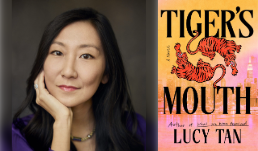
Independent booksellers across the country have chosen Lucy Tan's Tiger's Mouth (Ballantine Books) as their top pick for the December 2026 Indie Next List.
“Tiger’s Mouth is a searing, emotionally charged novel of an intense and unlikely friendship between two very different Jacks. The summer they team up during a cutthroat internship changes the course of their lives forever. If you loved Tomorrow, and Tomorrow, and Tomorrow, you will love Tiger’s Mouth,” said Andrew King of Edmonds Bookshop in Edmonds, Washington.
Here, Tan discusses Tiger's Mouth with Bookselling This Week.
Bookselling This Week: Chen and Owens could not be more different, but they’re working with oddly similar approaches — early on we learn that Chen specializes in “breaking systems” and at the same time we see Owens cling to the phrase “make your own rules.” Would you tell us a little more about developing these characters?
Lucy Tan: Chen and Owens are penned in by other people’s ideas of who they should be. Chen is limited by his social class, whereas Owens is shoehorned into the role of his father’s successor. It’s natural to want to break out against societal expectations, and isn’t this squaring of identity something we all face? Coming-of-age fiction shouldn’t be limited to the young. We come of age at any age.
BTW: Would you like to tell us a little more about the title, Tiger’s Mouth, and the decision to use this Go strategy as a motif in the story?
LT: “Tiger’s Mouth” is a shape in the strategy game Go that allows a player to assume a position that is both offensive and defensive. This represents the characters’ strategic moves within the corporate world as well as the way I’ve constructed the narrative to be lean and propulsive. The image of the tiger’s mouth also symbolizes New York City, a place where external pressures can feel like a predatory animal breathing down your neck.
BTW: This story does an amazing job portraying an intense friendship/rivalry, and tackles some pressing current issues like Al as well as morality in the corporate world. What was the most challenging part of writing this novel for you?
LT: There are two characters who face hardship I’ve never known. One has suicidal ideation and the other has Down syndrome. It was important to me to be patient with these sections — to do enough research and imaginative work to get this down as accurately and compassionately as I could. It’s always hard to know how much is enough.
BTW: You’re also a bookseller! Does working in the book world impact how you think about your own writing?
LT: It has made me appreciate the breadth of stories that get published and are available to readers. This has inspired me to push that breadth even further in my own writing. I’m now a better writer because I’m a broader reader.
I’ve been a bookseller for four years now, and over time I’ve come to feel less pressured to write for universal appeal. Selling books has shown me that universal appeal is a myth.
BTW: Would you tell us a little about the role of books and indie bookstores in your life?
LT: I’ve been a reader as long as I can remember, and indie bookstores became central to my work as a reader and writer when I started a job at my neighborhood store, Secret Garden Books. Writing a novel can mean spending years by yourself in an imaginative space before you get to invite someone else in. Being a bookseller, on the other hand, is immediately gratifying. Each time I go in to work, I get to be part of a community of readers and to contribute to the conversation around books. I’ve come to depend on my local indie bookstore as a third place that keeps me grounded — both when my writing is going well and when it is not.