Julia Riew and Brad Riew are the co-authors of The Last Tiger, a Summer/Fall 2025 Indies Introduce selection. 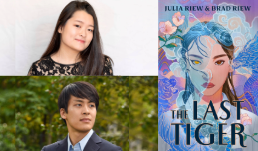
Erin Decker of White Rose Books & More in Kissimmee, FL, served on the panel that selected the Riews’ book for Indies Introduce.
“This tale of conflicting households, weaving together a beautiful story of the author’s grandparents, shows us that love truly can conquer all,” said Decker. “In a world where order depends on people staying in their place, these star-crossed lovers tell us that some things can’t just be left up to fate — fate is what you make of it.”
The Riews sat down with Decker to discuss their debut title. This is a transcript of their discussion. You can listen to the interview on the ABA podcast, BookED.
Erin Decker: Welcome! My name is Erin Decker. I am one of the co-owners of White Rose Books & More in Kissimmee, Florida. I'm joined today by the authors of The Last Tiger, Brad and Julia Riew. They are siblings.
Brad is an MFA candidate in Fiction at NYU’s creative writing program. He graduated from Harvard College in 2018 with a degree in Psychology, where he won the Ecker Short Story Prize. The Last Tiger is co-written with his younger sister, Julia, and it's his first novel. Brad lives in Brooklyn, New York.
Julia is a composer, lyricist, librettist, and novelist best known for her Korean folktale inspired musical Dive, which is currently in development with Tony Award-winning director Diane Paulus and GLAAD Award-winning playwright Diana Son for a world premiere at the American Repertory Theater. In addition to being the 18th Annual Fred Ebb Award Winner, Julia has been Playbill’s Featured Songwriter of the Month, a Woman to Watch on Broadway, a Princess Grace Award Honoraria recipient, and the recipient of the Harvardwood Artist Launch Fellowship. Julia graduated from Harvard University magna cum laude as a member of Phi Beta Kappa with a joint degree in Theater, Dance, Media (TDM) and Music.
Wow, that is awesome. I read The Last Tiger many months ago now. It was one of my favorite reads of the year, definitely my favorite young adult read, so I'm super excited to be talking to you both. I just thought it was so beautiful the way it was written, the way you guys wove this story together. Can you tell me a little bit about the inspiration behind The Last Tiger and why it was important for you to tell this story?
Julia Riew: First of all, thank you so much for having us and thank you so much for reading the book. We're so excited! In terms of the inspiration, as you may know per the author's note, this story is inspired by our grandparents’ actual forbidden romance during the Japanese colonial period, during the Japanese occupation of Korea. Brad, did you want to talk about that?
Brad Riew: Yeah, so happy to be here. It's really great to talk about the book and thank you again for reading it.
Our grandfather passed away in 2020 — he was part of the early COVID wave — and our grandmother ended up writing almost fifty pages of memories from their lives, how they met, all the ups and downs, the things that they'd experienced and gone through together. When we read it, we were so floored by it that we thought we had to do something with it.
The Last Tiger is inspired, as Julia said, by true stories from their lives, by some of the strange and difficult history they lived through — colonization, oppression, poverty — but in our reimagining, we've taken some of that historical context and wrapped it in a fantasy world. One of the central ideas of the book is this idea of cultural erasure; the official Japanese state policy at the time was to try to eradicate the Korean culture and Korean language and folk songs and customs. We've reimagined this act that was committed by the actual colonial government, which was to kill all of the Korean tigers — the national animal — as a fantasy piece. In our retelling, the tigers are these magical spirits which give the power of empathy and the power to feel other people's memories to the people. We're drawing on some of those real stories from our grandparents’ lives, while retelling it for a younger and modern audience.
ED: It's amazing. I'm so sorry for the loss of your grandfather. With that being said, has your grandmother been able to read The Last Tiger and [has she] been involved in this writing process with you guys?
JR: I would say [our grandmother is] fluent conversationally in English, but her reading level might not be up to the level of reading a full novel in English. That being said, she has received the copy and we actually have a couple of videos online of the time that we first gave [it to] her, and she was able to read the dedication and see that it was dedicated to her and our grandfather. We've explained to her what the novel is, although I'm not sure if she quite understands the concept of what a YA fantasy novel is, but she's really excited that it exists.
ED: That's amazing. I love that you're getting to share parts of it with her. Hopefully people will go find the video. Is it on your social media?
JR: Yeah, it's on Instagram and TikTok.
ED: I will go check that out because I haven't seen it yet. What type of readers are you hoping will get to read The Last Tiger? Who do you hope this reaches?
BR: The Last Tiger is for anyone who enjoys fantasy, for people that enjoy historical fiction or historical fantasy. More broadly than that, we know that people right now are growing up in a time that feels maybe confusing or disorienting or disheartening to many. [For] anyone who is feeling lost about how to navigate that moment, one of the things that was really helpful for us while we were researching and writing this piece was that we were able to look back at some of the things that our grandparents had lived through and to feel the resonances with the present moment, [we were] able to understand some of the things we were going through ourselves.
This is really a story about how love can help us through dark times, the love for each other and the love that they found in their hearts was able to carry them through and give them a new life and a new sense of hope. We hope that anyone struggling with the historical moment of today is also able to find that spirit in the book that we've written.
ED: When I was reading there was a lot of history that I didn't know a lot about, so I was doing research on that, but I also was comparing it to our modern times and what is happening now in our country and seeing those parallels. It is hopeful that two people can reach across cultural and economic divides and find something to empathize with each other in and also find love in that as well. So that's who I hope it reaches too. I think your beautiful packaging, and just the idea of the fantasy, is going to reach so many people first and then they'll get all that out of it while they read.
What is it like to co-write with your sibling? I have a great relationship with my own sister, but we’re very different. I can't imagine writing with her or putting together something like this [that’s] so personal.
JR: It's funny because I actually think the ways that you are different could help make the story better, especially since I come from a theatre background. For me, collaboration is almost more natural than writing something by myself. The opportunity to collaborate with someone who has a different brain than you is often really exciting. It’s funny — this is the number one question that we get. Whenever we go anywhere people are like, “What is it like co-writing with your sibling?” So, we try not to give the same answer every time.
BR: Yeah, people are really curious about it.
JR: They always want to know! It's helpful to say that Brad and I have been essentially collaborating for as long as I can remember. I've known Brad since I was born, and when we were little kids, the way we used to play together was telling stories and acting them out or jumping around in the bed. We would take stories like Star Wars or Pokémon, then Brad would make up stories, and then I'd be like, “Oh and then this happened! And then this happened!” We would act it out together and with our other brother, Grant, who is now in med school.
We wrote our first “book” when I was eight and Brad was twelve, and then we were always coming up with stories together. We wrote a musical together when I was in high school and Brad was in college, so it's almost second nature for us to collaborate together. So much of it also comes from the fact that we grew up watching all the same media, reading all the same books. We have very different tastes, but we understand each other's sensibilities really well because we're siblings and grew up that way. Also, we have a sort of shorthand that when you meet a new collaborator, you don't necessarily have. Brad and I understand each other's lives so well that we're able to communicate in a deeper way than I would with someone who wasn't my sibling. I would say the other thing is, we're able to communicate without sugar coating anything. There are no boundaries. It's kind of like the way that siblings can fight and still be friends, we can do that in a collaborator sense as well.
In terms of the actual process, we started this on Mother's Day in 2021. Brad was home for Mother's Day; I was home because it was the pandemic. I had just gone through a whole phase where I'd read a bunch of YA fantasy, and I said to Brad, “What if we turned grandma and grandpa's love story into a fantasy novel?” at dinner. And he goes, “Yeah, okay!” Literally by the end of the evening, we had an entire journal full of ideas. We had started brainstorming all the characters. We had a rough plot arc charted out. We had taken grandma and grandpa’s various stories that they had told us, and sort of slotted it into space, and then we went from there. It was a lot of figuring out who's doing what and then where do we go from there. But ultimately, by the end of the process, we had both truly worked on every single sentence and chapter.
ED: Wow, that's amazing! That’s awesome that you guys are able to work so well together, and can support each other's imaginations and work styles. What do you think was the most difficult part of writing this novel?
BR: As Julia mentioned, it was so much fun to work together, and she's one of the people I trust the most and we got to spend a lot of time together so I really enjoyed that whole process. I want to say, it was really helpful for me during this period because I ended up in the pandemic coming down with a pretty serious post-COVID Chronic Fatigue presentation and I, at the time, had to stop working and really pull back from many aspects of daily life as I had been living it before. But being able to have a trusted and deeply loved collaborator to pull through on the times that were most difficult was really, really helpful.
Writing with a chronic illness is a challenging experience; there would be days when I'd be able to write a paragraph or two, then I would have to take off 48–72 hours to recover from that experience. So [it was] definitely a challenge to write with an illness in that way. But all of the experiences that we've had made it into the book. One of the things people say about Korean history is that the challenges that you've lived through sort of get into your blood, they get passed down through the years and make their way into your lives. My own experiences of difficulty have certainly made it into the book as well.
ED: Yeah, part of the process of writing, it seems, is putting a little bit of your soul into writing, and that just includes every experience that you're having. What was the most surprising thing that you guys learned while you were writing — whether it was research or something you learned about each other or about your family?
JR: There were a lot of surprises along the way but the biggest one, I think for us, was learning about the concept of Han, which is something we thought we knew. Part three of the book is called Han.
Han, as a concept, is talked about quite a bit in the book. It’s this sort of inherited trauma and deep grief that is shared by the Korean people through all the struggles that we’ve experienced in history. This is something that in Korean-American culture has been really adopted and really widely talked about, especially in forms of entertainment. It was really interesting because I had my fiancé read a copy of an early draft of the book, when it was sort of in its Advanced Readers Copy era. My fiancé is from Korea, and he said that Han takes on a very different meaning for Koreans than for Korean-Americans; actually, a lot of people are beginning to object to the concept of Han because of the history behind it. This is what we didn't know and a lot of Korean-Americans I’ve talked to don’t know that, while we have taken Han as our strength, and it's our thing that unites our people, Han’s origins are actually widely debated. Some people say that it was actually created by a Japanese artist to explain why the Korean people are inherently weaker and inferior because their people [are] characterized by their suffering.
It’s a really interesting thing where we wrote so much of the book kind of inspired by this thing that has really been a term of strength for the Korean-American people, that actually has a deeper, darker, or more complex history than we knew, which I think speaks to the book itself. This is a very recent history; our grandmother and many other people are still alive today that experienced the time that this book is inspired by. There are a lot of feelings surrounding that time, and a lot of different ways to feel about it, and a lot of different ways that history has been passed down. I think that was, for us, the biggest surprise and then we did some edits from the ARC copy to the final copy. But there were a lot of surprises along the way!
BR: This concept of Han was really central to how we were thinking about The Last Tiger and what its meaning was for a current audience. As Julia was saying, we were surprised to learn about its origin story. One of our experiences in rewriting history and stories inspired from our grandparents was the ability to tell something new and to tell it for new people; it has its origins in Korea and the colonial period, but really what we're hoping to speak to is young people growing up today across the world, some with a Korean background, some without. This idea of the grief that we share being a source of strength, if we can transform it into something, has been really meaningful to us — and while [it’s] an idea that we can problematize and understand in its origins — we can transform it into something meaningful for our own lives. That was really important to us and we hope it shines through in the book.
ED: Absolutely. Language is such a powerful thing and so I appreciate you guys sharing a little bit more background about that with me. Thank you both for joining me today! I've been waiting for my copies to come to the store so I can share this story with everyone who walks in the doors, and I hope other booksellers who are listening will make sure that their copies are on their way and handsell it as well.
JR: Yay!
BR: Thank you so much, Erin.
JR: Thank you so much.
The Last Tiger by Julia Riew and Brad Riew (Kokila, 9798217002047, Hardcover, YA Historical Fantasy, $21.99, On Sale: 7/29/2025)
You can follow these authors online @juliariew and @bradriew.
ABA member stores are invited to use this interview or any others in our series of Q&As with Indies Introduce debut authors in newsletters and social media and in online and in-store promotions. Please let us know if you do.