Susan Metallo is the author of Reasons to Hate Me, a Summer/Fall 2025 Indies Introduce selection. 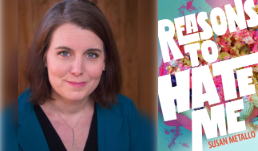
Mara Lynn Luther of Chapter One Bookstore in Hamilton, MT, served on the panel that selected Metallo’s book for Indies Introduce.
“After a traitorous event with her best friend’s boyfriend, high schooler Jess Lanza has been the topic of a nasty blog. When she decides that the insults have gotten stale, she takes matters into her own hands and through her own blog, Jess gives her bullies a year’s worth of creative reasons to hate her,” said Luther. “Smart, neurodivergent and so so funny, this voice is simultaneously unique and familiar to anyone who lived outside the social structure of high school (including my fellow theater nerds). Taking on the themes of fractured friendship, slut-shaming, masking, bullying and trauma is no small feat, but Metallo writes so deftly and personally, Jess comes to life and we can’t help but cheer for her through the ups and downs of senior year.”
Metallo sat down with Luther to discuss her debut title. This is a transcript of their discussion. You can listen to the interview on the ABA podcast, BookED.
Mara Luther: Hello, I am Mara Luther from Chapter One Bookstore in Hamilton, MT. Joining me today is Susan Metallo, a young adult author and librarian. Her debut novel, Reasons to Hate Me, is a September/October 2025 Kids’ Indie Next title and a Summer/Fall 2025 Indies Introduce Kids’ selection and won a SCBWI Work-in-Progress Award and the Tallahassee Writers Association Seven Hills Literary Contest in the YA category.
In addition to these honors, her work has been recognized by Book Pipeline and published in Ladybug, Cricket, The Seven Hills Review, and Publishers Weekly. She lives in Albuquerque with her husband, her children, and an 80-lb bulldog who fervently believes she will fit on your lap.
Hi Susan!
Susan Metallo: Hi, Mara! It's so good to talk to you!
ML: This was my favorite of all the Kids’ Indies Introduce titles, so I'm excited that I get to be the one to interview you.
SM: Thank you, I'm so excited! You're a superstar in our house, because when you called to tell me about Indies Introduce everyone in my house was so excited. My nine-year-old actually made a poster that said, “Yay, Mara liked Susan's book!”
ML: That’s awesome, because to booksellers, authors are the superstars. I feel very honored.
SM: Well, no, to us authors, it's definitely you guys who are out there supporting and championing our work. We're very grateful for you.
ML: Excellent. I think one of the things that we all talked about with this book is how much we love Jess’ voice. When you were writing, did Jess come through exactly how she sounds right now? Or was there a lot of tweaking that happened to give her that punchy voice that we love so much?
SM: The honest answer is both. Actually, the voice was the thing that started the novel for me.
I had been writing something different and in my free time I was doomscrolling. I came across a news article about a murder. The murder was filmed by a woman on her cell phone, and that evidence was submitted to the police. I read this whole article, then I looked down at the comments. The top comment was about how in the first few seconds of the video the woman yells at her daughter so “you shouldn't believe this video.”
That was the most surreal thing I'd ever seen. It reminded me of victim blaming and the way that women, and people of all marginalized genders, get picked on for little things in order to make excuses for the bad actions of more powerful people — usually more powerful men.
In this pit of feminist rage, I sat down at my computer and opened a Word document. I titled it “Why No One Will Believe Me if I Ever Witness a Murder” and I started to type a story about a true thing that I did one time which involved a cake.
If you haven't read the book yet, I will not spoil it for you, because it's in there. That was a real thing that I did when I was 23 and in graduate school. It does not show me in the best light, because it is not only completely ridiculous, but it also affected other people. I never apologized. I couldn't stop laughing because it was funny, but also, I felt bad.
I think because of all the feminist rage and the context of seeing new stories of victim blaming, the voice that came out was not my voice. It was a lot more performative — very pointed and sharp — and not necessarily how I would tell the story to my friends.
I just loved having that voice. I love playing with that voice and that angry, performative part of myself. When I sat down to write the book, each chapter became another story from Jess’ life that is framed as a reason to hate her, but is not actually. There's that cognitive dissonance from people who get angry at us for making normal human mistakes, and use that as a reason to hate and attack and blame. It was that voice and that structure that kicked off the whole book for me.
The boring part as a writer is that you have to write the whole book, you have to look at the place where the voice is strongest, and then you have to go through the whole book and make sure the voice is consistent. It was definitely a combination of serendipity and intentionality, but it started with this playful thing that I just typed out on my computer.
ML: We all have those voices that don't often come out, but they're always in our heads and they’re in us. That's very cool that you were able to find the spot for it.
I really appreciate your supporting characters. Sometimes, when there's such a strong main character voice, the supporting characters don't get their own strong voices. I wanted to talk to you about that: how important are the supporting characters to you as a reader and as a writer? How did they come to you?
SM: They're so important to me as a reader, and have been my whole life. I imagine that booksellers may be similar in this. I felt like I would get immersed in books and the characters were all my friends. Because I was looking at the book through the eyes of the main character, my friends were the supporting characters.
I was very into the Alanna books as a teenager — and to be honest now — and I was into all the different knights and the group of thieves. I would pretend that I was hanging out with them when I would go on hikes in the woods, or when I would play games. Do you remember playing Hearts on the computer? I would name the other phantom computer characters after the secondary characters from books.
I pay a lot of attention when I write those secondary characters. I do the same thing I did with Jess’ voice in terms of reading all their dialogue lines, making sure that they have consistent voices and are distinct from all of the other characters. It's a nebulous thing when we talk about voice and about characters coming off the page. The reality is that it comes down to all of those tiny details that you put into the text. That could be little quirks, like the character Nic, who says things three times when she gets excited, like, “It's so, so, so nice to meet you!”
That creates a voice in your head, because that immediately gives you a feeling of how she talks, who she is, and even what her face looks like.
I try to do that for all of the characters — even the ones who have small moments in the book — so that it feels like a complete world, a complete school community, and a complete friend group.
ML: I appreciate that and I think you're right. When I imagine myself as friends with [characters], it's those supporting characters that I want to hang out with. Were you in drama in high school?
SM: Oh my gosh, yes.
ML: So was I. It's the only thing I lettered in!
SM: Same! I have my varsity letter in theater. I'm very proud.
ML: I am too. Did you have a favorite play? Were you on stage? Were you on crew? What do you remember from it?
SM: Oh my gosh, I remember a lot, and I put a lot of it into the book. “Stage-Right Orgy Couch” — real thing! I did a little bit of everything. I did some acting; I was not great at acting. I did theater because it was fun, not because I was good at it. I did a lot of crew stuff. I'm a musician also, so I did play in the pit sometimes and that was always very fun.
My one lead role: I was Sally Brown in You're a Good Man, Charlie Brown, which was fun. My favorite production that we did as a school was Cabaret. The director really played up the anti-Nazi stuff to the point that the Nazis were terrifying, and about half the audience left at intermission. We were so proud. We were like, “We scared the audience away! We did so great!”
There were a lot of fun times in theater, eating vending machine dinner, and just feeling like you owned the school. I don't know if you felt this way, Mara, but being at school after hours gives you a real sense of power and ownership of the space.
ML: I was Lucy [van Pelt] in You're a Good Man, Charlie Brown! I think for drama nerds, that part of the book really does come out. It's a great one for kids who are in theater or speech and debate, all of those groups where you collect people who don't belong anywhere else.
SM: I wanted it to be a book for the theater nerds and the misfits. I pushed really hard — and my editor was really supportive of this — to make sure that the references to theater terminology and plays were not treated like a foreign language that we stopped and explained constantly. I didn't want this to be a book where theater kids were just rolling their eyes the whole time, like, “This old lady is old lady-splaining to me what I clearly know.” I tried to make that part of it extremely authentic for the kids.
ML: That’s definitely going to come through. The parts of the book that you wrote as a script too, I really appreciated.
There are parts you write it as a blog, there's script, and there are parts that are not necessarily either. They're more in the moment. How did you choose those moments where it was more action-driven?
SM: That’s a great question. I started out thinking it was going to be looking back at all these little funny anecdotes, and I realized that that wasn't giving enough room for Jess to grow and change throughout the book. That’s so critical in YA, giving the main character a chance to be this dynamic figure that the kids can read along with.
Frankly, I keep saying it's for the kids, but it's for me too. I read so much YA. I need to process through these moments with teenagers, possibly in part because when I was a teenager, we did not have books about neurodivergent protagonists that felt respectful and authentic. We did not have books about queer protagonists that were nuanced, normal books about kids going through their normal lives. For me, reading books with representation is so important. I'm stuck in that YA phase where I need to process all this stuff I didn't get to process as a teenager.
That was really the motivation for having some blog chapters where it reads as though it's happening right now, even though that was a little bit of a suspension of disbelief. Would a kid actually write down their entire day with dialogue in a blog post? Maybe not, but I'll accept it from Jess because she's a little weird, writerly, and out there.
The moments that felt like something pivotal was going to happen in Jess’ life needed to be in the present tense. Then the interior exploration could happen from past events, or the reader could come to understand something that was happening in Jess’ life from past events. It was really important for me to show her going through her day, through her year, and changing in real time, rather than looking back on it.
ML: It did help! Like you say, when we're reflecting on something, we think of it in a very different way than when we're experiencing in the moment. I thought you did a really good job.
You talked about seeing representation in teen books — which I also think is so important, and I was so excited to see it — and having books where teens are making mistakes and trying to fix it. When I was a teen, if I made a mistake, it felt like the end. I didn't get a lot of practice at making amends or apologizing. In your book, you let your readers really practice that in awkward, social, emotional ways.
SM: That’s so critical and such a huge part of this book. Mistakes can hurt people, but if we make mistakes and then we shut down and retreat into a shell, there's no growth. There's no possibility for healing and for moving forward. A lot of this book is Jess figuring out how to break out of her shell and make positive strides in all of her relationships. Jess is figuring out how to be okay with herself and how to forgive herself, and Jess is trying to make things okay with Chloe.
But there's also Jess and her mom, Jess and her sister, Jess and Cameron. All of these relationships form this intertwined character arc where Jess figures out how to take small steps forward. Even with some of the bullies, she's able to start admitting where she's made mistakes, and they're able to start admitting where they made mistakes.
ML: Going back to drama, I know sometimes finding the right cover for your book can be dramatic. How was it for you? How do you like the cover?
SM: I love the cover! It turned out perfect. It was a long road to get there. With book like this, it was hard to pinpoint. There wasn't an obvious symbol to put on the cover of the book. Even deciding which characters were going to put on the cover… There are so many characters. Would it just be Jess? Would it be Jess and the bullies? Would it be Jess and Chloe?
I love what the designer came up with, which was using the smashed cake as a metaphor for smashed friendship and putting that cake on the front of the book. It was very bold and very bright and the title is huge. I think the title is very fun and a good selling point for the book, so we wanted that to be the most prominent aspect of the cover.
It was actually kind of funny, because the stock photo they found for the cake is a vanilla cake with pink icing, and in the book (if you've read the ARC) the cake is chocolate. We changed it for the final version. It really changed a couple things in the scene with having hot pink buttercream instead of the chocolate. It's interesting how something that seems like just the package becomes part of the book; it becomes part of the story. It affects the text and how readers are going to interact with the book. I'm just really happy that we found something this wonderful to put on the front.
ML: I appreciate that you made it match too because, as a reader, if the cover art doesn't match, what's happened?
SM: That's why I'm always hesitant about characters on the front of books, too. I get a little anxious because what if the reader doesn't want to picture the character that way? What if they picture the character differently? I know I've had that experience when watching movies that are based on books. I think we're pretty safe with the cake though.
ML: It’s a good choice, it's gonna really pop on the shelf. What have you been reading, what you've been loving this year?
SM: Oh yes! Plug for my fellow Indies Introduce authors: Last week, I read Joanne Yi's book All the Tomorrows After. Sometimes you read a book and it's so good that you're not okay afterward. That’s how I was with that book. I was sitting on my couch, staring into nothingness. My husband was like, “Are you okay?” and I was like, “No, I'm not. This book was too good. I don't even know how to talk to you right now.” It’s still in my head and it is never going to leave. That was wonderful.
And then I read the ARC for Cassandra Ramos-Gomez's Lost on Doll Island. That was super creepy and I was in love with it. I've just been trying to read everyone's books before they come out, because it's a lot of fun to support each other and read these great stories.
ML: Yeah, it's like you're part of a little club! Like a drama club.
SM: Yes, it is! They're my supporting characters, right? And I'm their supporting character.
ML: Thank you so much for joining me today. This has been very delightful.
SM: I really enjoyed talking to you. Thank you so much again for reading the book and selecting the book, but also just for chatting.
ML: Have a great rest of the day and congratulations!
SM: Thank you!
Reasons to Hate Me by Susan Metallo (Candlewick, 9781536240351, Hardcover, YA Contemporary, $18.99, On Sale: 9/2/2025)
You can learn more about Susan Metallo by visiting her website.
ABA member stores are invited to use this interview or any others in our series of Q&As with Indies Introduce debut authors in newsletters and social media and in online and in-store promotions. Please let us know if you do.