Joanne Yi is the author of All the Tomorrow’s After, a Summer/Fall 2025 Indies Introduce selection. 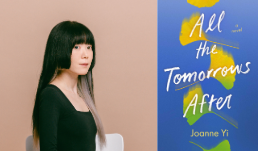
Grace Lane of Linden Tree Books in Los Altos, California, served on the panel that selected Yi’s book for Indies Introduce.
“Honestly, I can’t stop talking to people about this book,” Lane said. “The explorations of grief — of the many kinds of grief we experience in our lives — the raw and real prose that just sucks you in, the realistic setting, all of it. It’s a book everyone can find themselves in, for better or worse. Winter’s decisions with her friends, her maybe boyfriend, and her family all felt real and true and they hurt in all the most beautiful and awful ways. I’m so deeply looking forward to everything and anything Joanne writes next.”
Yi sat down with Lane to discuss her debut title. This is a transcript of their discussion. You can listen to the interview on the ABA podcast, BookED.
Grace Lane: Hi, I'm Grace Lane from Linden Tree Books in Los Altos, California, and I'm here with the ABA and one of our Indies Introduce authors for Summer/Fall 2025 Season, Joanne Yi.
Joanne grew up in Orange County, California, and currently resides in Los Angeles. She graduated from the University of California San Diego, and holds an MFA in Creative Writing from Antioch University. When she's not writing, she enjoys baking, horror films, Korean dramas, and spicy food (correctly), you can visit Joanne online at joanneyi.com and on Instagram at @writingjojo. Hi Joanne!
Joanne Yi: Hi, thank you so much for having me today. I'm so grateful to be here.
GL: I really loved All the Tomorrows After. It was probably my favorite book that I read for Indies Introduce, so thank you for writing it.
JY: Thank you for reading!
GL: I know you have an MFA in creative writing — obviously, we just talked about that — but how did you know that that's what you wanted to do, that you had something to say that the world needed to hear?
JY: Thank you for your question. Like a lot of people in this field, I knew from a young age that I wanted to be a writer. All of my hobbies revolve around stories. I always planned to study writing in college, but as life goes, I ended up on an entirely different path and this roundabout journey actually made me realize what I was missing, [which compelled] me to return to writing. I still question whether my words are needed or if they are contributing anything to an existing conversation, but my hope is that they might touch someone in some way, as some of the wonderful books I've read over the years have touched me.
GL: I think that you have achieved that and I'm excited to see what comes next from you!
JY: Thank you.
GL: One of the things that I really loved about All the Tomorrows After is its sense of place. I don't know that this would hit as hard for someone who's not from California or hasn't spent significant time in Orange County. I was the only person from California on this Indies Introduce panel, so they had to take my word for it when I said that it really captured the regular side of the OC. We hear about Newport Beach, Anaheim, and Disneyland, but the OC is actually a pretty big place, and it has normal towns with normal people doing their thing. Then you also have the bit about LA and how much fun it is to drive to LA. And also, the high school experience. To me, it really captured high school in California.
I was really curious if that was something that you actively had to work on, or if it was just writing what you know as someone who was raised there?
JY: I'm so happy this sense of place came through, especially for a fellow Californian. I grew up in several parts of Orange County and LA, so a lot of the settings and Winter’s experiences in the book do intentionally reflect what I know. I wanted to pay homage, in a way, to the places that informed my adolescence, such as the huge public library, the beach, and the Korean markets and restaurants, to name a few.
Writing a fictional suburb based on an existing one was an interesting experience. While I wanted to stay true to reality, I also had the freedom to veer far from it if I chose to and not many people would have known. Ultimately, though, my priority was to try to maintain the unique spirit of the area with the people and the culture that make it so and that wasn't a chore at all.
GL: I love that so much. One of the things that actually really struck me about how you wrote the book — and one of the things that I really loved — was that there's not really very many white people. For me personally, growing up here and spending a lot of time in various parts of California, that tracks; that makes so much sense that all of [Winter’s] friends would also be Asian, that she is working at businesses that you're just not going to have a lot of white folks at. That's her life as someone who's the daughter of an immigrant.
I really appreciated that, because you don't see it enough in books. I think that's really important for kids and teens and young adults to see reflected. That’s the life that they've lived. I just loved it so much.
JY: Thank you. I really appreciate that you picked up on that, because when I was growing up, I also didn't see too many books that had so much diversity or had a lot of minority characters, so thank you, I’m glad.
GL: Now to get to the really hard questions. Your book explores a lot of the different kinds of grief that we can experience in life, like parental abuse, neglect, death, lack of secure housing and food.
But it really did embrace the smaller griefs that we experience every day, especially as teenagers. Navigating friend stuff, being a teenager, trying to figure out how you work a job when you haven't really had someone to walk you through it, dating someone, and sleeping with someone.
It was really amazing that you just wove all of these things into Winter’s life. It was so perfectly done. Obviously, you're incredibly talented but I also wanted to know: did you have to consult with anyone? Did you want to consult with anyone, like a social worker or psychiatrist?
JY: These are such thoughtful questions, I love it. For this book, I didn't actually consult anyone, but I was inspired by characters in different books and Korean dramas. I love characters who are searching for home and belonging, and I also feel that some experiences are just ingrained in our memories. Even though it's been a while since I was a teenager, I clearly remember the themes of friendship, betrayal, the uncertainty of first love, and that inexplicable loneliness of growing up and having to face the future.
One thing I'm continuing to learn is that we personally face these challenges throughout our lives. To your point, there are losses and conflicts of varying degrees, with many of them being difficult at any age. Change is just hard to accept overall. All of these factors, I feel, culminated in a bigger overarching question: how will these characters navigate and live with their respective griefs? Will they be okay?
Viewing the challenges as a significant and necessary part of their arcs made it possible for me to weave these details together.
GL: I literally just wrote down “the inexplicable loneliness of growing up”— I don't want to forget that. It really encapsulates a lot of what this book felt like when I was reading it the first time.
One of the things that I really loved about this book is the other characters. While Winter is so beautifully fully realized as a teenager who's dealing with all of this, every other character you wrote is also fully realized. Even though the whole book takes place from Winter’s point of view, you're really getting people's backgrounds and other things that are happening in their lives. You somehow also managed to make us feel empathy for Winter's mother and we know that Joon’s going through some serious crap and all of that.
One of the characters that really stuck out to me was Helena, the stepmother. It would be so easy for you to have written a one-dimensional stepmom — specifically a one-dimensional white stepmom who has married into an Asian family, and has decided that doing Korean stuff is not really for her, but you didn't. You wrote Helena to be a full person who makes mistakes.
When I got to that part of the book, I just had to set it down and just breathe for a few minutes because I was so mad at her. I had been totally on her side up until that [moment], I had been like, “Wow, she's such a great person. I love her so much!” Then this thing happens, and even within that, you still wrote her in such a way that readers have a deep empathy and sympathy for her and understand why she's complicated and messy. I don't even have a great question here, I just really wanted to say all of that and be like, how? “How do thing,” Joanne?
JY: I am very grateful to hear your thoughts on the characterization and your response is much more than I could have hoped for. Writing nuanced characters is, to me, one of the biggest struggles of writing a novel. I knew all along that I wanted Helena to become the unexpected, loving, maternal figure that Winter had been lacking for years, a contrast to Winter's biological mom, Sunny, who is far from loving.
I wanted Helena to be a warm and safe space, but it was equally important for me to depict her as nuanced and flawed because that's who we are in real life. Once faced with grief and immense challenges, sometimes we react in ways that hurt our loved ones and my goal is to show here that Helena and Winter are able to overcome the differences and misunderstandings, admit when they're wrong, choose love and forgiveness, and ultimately choose family.
GL: I feel myself tearing up a little bit just talking about this, because that was one of the things that really got to me, how nuanced every single one of your characters was, and how that really came out in Helena, more so than either of Winter’s parents or sister.
I love complicated, messy, real-life people, because you're so right, that's who we are! We're flawed and we're messy and we make mistakes. And the fact that you could write Helena as a loving maternal figure who Winter needs, who is also a good mom to her biological daughter and a good wife, it really hit me.
JY: I'm happy to hear that, and I also would like to say that mother/daughter relationships and books have always struck very hard [for] me as well. A lot of them also make me tear up and so I naturally gravitate toward them.
GL: It was really beautiful writing. It was the kind of thing that made me cry in a different way than when Halmoni died; there's a lot of tears that come with this book and I actually think that also feeds into you writing something that is so true to life. There's a lot of tears in real life, and sometimes they're good tears, and sometimes they're bad tears, and sometimes they're just really, really sad tears. Sadness itself can be so different in so many different ways, and it was just so perfectly done.
JY: Thank you, and I agree with everything else you've said.
GL: When I had to come up with five questions, I wrote these really intense things that I wanted to know. I was like, “I can't end it on something sad, because that is just that's too much. I want people to listen to this. I want people to read the book!” So mildly lighter note: did you set out to make people crave Korean food and want to listen to K-pop?
JY: Short answer is yes. Long answer is, I personally really love when books have food descriptions, because they're just so immersive, and I actually enjoy craving those foods. I am very flattered that this food, you know, made you hungry, and I hope it makes other people hungry as well.
GL: I hadn't really thought about it that way, that the food descriptions help bring it to reality and the sense of place, you're so right.
JY: Going on the fact about [food] being immersive, I also think it's nostalgic; it's just so precious to a lot of people, as is music. I included both hoping to convey that bittersweetness of times bygone and the things that we choose to hold on to.
Just to share a fun fact about myself: I lived with my grandma for a significant part of my childhood, which meant I grew up with a lot of this home-cooked Korean food mentioned in the book. As a teenager, my friends and I often went to this local Korean restaurant that's very similar to where Winter works, and I really wanted to make the effort to capture those memories and just put them on the page and give shape to them.
GL: I love that. It really contributed to the sense of place. When we think about food and music and smells and feelings and stuff like that, [it] really brings us back to places. So you're right that specifically including that in a book is going to hit us in an entirely different way.
I live in Redwood City and I fully drove down to San Jose after I finished the book the second time (the first time I finished the book in the middle of the night and that was not happening.) But I drove down to San Jose and I got myself some Korean food. Now there is a place mildly closer between me and San Francisco, but it was so worth it.
JY: I'm so glad there's a place that's slightly closer now.
GL: One of my best friends is hugely into K-pop, so I have a lot of weird K-pop knowledge for someone who doesn't actually listen to much of it myself, so I also really enjoyed that. It’s like I was able to have a soundtrack in my head. When I reread it recently, I had K-pop playing in the background, which I think helped with how I was entering the book again and entering Winter’s story.
JY: I really love that, and I think music will really help readers feel grounded in the book as well. I do have a playlist that's available on Spotify and on my website, if anyone is interested in checking it out.
GL: They definitely should! I had forgotten about it when I read the book the last time, so I just sort of had my own music going. But Joanne’s actual playlist would be more helpful for readers who haven't read the book yet. Definitely have some food ready to go as well.
JY: Oh yes.
GL: I just wanted to say again how much I loved this book and I'm so grateful that you wrote it and I really can't wait for everything else to come from you. Thank you for joining us, Joanne.
JY: Thank you so much again for having me and for all of these insightful questions that really helped me dig deeper into this book. I'm so grateful to you and the Indies Introduce committee, thank you so much.
All the Tomorrows After by Joanne Yi (Atheneum Books for Young Readers, 9781665972550, Hardcover, YA Contemporary, $19.99, On Sale: 8/19/2025)
You can find this author at joanneyi.com.
ABA member stores are invited to use this interview or any others in our series of Q&As with Indies Introduce debut authors in newsletters and social media and in online and in-store promotions. Please let us know if you do.