Addie E. Citchens is the author of Dominion, a Summer/Fall 2025 Indies Introduce adult selection. 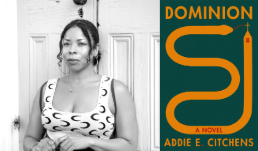
Nahin Cano of Seminary Co-Op Bookstores in Chicago, Illinois, served on the panel that selected Citchens’ book for Indies Introduce.
“My heart will always be with Priscilla and Diamond,” said Cano. “Citchens is an absolute force in this debut about patriarchy, the church, and life in Mississippi. As the story progresses, you catch more and more glimpses of who these characters really are. A phenomenal examination of how we hide who we are, and the inevitable outcomes when the truth comes to light. An instant classic!”
Citchens sat down with Cano to discuss her debut title. This is a transcript of their discussion. You can listen to the interview on the ABA podcast, BookED.
Nahin Cano: Hi everyone! This is Nahin with Seminary Co-Op Bookstores in Chicago. I am so excited to be speaking today with Addie Citchens, the author of Dominion.
Addie E. Citchens was born in Clarksdale, Mississippi, and lives in New Orleans. A graduate of Jackson State University, she studied in the Florida State University Creative Writing Program and the Callaloo Creative Writing Workshop. Her work has appeared in The New Yorker, The Paris Review, the Oxford American’s “Best of the South,” midnight & indigo’s speculative fiction anthology, and other publications. Her blues history work features prominently in Mississippi Folklife, and she has been heard on The Mississippi Arts Hour on Mississippi Public Broadcasting. She was the inaugural recipient of the Farrar, Straus and Giroux Writer’s Fellowship, and her short story “That Girl” won the O. Henry Prize. Dominion is her first novel.
Addie, I am so excited to talk to you today. Dominion is by far one of my top novels this year.
Addie E. Citchens: Yay! I'm excited to be here, and thank you so much. I'm glad to hear you enjoyed the novel, I enjoyed writing it.
NC: This novel definitely has, I think, one of the best blurb lists that I've seen in promo this year. One of my favorite other authors is Kiese Laymon. When I saw that blurb, I was like, “Oh, this is going to be so good.” So, going off of that: what author’s influence do you see reflected in your own work, or what other authors’ works have really inspired you in your writing journey?
AEC: I think for this novel, it's got old influencers, and so it may be blasphemous to say this, but I would say Faulkner, Hurston, and Morrison. I would say Faulkner and Hurston, because of the deceptive simplicity of the novel, the humor that you don't know whether or not you should laugh at, whether or not it's appropriate, and this use of dialect and a real heaviness on location and where the characters are, because that's a lot of the story.
I think Morrison, because of the story’s brief, steel-booted oomf, you know?
NC: I can definitely see all of that reflected in the story. I'm not from the South, but I was from the South when I was reading this book, like I could just feel the space that the story was taking place in.
I did see that a lot of the issues that the community was facing are issues that can be found everywhere if you’re looking. Why was it important for you to set your story in a small town in Mississippi?
AEC: Small is simple because small Mississippi towns are the places I am most intimate. What I know is where I grew up.
In another interview, I was asked about what I wanted people to know about Mississippi. I wanted them to know it's just a microcosm of American society as a whole, but at its most base, most hyperbolic, most hypocritical level, because of the adherence to strict Biblical notions without knowing anything about the Bible, or without being the person that they're supposed to be themselves. It's a microcosm of society as a whole, plus it's what I know. Every time you see the South fictionalized, it's always something that's ugly and less intelligent. I wanted this to be something that would make you think.
NC: Your book definitely does that. Like you said earlier, there were so many points where I was like, “Oh, I want to laugh, but this is so serious.” There was so much complexity with your characters and with the story itself. There were so many layers to it that, as you keep reading, you keep discovering more and more.
One of my favorite characters was Priscilla. At first, I was a little frustrated with her, because I'm like, “You see all the red flags, Priscilla, please do something about this!” But then you get to know her a little bit more, and you see why she's not making some calls that you would wish that she would make.
I think that we see that reflected a lot in people who live in these situations. Why do you think it was so hard for her to call out a lot of the toxic masculinity that she was seeing right in front of her?
AEC: Well, for one, toxic masculinity is masculinity for the most part. Rashness is taught as a rule of masculinity; violence is taught as a rule of masculinity. It was hard for her to separate herself from it or call out those actions because we perceive our compliance in these systems as some sort of protection. She had this idea that she was protecting her status in society, her husband's legacy, her son's legacy. She was operating without the knowledge that understanding, refining, rewriting, and operating in reformed notions of masculinity — which is throwing away these gender-based systems — is what it will take.
She's not necessarily there in her head yet, so she didn't understand — and a lot of us don’t understand — that if masculinity in itself wasn't dangerous, we wouldn't need protection from it. We can all do better by calling it out and not entertaining it.
It was hard for Priscilla to call these actions out because admitting there was something wrong with her son is kind of like admitting there's something wrong with her. That was not something that she wanted to sit with, or she was ready to sit with, or acknowledge yet in the story.
NC: Yeah! It also felt like, in addition to just trying to save herself, she was also protecting her son. I think that’s a big point of the story, where calling it out means that there's something wrong with the person that you're supposed to protect the most, right? So how do you navigate that?
This is not going to be a spoiler-free interview, because there's too much to talk about and while I have you here, I'm going to take my opportunity to discuss it.
The story is told from two alternating perspectives, Priscilla, who is married to Sabre, who runs the town, and Diamond, who is the girlfriend-esque of Wonderboy, who is their golden son who does not fall far from the apple tree, unfortunately. Diamond, oh, I just want to hold her, I just want to tell her that everything's going to be okay.
Why was it important for you to really center [Priscilla and Diamond’s] voices in the story?
AEC: Because they're the ones that are unheard. In the original draft that I wrote, there were parts that had Sabre’s point of view, and there were parts that had Wonderboy’s point of view, but they were scrapped in editing because I felt ultimately that it was unnecessary. I believe cisgender heterosexual males are the apex predators, and getting in their heads, for me, is just like asking a wolf to explain the hunt. All he's going to do is explain his justification for blood, for his misdeeds. It’s the same way culture works.
When you're a minority in the system, you know all about the people who are the dominant culture. You're forced to interact with it on TV, in school. We already know their point of view. It’s their “right” because of this hyperbolic toxic masculinity thing that we have this love relationship with in the world.
When you're a minority, you're so inundated with the hunter’s story that you believe they have a right to eat you, so both Priscilla and Diamond had this idea. I didn't think it was necessary to put the male point of view in it, because you see the aftermath. All they do is justify what they do.
NC: Yes! I think the only time where I wanted to know exactly what they're thinking was at the end, right as it’s all coming full circle and everyone's getting what's coming to them. Where I was just like, “How can you explain this one away now?”
I do love that you chose to stay with Priscilla and Diamond, because I think leaving that complexity to the reader, to just consider that viewpoint, is really important. I love that.
AEC: Like the ending, I purposely left it up in the air. It also fits into the community aspect of the novel. It's something for them to talk about for the next 10 years. It's the topic of conversation. We have so many scandals in the small town — I can name so many of them — and 15, 20 years down the line, people are still wondering about it. I kept it like that for that reason.
NC: I loved it! The pacing of the book did so much for the story, where you're layering and uncovering everything at the start and then at the end, the truth is catching up with everyone, and it's just snowballing and snowballing.
AEC: That’s how the truth is!
NC: Yes, exactly! It was so, so good. I can't wait for everyone to read it and to be able to talk to everyone about it.
AEC: I definitely want it to be something that you could potentially read in one sitting. You can come back and read again because you will have probably missed something; I planted that stuff in there. It was great working with FSG on it because I was able to, at every junction, go plant something else. I wanted it to be that kind of novel that’s paced [that way]. I don't like plotting through novels, so I think I wrote the novel I would want to read.
NC: How long did it take you to write the novel?
AEC: I think I've been writing this since the beginning of time, since I got here. Since I’ve been observing people. I was a church kid, watching, looking, and seeing. I used to read books when I was at church, I used to read books while they were praying. I knew something wasn't quite right, so [I’ve been writing] ever since I was little and just taking notes and stuff because I'm a nosy writer, you know?
NC: Yes, I love that. That’s a wonderful way to classify a new genre of books: Authors Who Are Nosy. [Authors] who are just gonna be looking into the human condition like a small-town fishbowl. I love that.
Okay, so talking a little bit more about Diamond and some of your characters, was it hard to write their stories? Because [for] a lot of parts of Priscilla and Diamond’s stories, I was just kind of like, “Oh, I just want to take you out of this situation,” or “I want this to be easy for you.” How hard was it to actually put pen to paper and have your characters go through these situations?
AEC: Oh, very. Diamond is an orphan, as far as she knows, and in the story, things happen to kids when they're in the system. I purposely did not put that on her, but to understand it still was heavy.
It was just so hard writing her. She is representative of the least protected class in this country, or maybe the world: a Black female child. We’re objects. We're objects to do, to fetch, to use. I wanted her there, and I wanted her not to be used, even though she's experiencing this, I didn't want her to be an object.
It was hard because she's just a tender spot [for me]. I remember a girl just like her and I remember her telling me her story when we were kids. And I remember I was like, “There's absolutely nothing I could do for her.” Absolutely nothing.
Diamond was my [way to look at] girls like that and say, “There are some things that you can do for yourself, though. You don't have to be a part of this. You don't have to [do it] voluntarily. That was that generation; we don’t have to do it like that.”
NC: To an extent, everyone knows someone like Diamond, [or has] a Diamond in their life. As tough as the read was at times, you're just rooting for her the whole time and just wanting things to kind of turn around for her so the care was definitely there. I'm excited for readers to be introduced to Diamond and to get her side of things.
What advice, if any could, would you give her and all the other Diamonds out there?
AEC: I would have given the advice that Miss Kathareen tells her in the novel, but I will also tell her — to center [yourself], love yourself, revel in yourself, because that's the most important thing: be yourself. You don't have to give yourself to someone to be someone.
She finally found an identity in him, and toward the end, she's understanding, because she was looking for identity, for her people, for love, she was looking for all of that. But, in the end, I think she was just looking for herself, and that meant not having to go through what she was going through.
NC: 100%. I think her fascination and interest with Wonderboy was particularly hard because, reading Priscilla's points of view, you see the concern that Priscilla has about her son, but then you see Diamond just avoiding those red flags. And you're just like, “No, please, just see it girl!”
Especially as you're younger, it's really easy to avoid [seeing red flags], because you just want the fairy tale ending and the football star can definitely give that to you, right?
AEC: She's seventeen, of course. I don't even want to think of my brain at seventeen.
NC: Not at all! She’s seventeen, and she is so childlike, in some ways, but she's been forced to grow up in other ways. Knowing that she doesn't get it as much as she may present that she does is so hard.
I won’t say what happens, but did you always know what Wonderboy’s ending was going to be?
AEC: Absolutely not. I started writing this novel a long, long time ago, and I actually had shopped it around before with great success for the first half of it but then I couldn't figure out the ending. I think I had to go through a process in life to be able to write the ending the way I did.
One of the things I had to do was understand [my mom’s experience]. My mom was married a lot of times, and she was the first woman councilperson in city government at all in my hometown. But she was very male centered, and I think that's a journey we went through together.
She was a principal. She was going to get up in the morning, cook breakfast before her husband went to work, she was going to cook lunch, she was going to cook dinner, she was going to fold clothes. She worked 50, 60, 70 hours and would come home and wait on a man, hand and foot. That’s a raw deal!
I had to basically work myself through those ways of thinking, centering maleness, centering this idea that I need to be connected to a man, [that] that's what validated me. I had to go through that process of decentering maleness and masculinity before I could write the [ending]. That just took years in my life to do, that took learning and experience.
NC: I love that you said that, because I feel like while I was reading it, that's how I felt reading it. Yes, men are like this, and [learning that] you get to choose yourself throughout all of it, which is, ultimately, what Priscilla does. Even when it's hard, even when you’re the talk of the town, it has to be about you and your survival and your success outside of your survival.
AEC: The original ending was Diamond, in some way, got her happily ever after with him, but I left it intentionally dubious because you know she’s not really getting [the happily ever after]. A leopard doesn't change the spots, you know? But I knew that wasn't powerful enough.
NC: I think that would have broken my heart at the end, as a reader. You know that he's not what he appears to be, and it will have eventually showed up in front of her in a way that she could no longer ignore.
AEC: I didn't want her to remain naive. I wanted her to have the same process that I had learned. I think [that’s] maybe because, like I said, the earliest drafts of this were finished 10, 15 years ago. I would put it away, look at it again, put it away, look at it again, and times were very different then. There was a time where people got to be seen, everybody of any kind of gender expression, could be who they were. There was a while we were all visible in the short amount of time. That time — and you know what’s going on now — gave me the freedom to free her too.
NC: Well, it definitely shows, and it's just such a powerful read. This is one [that] I want mothers and daughters to read.
AEC: Me too.
NC: I want them to talk about it. I think for a lot of us, we grew up in a generation where the patriarchy was the center of the family and that's where the focus was and that's where the care went. It’s definitely…it's shifting now, but I think opening up those healing conversations, for daughters to say how they felt growing up in that, and for mothers to say, “that's maybe not what I wanted either.” I think this is such a great book to open up those conversations, and for everyone to see that even though we are making strides towards a less male-centered society, there's still work to do and it's not over.
AEC: Right.
NC: Well, Addie, thank you so much for taking the time to talk with us, and congratulations on this absolutely stellar debut novel. I cannot wait to see what's next, and we're so looking forward to it.
AEC: Thank you so much for having me. I appreciate y'all so much.
Dominion by Addie E. Citchens (Farrar, Straus, and Giroux, 9780374609337, Hardcover, Fiction, $27, On Sale: 8/19/2025)
You can find this author on Instagram @addie_citchens.
ABA member stores are invited to use this interview or any others in our series of Q&As with Indies Introduce debut authors in newsletters and social media and in online and in-store promotions. Please let us know if you do.