Cassandra Ramos-Gomez is the author of Lost on Doll Island, a Summer/Fall 2025 Indies Introduce selection. 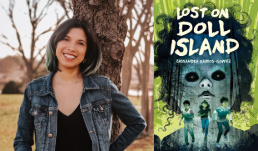
Mara Lynn Luther of Chapter One Bookstore in Hamilton, MT, served on the panel that selected Ramos-Gomez’s book for Indies Introduce.
“Diego has been sent to his tia’s house in Mexico City while his parents negotiate the last details of their divorce and while he begrudgingly admits that his tios are excellent cooks, he just wants everything to go back to the way it was,” said Luther.
“In fact, when an old woman in an antique shop tells him about the legend of Doll Island and the hidden doll who grants wishes, he becomes obsessed with finding the doll and wishing everything back to normal. Is it creepy that he hears the doll’s voice in his head and that a doll seems to be moving around at night by itself? Sure, but he’s trying to toughen up so he can be the kind of boy his dad wants him to be. When school announces the field trip to Doll Island, it feels like a sign and Diego convinces two other kids to help him get to that doll. A gently creepy story about being yourself and navigating through life’s big changes. For anyone who has ever sworn that the doll’s eyes have moved.”
Ramos-Gomez sat down with Luther to discuss her debut title. This is a transcript of their discussion. You can listen to the interview on the ABA podcast, BookED.
Mara Luther: I'm Mara Lynn Luther from Chapter One Bookstore in Hamilton, Montana, and joining me today is Cassandra Ramos-Gomez.
She's a Mexican-American writer focused on creating middle grade and young adult fiction that centers Latinx experiences. She has a Master's degree in Education and an undergraduate degree in Art History, and she has taught middle school language arts and social studies. She currently lives in Texas with her husband and two kids. Her hobbies include painting, collecting animal bones, and playing Minecraft with her kids. Lost on Doll Island is her middle grade debut. Thank you so much for joining us today, Cassandra.
Cassandra Ramos-Gomez: Thank you for having me! I'm so excited. It’s my first podcast!
ML: Oh, me too!
CRG: Yay!
ML: We were so excited as the Indies Introduce panel to have middle grade horror, because for a lot of us, that was very pivotal for our own young reading so it was really exciting to have a spooky pick.
CRG: I'm glad that you guys even looked at it at all, [it] was a huge honor. The fact that it was chosen was just amazing and surreal. Thank you for reading it at all and for enjoying it.
ML: Yeah, we sure did! This was your middle grade debut — have you done any other writing, and was it spooky?
CRG: Yeah, actually. I have on submission right now a young adult book that is more speculative than spooky — it's more like an afterlife story. I also have another middle grade book that I had written before and it was a little spooky. It was [about] a girl who accidentally summoned La Llorona in her bathroom, and from there it was an embarrassing-moments kind of book. That one went on sub and then never got picked up, so we just shelved it for a while, and then [Lost on Doll Island] was the one I wrote after that and here we are now.
ML: Yeah, that's awesome. For those who don't know what Lost on Doll Island is about: It's about Diego, who is spending time in Mexico with family because his parents are going through a divorce.
I think that particular childhood experience is going to speak to a lot of kids, whether they're going through it themselves or they know kids who are. Is there a reason that you included that for your character, Diego?
CRG: I think divorce starts to happen during that time period, especially in middle grades. Not for all kids, but in my case, I was in middle school and my parents got divorced. Unfortunately, it's a common growing up trope now, like you said, a lot of kids have experienced it.
They understand having feelings towards both parents that might be different, and even though it's not their fault at all, they may feel that they are responsible for the stuff going on in their family. I wanted to include those feelings. Even though it is a book for middle grade children, I do think they are dealing with a lot of heavy stuff and so I think they can handle it.
ML: I totally agree. There’s also the deeper piece of Diego being of an age where he's trying to figure out what a man is, how a man behaves in scary situations, and what bravery is. I think that's really going to be powerful too.
He gets set up with some spooky doll action right away, which I love. What do you think makes dolls in particular so darn creepy?
CRG: I had a lot of time to think about this when I was writing the book and doing research on dolls. Our brains are programmed to recognize faces, and so we see a doll and [we] want to give it human qualities, but because it's a doll, it's not going to give you the responses you want. It's going to be unblinking; it's going to be still. You're going to be expecting it to move, and it's not going to move.
It looks like a human but it's not behaving like one. That's what makes them a little creepy or unsettling, especially if there's something wrong about them, like they're disheveled or their eyes seem to move when you're in the vicinity.
For me personally, I actually really like dolls, and I feel like I'm going to be one of those old ladies that collects a bunch of them because I just want to take care of them.
ML: I hope you do. You could make a little safe haven, like, “Did someone think you were spooky? Come live at my house!”
CRG: Yeah, my kids would hate that. But maybe I'll make a little corner for [the dolls] away from them.
ML: Yeah, there you go. Was there anything in your research that was extra surprising? I'm so curious about what doll research looks like.
CRG: Right? I actually have this doll called a Jenny Doll. When she was manufactured, it was a big deal to have a doll with movable parts that was affordable and accessible to all girls. She was being mass produced, and that was a huge deal at the time.
One that I really did like the best was the Edison [Phonograph] Doll. She comes into the book at some point, just because I had to. I was like “I have to include this somehow.”
Thomas Edison made them, and he wanted to have talking dolls. It would have been a huge deal, no one had done this before, and it was the latest technology with a little record inside that would play. But they were a total bust; they were only on the market for six weeks and people hated them because they were too creepy.
ML: We could have probably told him that.
CRG: They’re just too creepy! Part of the reason they're creepy is the fact that they're singing lullabies, but they’re also recorded on wax cylinders, so the voice is warped. That’s just not a very good material to record on.
The other thing that's creepy is that Edison hired factory girls to record onto the wax cylinders. So, the girls are working in factories, and [Edison] pulled them from the floor and was like “Hey, I need you to record this.” But because they're shouting over the machinery to get the recording, they're really screaming. They're screaming lullabies — “If I should die before I wake, I pray the Lord my soul to take” — but they're screaming it. It’s creepy for many reasons, [and that’s why] they didn't make it. But they're in the Smithsonian, so that's cool.
ML: Thanks, Thomas Edison! As you're writing about these dolls, do you ever creep yourself out? Or while writing any of your spooky stories, do you have to be like, “Oh, I think I'm gonna turn the light on, or maybe I just need to go get a glass of water.”
CRG: At first, I was like, “Oh no, I'm not scared of my own stories.” But there actually are moments when I'm writing, when I'm building up the suspense and I'm really thinking about how a character is behaving in a scene or how they would feel in a certain environment. Say in a dark attic, then I'm thinking about: How would the air feel? What would they smell? What would be the creepy emotion? What would the sensation [feel] like, when you feel like you're being seen but no one's there? How would your spine feel?
When I get into that space, I do sometimes give myself the chills, and I have to take a breather. I usually write in my kitchen with the big, sliding glass door next to me. It’s a very bright, happy place. It's not too hard to step away and be like, “Okay, this is just fiction, Cas.”
ML: That's good, because we want you to keep writing so you can't spook yourself out too much. Specifically for Lost on Doll Island, were there any scenes that didn't make it into the book, or details that popped up in your imagination that we didn't get to read?
CRG: This particular book had some earlier drafts. At the beginning, the disembodied voice of the doll was not actually a disembodied voice; it was an actual doll that was with Diego throughout the story, walking around and talking.
I got rid of that simply because it was more comical than scary. It's really hard to make it creepy, especially if it's a doll that's a wise-cracker. It comes off a bit like a little gnome or something, and that's just more funny than scary and not the vibe I was going for. So I had to take that out, but there were some really fun moments — it was fun to write — it just wasn't what I was going for.
ML: You can remember that later if you need some kind of humor to sprinkle into something that's scary.
CRG: Yeah, definitely.
ML: I was excited to find out that there was a real Doll Island, and so I'm curious about that. Is the origin of the real place what you included in the book, or did you change that at all?
CRG: The real place is La Isla de las Muñecas, or the Island of the Dolls. It has a few different names, but it is in Xochimilco or along the Xochimilco canals in Mexico City. It’s a borough of Mexico City along the lake, and all those islands have been there since pre-colonial times. They are man-made islands, but they've been there for a long time. I tried to include as much of the real history as I could into the book, because if a kid's reading it and they Google it, I wanted them to [see] what I saw in the book.
It's a real place and the lore of it is that a man named Don Julián Santana Barrera collected the dolls because he found a dead girl or he failed to rescue a girl. The story is kind of mixed there. The next day, he found a doll in the same canal, and he assumed it was hers, and so he put it up as a memorial to her and as a token or talisman to ward off evil.
Then he just continued to find dolls and put them up all over the island. He felt that it was haunted or that she was still lingering, so he put them up to appease her spirit. He did this for decades, and so dolls are all over that little island.
The place is really, really spooky. It is based on local legend — it's not in newspapers, and there's no name to the girl — so I don't know if that actually happened. I didn’t want to put too many of those details in my book, because they were a little bit grim. I don't know how much of that is true, so I just tried to keep it as true as I could without making stuff up.
ML: You kept the mystery piece: What happened? Why are these dolls here?
Diego's relationship with his new friends struck me, because in middle school, if you don't already have a real tight group of friends, you sometimes ask yourself, “Is this kid cool enough for me to hang out with?” It’s not a thing that we’re proud of, but everyone has felt that at one time or another. Can you talk a little bit about his journey meeting kids and trying to figure out if he's going to be their friend or not?
CRG: When he first gets there, Itzel is his friend almost by default because she's the neighbor and she's always hanging around. Then Jandro becomes his friend because he stands up for him against a bully. But it's very much by default, and Diego is not sure he wants these kids to be his friends, because he's a little bit embarrassed by them. They're into the same things he's into, but he's not proud of being into those things. He's not proud of being into rocks. He's not proud of being into Minecraft. He's not proud of being into gaming. Those are all things that he feels he has to hide to be cool.
Because these kids are really open about their interests, he thinks they're uncool. I wanted to add that in because that is a very common feeling or experience for middle schoolers.
I myself was new to my middle school (and the area), because my parents were stationed in Germany and we moved right before seventh grade. So I didn't know all the kids at this middle school, and a lot of them knew each other from elementary school.
You do this weird social math, of like, “If I talk to this person, will these other girls not talk to me anymore?” Like you said, it's a very shameful thing looking back now and being like, “Why did I even care? We’re all friends on Facebook now!”
Diego does a lot of that social assessment, trying to figure out if he should be hanging out with these kids or not, if he looks cool, or if he actually wants to be as close friends as they want to be. But the truth of the matter is he doesn't really have a lot of choice, because they're hanging out with him anyway.
ML: Then he pulls them into all sorts of hijinks, so better be friends with them after all of that!
Just to bring it back to dolls one more time, I had an American Girl doll named Samantha when I was a kid. I was inseparable from her, and then at some point she became a little scary. It started with me wanting to make sure I said goodnight to her every night, and then feeling like, “Oh no, if I say goodnight to her, then I have to make sure to say goodnight to all my stuffed animals.” It became this weird ritual for me, not out of actual affection, [but] fear of retribution or something. Did you have any strange toy or doll practices when you were a kid?
CRG: I like what you're saying, it sounds super familiar. I did feel like if I did something with one doll, I had to do it with all of them. Or I had to line them up all like, “We're playing together, we’re all included!” because you don't want to get the scorn of the mean one. But in terms of rituals, I can't really think of anything that I did ritualistically. I did have Barbies, where I would continue their storyline. We'd have little episodes and then there would be the wider overarching story that I had going on.
For example, I had one story about peer pressure. I was maybe eight or nine, and I came up with this story where they're all going to peer pressure each other into cutting off their toes to join their club. If you wanted to be cool and pretty, you had to cut off your toes. Then a new Barbie came, and she didn't have cut toes, and they were snubbing her, and she was like, “But I'm not going to cut my toes for you.” Then, of course, cutting your toes fell out of fashion, and so those girls who had their toes cut off, they were left with their toes cut off because they're Barbies.
That’s probably the strangest story I came up with. People would come up and be like, “Why do the dolls look like that?” and I’d have to explain, like, “Oh, because they fell into the trend.”
ML: I think it's awesome that you had overarching story lines, because now you're an author — of course, it wasn't just a one scene thing. Are you writing something right now that's exciting to you? I know you have something that's in submission, but do you move right on to the next thing, or do you take a little break?
CRG: The thing that was on submission is still on submission, but I got a revision prompt and so I just finished that. I'm really excited for the way that that's been revised, but I don't want to go too far into it because it's still on submission.
I do have another middle grade story. It's not spooky, though. I don't know how far I want to move on with it, but it was inspired by Karina Evans’ book about periods (Grow Up, Tahlia Wilkins). I wanted to do a period book too, but I was like, “How can I make a period book that's my own about a girl getting her first period?” I wanted it to be that she's faking that she has her period to look cool, like all her friends have their period, and she's the late bloomer and so she's faking it. It's another story about trying to fit in and having shenanigans ensue because of that. When you're not true to yourself, things happen.
ML: Middle schoolers, you're going to survive. You'll make it through middle school. You'll find yourself. At the end of Lost on Doll Island, that was your message: you're going to find your people no matter where you are.
CRG: Yeah, and they'll accept you for who you are, because all the things that you are ashamed of are actually the things that make you cool and they can see that about you. I hope that readers get that from it.
The librarian from my old middle school reached out to me recently to do a visit. I would have to go back to El Paso for it, and we still haven't gotten all the permissions — because it's Texas and you have to get your book approved by a board beforehand — so it's still up in the air, but it is really exciting to know that my book might be read at the middle school I went to. How cool!
ML: It's so cool for those students to be like, “She was here and now she's writing stories!”
CRG: That’s what's on the horizon for me right now, that's where most of my excitement is.
ML: Awesome, that is excellent news. Thank you so much again for chatting, this was lovely.
CRG: This was super cool! Thank you for making my first podcast experience just really easy, exciting, and fun.
Lost on Doll Island by Cassandra Ramos-Gomez (Simon & Schuster Books for Young Readers, 9781665975131/9781665975124, Hardcover/Paperback, Middle Grade Horror, $18.99/$7.99, On Sale: 8/26/2025)
You can learn more about Cassandra Ramos-Gomez by visiting her website.
ABA member stores are invited to use this interview or any others in our series of Q&As with Indies Introduce debut authors in newsletters and social media and in online and in-store promotions. Please let us know if you do.