Shafaq Khan is the author of Zeyna Lost and Found, a Summer/Fall 2025 Indies Introduce selection. 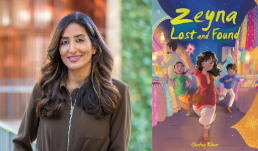
Lauren Pronger of Chapterhouse Books in Amarillo, TX, served on the panel that selected Khan’s book for Indies Introduce.
“Set in 1970 along the Hippie Trail from Lahore to Istanbul, British-Pakistani Zeyna must work with her cousin and brother — the Watsons to her Sherlock — to outwit a jewel thief and international band of criminals and prove her parents’ innocence,” said Pronger. “Filled with historical references, informational backmatter, and adventures in pre-revolution Iran and post-Partition Pakistan, this humorous anti-heist novel is the perfect introduction to historical events while reminding us that whether you’re from London or Kabul, we’re all just trying to protect the people we love.”
Khan sat down with Pronger to discuss her debut title. This is a transcript of their discussion. You can listen to the interview on the ABA podcast, BookED.
Lauren Pronger: Hi, welcome to the ABA podcast. My name is Lauren Pronger. I'm a bookseller from Chapterhouse Bookstore in Amarillo, Texas. We're on Route 66 and we specialize in queer, racialized, and migrant literature.
Talking with me here today is Shafaq Khan, who is the author of a debut middle grade novel called Zeyna Lost and Found. Shafaq is a mom and lawyer. Born to Pakistani parents, she grew up in a small port city in Saudi Arabia, called Jubail Industrial City. Shafaq attended college in New York City, majoring in Political Science and Middle Eastern and Asian languages and cultures, before heading to law school. She worked for nearly a decade as a legal services attorney, representing low-income people with disabilities facing eviction and benefits issues. In this role, Shafaq became acquainted with people's stories — the ones we tell and the ones we don't — and learned to listen to the stories beneath the surface. Shafaq works at Stanford Law School and lives in the San Francisco Bay Area with her husband and children.
Zeyna Lost and Found is a historical fiction novel set in 1970 along the Hippie Trail, going from Lahore to Istanbul and then on to London. Zeyna is with her brother, her parents, and one of her cousins, and has to stop an international gang of thieves called the Fifteen who had stolen the Shirin Jewel from Iran. She also has to help her parents clear their names, because everyone thinks that her parents stole the jewel, so she has to find the jewel and then return it to Iran without the help of her parents. They have this great international adventure. It's an anti-heist novel. Do you want to talk a little bit about it?
Shafaq Khan: Zeyna Lost and Found was inspired by a real-life trip that my mother-in-law took in the ‘70s. She is British Pakistani, like the protagonist Zeyna. They went to Pakistan, and for various reasons they weren't able to fly back to their home in London, so they went on the Hippie Trail. What I found fun about writing this book was the opportunity to focus on an era where travel was relatively seamless — a notion that feels beyond reality right now.
This was an opportunity to capture that moment in time, but also to talk about issues of identity, which I know I've experienced, that all of us experience in our own ways. Being able to talk about those things with the adventure in the foreground was a unique opportunity to explore my creativity and some aspects of frankly imaginative fiction writing that I hadn't done for a while. I threw in some jokes that probably no one will get, but I found some amusement in. I think the book will be an opportunity to make a permanent record of my point-of-view, in case anyone wants to cross examine me on those issues in the future.
I wanted to put something out there that was meaningful and important to me and for anyone that's ever felt like they're on the outside looking in. I've felt increasingly like each of us has felt that way, that we've been on the outside looking in, sometimes even within our own families and communities. We've felt out of place and uncertain in ways that Zeyna does. I wanted to give voice to that universal aspect of the human condition.
Children who are similarly situated to Zeyna, 12-year-olds who are coming of age and are curious and have questions are often pooh-poohed and told to not ask those questions. But in this case, Zeyna’s questions and curiosity, her critical thinking and problem solving, end up being the key skills that help her navigate this problem of epic proportions.
I'm excited for people to go on this adventure with Zeyna, both the internal and external adventures that she has in this book.
LP: Absolutely. By the time this podcast comes out, your book will be published. Congratulations on your debut! Your book is now sitting on shelves across the country, and a lot of readers are about to pick it up for the very first time.
What was your favorite part of writing it? Did you have a specific scene that was your favorite to write? What do you hope that readers will get out of it?
SK: Thanks much for that question. It's hard to figure out my favorite part about writing it, but I would say it's the relationships between the different characters. Exploring the brother/sister dynamic between Zeyna and Mahir, the family dynamic between Zeyna and her cousin — who is sort of a new friend but quickly becomes a familial relationship in ways that don’t necessarily correlate with how much time they're spending together.
Part of the reason why I think an exploration of relationships was really important to me is because, again, when we're thinking about an audience that is following this adventure and wants to know how this 12-year-old is outwitting adults in her life, I also want them to think about the ways that she's leaning on the people in her life. What are some ways that those people matter to her, the ways that those relationships inform her decision-making and her willingness to take on risks that a regular 12-year-old wouldn't?
What makes her extraordinary isn't just who she is — but I do think it is her bravery, it's her agency, it's her loyalty — but it's also the people around her. It's Mahir’s inventions and love that is unconditional. It's her cousin Amina’s street smarts and jokes and her ability to think clearly in difficult situations. It's her parents being role models to her in so many ways, but also being flawed, and her recognizing them for who they are, but all these relationships existing in their messiness on this adventure.
Balancing moving the plot along, but also maintaining some level of clarity in the trajectory of the actual relationships was my most favorite part about this book.
LP: There’s definitely a lot of really cool moments where each of the characters are always true to themselves, but they also are, like you said, flawed. Or, not even, they're just human, right?
Zeyna is, for the most part, trying to keep a strong face for her brother, but a couple times she’s just like, “I'm freaked out, and I don't know what to do!” So her cousin Amina or her brother will be like, “That's okay. We have you this time. You were strong for us then, so we'll be strong for you now, and we're all gonna get through it together.” That kind of relationship is really cool to see.
SK: So many of these friendships that children are forming become really important in later years. Because they set the background for how you think about engaging with people, period. Especially in this moment, there's such a lack of that. There’s so much isolation and obviously, there's a variety of reasons that that might be happening, but I think that isolation carries with it feelings of loneliness and despair.
The book, and Zeyna in particular, hopefully lends itself to an opportunity to think about yourself as part of a collective, as part of a community, even when we feel like we don't belong to that community. We still want to try, and we don't stop trying.
I really hope that people take away that, at the end of the day, Zeyna doesn't stop trying to be part of community. She doesn't stop trying to belong. Everyone deserves to belong, because we're human and that’s the reason why we deserve to belong.
LP: Absolutely. She also changes what she thinks that belonging is based on the new information that she gets, which is really important. There is a character in the book that is an antagonist for a very long time, and once Zeyna has new information, she reassesses the character, which I think is really cool.
Your book is historical fiction — which isn't uncommon for middle grade — but typically we see a lot of World War II books, or we're a lot of Y2K/turn of the century books. I think this is the first kids book I've seen that set in the ‘70s. What made you want to set the book in this particular decade, and what was special about that time period?
SK: I, along with many others, view the ‘70s as this unique era. You think about hippies, you think about the cool aesthetic and a level of peace and freedom in ways that might be sort of romanticized, but many of these countries were about to go through a big change. That was one of the reasons why I thought this would be an interesting time to capture.
We see photos of travelers on the Hippie Trail, and want to understand, how is this possible, and what does this even look like? In this process, I learned quite a bit about the civic societies at that time. Where do people eat? Where do they play? Where do they learn? Where do they shop? Like a theater in Kabul, a university in Tehran, a cafe in Istanbul, I really wanted to better understand, what does the public space even feel like? What does it feel like to really experience being alive in the ‘70s from the outsider’s perspective, because Zeyna is new to all of these places — including Pakistan, where her parents are from.
A critical part of this is that I didn't want to romanticize this time because it was on the precipice of change. I didn’t want to paint it as being one way, and then after the change, it's now another way. So the book touches on economic unrest, the bazaaris in Tehran, who, at that time, were a litmus test for political discontent. Oftentimes it was like, “Well, how are the bazaaris feeling?” and that’s how you knew what was going on.
We understand also that faith isn't a monolith, so Zeyna sees people in Kabul dressed in different ways and practicing their faith in different ways.
You peel off that initial layer of, “Wow, Zeyna just crossed the Pakistan border into Afghanistan without adults and without much of a checkpoint!” (Which is true; I saw this photo of what that looked like, and it was not a militarized border.) What you have when you peel some of these layers off, is hopefully a questioning of how modernity is defined and perceived. What do we think is modern? What do we think is acceptable, and even just challenging how the nation state came to be. Why is it that you have a city like Lahore — obviously a critical backdrop for some of the clues that Zeyna gets — in which Zeyna and her family can travel, but then Mr. Sukhwinder, a Sikh man that she's friends with in London, may have lived there but now does not because of this arbitrary line that was drawn. There is this high human cost. The reason why I wanted to do this is because I felt like it was a chance to think about this time that we view through a rosy lens, but that had cracks, and I think that ultimately broke open to some of the changes.
LP: I thought it was a very good way to show that partition happened fairly recently, but East Pakistan hadn't broken away yet to become Bangladesh. So some changes have happened, but there's still so much more change to come.
Seeing her cross all the different borders, there are a couple lines in there where it's like, “The land is the same, the people look the same, I would never have known that I crossed a border except I saw that I crossed a fence.”
It is really cool that they’re all slightly different cultures, maybe different languages, but all people with the same priorities and the same wants and needs. That definitely comes into play, as you see the different kind of protests and the bazaaris missing because they're probably on strike throughout the different places that they visit.
SK: I'm so glad that comes through. I hope that this can be the beginning of a conversation and an opportunity for adults that might be reading this book to think critically about some of those events and the dynamics that were in the background of this book.
LP: Absolutely. You actually have quite a lot of back matter, which is super cool. I love nonfiction back matter in a book, I think more adult books need it. You have a glossary, discussion questions, and you also have a page about each of the different countries and their history before, during, and after the events of this book.
It feels like you did a lot of research. You spoke a little bit earlier about doing research on the Hippie Trail, and what civic life was like for all these countries at the time. Was there any part of that research, or any part of your mother-in-law's trip on the Hippie Trail, that you thought was really cool or wanted to include, but just couldn't find a way to get it in the book?
SK: Yes, and also no. I had to go back and forth on this one, and look back on the research that I had done. I'm one of those people that was just fixating on an interesting fact or detail, and found some kind of way to include it.
For example, grocery stores. What would a British Pakistani call a grocery store? She wouldn't call it a grocery store. She would call it a shop. When her mom is done and paying for the grocery she doesn't pay for it at the cash register, she pays for it at the till. Everything from language choices to what the recommended dish was on the pudding shop menu. I really wanted to include all those details; I'm not sure if anyone else will pick up on this, but if even one person does, it's worth it. Even if that person is me.
There is one small detail that is early in the book about an abandoned tape recorder that Zeyna’s mom leaves behind. Zeyna takes it and it actually plays a critical role in some of her adventures. The tape recorder in the story was used by Zeyna’s mom to communicate with Zeyna’s grandmother in Pakistan. That tape recorder detail was based on an art project in the UK called the Tape Letters. The Tape Letters played some of those recordings between recently immigrated folks in England talking about their day, talking about what was going on, and sending these cassettes back to Pakistan. They would mail these cassettes back and forth as a way of communication.
What's implicit in that sort of detail, and that I wasn't able to explore, is that British-Pakistani immigration happened about a generation ahead of Pakistani immigration to the United States; it happened as early as the ‘60s.
For British-Pakistani immigration, what was slightly different than immigration to the United States, is that it was a mix of “skilled” and “unskilled” workers. Families that wanted to communicate did so with tape recording, because they may not have known how to read or write or their family back home may not have known how to read or write. The impact that that had on self-perception, assimilation, then and perhaps even now…that was a difficult and a nuanced aspect of British immigration patterns. There wasn't a way to include that more explicitly but I left that in there because I wanted it to be a reminder of a type of a British-Pakistani immigrant.
LP: That's a super cool project. I didn't know about that.
In your author bio, there's a pretty incredible line about your role as a legal services attorney. You became “acquainted with people's stories — the ones we tell and the ones we don't” and learn to “listen to the stories beneath the surface”, which I think is fairly relevant to the Tape Letters project.
What would you consider the story beneath the surface in Zeyna Lost and Found, and what is the next story that you would like to tell?
SK: The story beneath the surface is that we never know what someone is grappling with when we meet them. It's important to treat interactions with a level of openness and willingness to give benefit of the doubt, both when people meet us and also when we meet them. Just being cognizant of the context in which we meet people is really important.
When we think about Zeyna, people that were meeting her before her parents disappear, versus people who were meeting her after, may not have understood why she was doing the things that she was doing, or why she was breaking rules and making unauthorized decisions. The context matters for her. The emergency was so great and the stakes were so high that it really justified doing what she needed to do.
It’s important to remember that what we might be saying with our words, or what we might be doing in the physical space, does not cover everything that's going on, both internally and in our life beyond what we see. The important takeaway is to listen to the story beneath the surface, because I think we can go further.
As a legal services attorney, this ended up being such a critical part of working with clients. I’m reminded of this time when I was working with a client on a clutter case, and she had collected unused fabric and beautiful ribbons, beautiful gowns, from a life prior life when she was into set design. She didn't want to save her apartment, which was now at risk, because the landlord was like “you have this clutter condition, you'll be evicted now.”
She didn't want to throw those things out, because she kept telling me, “These things are new, I can't throw them out.” What she was really trying to say — what she eventually did say to me, as we gained trust with each other — is that she was worried about not being able to replace those things; her purchase power had changed. So instead of just coming in and categorically removing everything — which would often happen if a city agency was asked to do that — we worked on different ways to edit down the clutter. She ended up being able to stay in her apartment and not lose all of her things.
It's really important to meet people where they are, to think about the stories that they're telling us, but also the ones that they may not be.
LP: Just to realize that we're only seeing one part of the picture.
This book does a good job of that, because there are a lot of people who are introduced as you see them through Zeyna’s eyes, and Zeyna only knows people through one specific lens or perspective. That frequently gets challenged throughout the rest of the book as you learn more about these people, which is always really fun.
SK: You also asked what's the next story that I want to tell. The next story that I want to tell would be a more contemporary story about a girl trying to solve a mystery. The story that I want to tell in this situation, this new idea that I have, is another example of someone who's coming of age and wants to belong, but how that belonging looks and feels a little bit different.
Sometimes it is about belonging in a relationship, which is a specific example of belonging and is the lens through which I view a lot of my characters — and maybe how I view my own existence and the world around me. The next story will have much of those same themes, and perhaps there will be an element of Zeyna in the next story as well.
LP: Awesome. Are you imagining an older story or still a middle grade?
SK: I'm thinking about middle grade.
LP: I love a good middle grade book. One of the things that you mentioned earlier, is how people underestimate Zeyna because of her age and potentially other factors. That is something that feels true to being 12, specifically. It's a good age, because she's old enough to take all these adventures by herself, but still young enough to be underestimated and dismissed by most of society.
I thought that was a really good aspect of the book. People just underestimate her all the time because she's so young, but that allows her to sneak up on people and go into places unnoticed.
SK: I highly recommend this tactic in life, by the way, just for everybody who's listening. I think it's really important to have people underestimate you a little bit so you can surprise or come out on top in some ways.
Zeyna has an element of this; she starts off feeling a little disgruntled by the fact that she's underestimated all the time and that her theories are disregarded, but I think she also feels validated like that. Like, “Some of my theories were correct, and also, because you underestimated me, I was able to fly under the radar to make it possible to resolve this conflict.”
It’s a necessary part of transitioning into being an older person. I want my readers to feel like they are heard and seen, and that their relentless questions are a really important part of growing up and understanding the world around you. That's exactly what Zeyna is trying to do. She has to ask those questions because she has to know, and so if you can't give her an answer, then you should probably get out of the way because she will figure out the answer herself.
LP: She is a formidable character. In the author's note, you mentioned a warm-hearted school librarian who gave enthusiastic recommendations to you in your enchanting school library. What kind of books did you read as a kid, and what do you think is really important about books that get kids interested in reading?
SK: Oh my gosh. Mrs. Murray was her name and she was amazing. She was this librarian who knew exactly what we needed at any given point.
At one point I was just tearing through The Baby-Sitters Club series, and she would always make sure there were many of those books to read. We were in Saudi Arabia, remember, and she used to get books through a mail order catalog and she would always make sure that she knew which books people were reading. She always made sure we had enough so that people never had to feel like there wasn't enough to read. She was anticipating what the reader needs at the different stages of their development; that was a really key part of how she cultivated a love of learning and of reading.
The physical space of the library was so welcoming — and I see this a lot in indie bookstores. There were reading spaces, of course, but there were wide enough aisles for you to just plop down where you are. You never felt ashamed if you had to start reading your book right there in the aisle before checking it out, she just let you be. I find that to be the case in a lot of bookstores that are close to us, like Linden Tree Books in Los Altos.
It was such an important part of that what made that library so special; it was her curating the books to be responsive, but also curating the space to be welcoming.
When we're thinking about instilling a love of reading, it's so important to read whatever it is that you find interesting. I'm now 40 years old, and I loved Sayantani DasGupta’s Kiranmala and the Kingdom Beyond series, which is middle grade. I love City Spies; I will read middle grade books, probably until my deathbed, because that's what I find fun.
So whatever it is that floats your boat, follow that. Sometimes we feel like we have to give due credit to the canon — and I think we should, ideally — but right now, given the demands on our attention, it's so important to lean into whatever strikes your interest. I feel like I do that a lot now with my kids. Reading is a big part of how they identify and how they see themselves, but also how they want to spend their time.
LP: Absolutely. I live in an area with a lot of kids who struggle to read. There's a kind of inherent elitism with books, sometimes people think you have to read a “quality book,” whatever that means.
SK: Exactly!
LP: Children’s books tend to get the short stick a lot of the time, where adults don't think children’s books are for them, but they're for everyone. Everyone should read kids books!
SK: During COVID, I relied more on middle grade books, because of the fact that they really unlocked something in me. I think it's really important to reduce/remove any barriers to reading right now, because there's such an onslaught of information and I think it's important to slow down. Reading helps you slow down a little bit.
LP: And to get different perspectives on things and be a little introspective as well, which is always good. Zeyna is very funny, and early on in the interview, you did mention a couple of jokes that may fall flat. What are some of the jokes that you think no one is gonna get except for you?
SK: I think some of the banter between Zeyna and Mahir is quite funny, where everyone wants to get everyone wants to get the last word in. I find that to be such a good example of how brothers and sisters communicate. But also, I find that to be really funny, because what are we even doing in this conversation, but one of us is going to win.
A lot of Zeyna and Mahir’s jokes are her insisting that she's Sherlock and he's Watson; there’s an emphasis on being the big dog and who's the leader right now? I find those kinds of dynamics to be very hilarious amongst kids, so I hope people will find that funny.
I had a beta reader who read the manuscript and she herself was 10 years old at the time. She was like, “Yeah, I really liked it, this part was nice.” And I was like, “Did you think it was funny?” And she was like, “No.” I was so mortified. Then her mom was like, “No, no, Shafaq, it was actually really funny.” And I was like, “I don't know if it's that great that you think it’s funny but she doesn’t.”
There was one scene that my 10-year-old beta reader thought was really funny, where a relative of Zeyna is in Pakistan, rummaging through a chicken and rice dish and trying to get the best piece of chicken. She gets annoyed at him and nicks his glasses and does an impression of him. One of Zeyna’s many talents is that she does impressions — no offensive impressions, by the way, just very hilarious impressions. That, for some reason, really resonated with this 10-year-old.
So, I think some will fall flat for some. You have to just keep on trying, though.
LP: I found it funny, but I am not 10! What do you want booksellers to know about your book, as we put it in readers’ hands? If people walk away from this interview remembering one thing about your book, what do you want that one thing to be?
SK: I just want to thank the American Booksellers Association again, for Indies introduce and also for having me on this podcast. Thank you to all the booksellers out there that are working so hard to cultivate a love of learning and a love of reading, by being so discerning about the books that they keep in their bookstores, and by ensuring that the experience is welcoming for everyone. We need that now more than ever.
The one thing I want indie booksellers to remember is that I believe that this book is for everyone. Whether you're an aspiring detective or you're the pragmatist telling your friend not to be an aspiring detective, this book is for you. Zeyna Lost and Found will hopefully scratch your itch if you love mysteries, if you love traveling, if you love good and bad jokes, and bonus points if you like all three of those things. I really hope that you have tons of fun with Zeyna Lost and Found.
LP: Awesome, thank you so much for being here. Thank you for writing Zeyna, and thank you for being on this podcast. Thank you very much!
SK: Thanks so much Lauren!
Zeyna Lost and Found by Shafaq Khan (Carolrhoda Books, 9798765639139, Hardcover, Middle Grade Historical Mystery, $19.99, On Sale: 9/9/2025)
You can learn more about this author at shafaqkhan.com.
ABA member stores are invited to use this interview or any others in our series of Q&As with Indies Introduce debut authors in newsletters and social media and in online and in-store promotions. Please let us know if you do.